

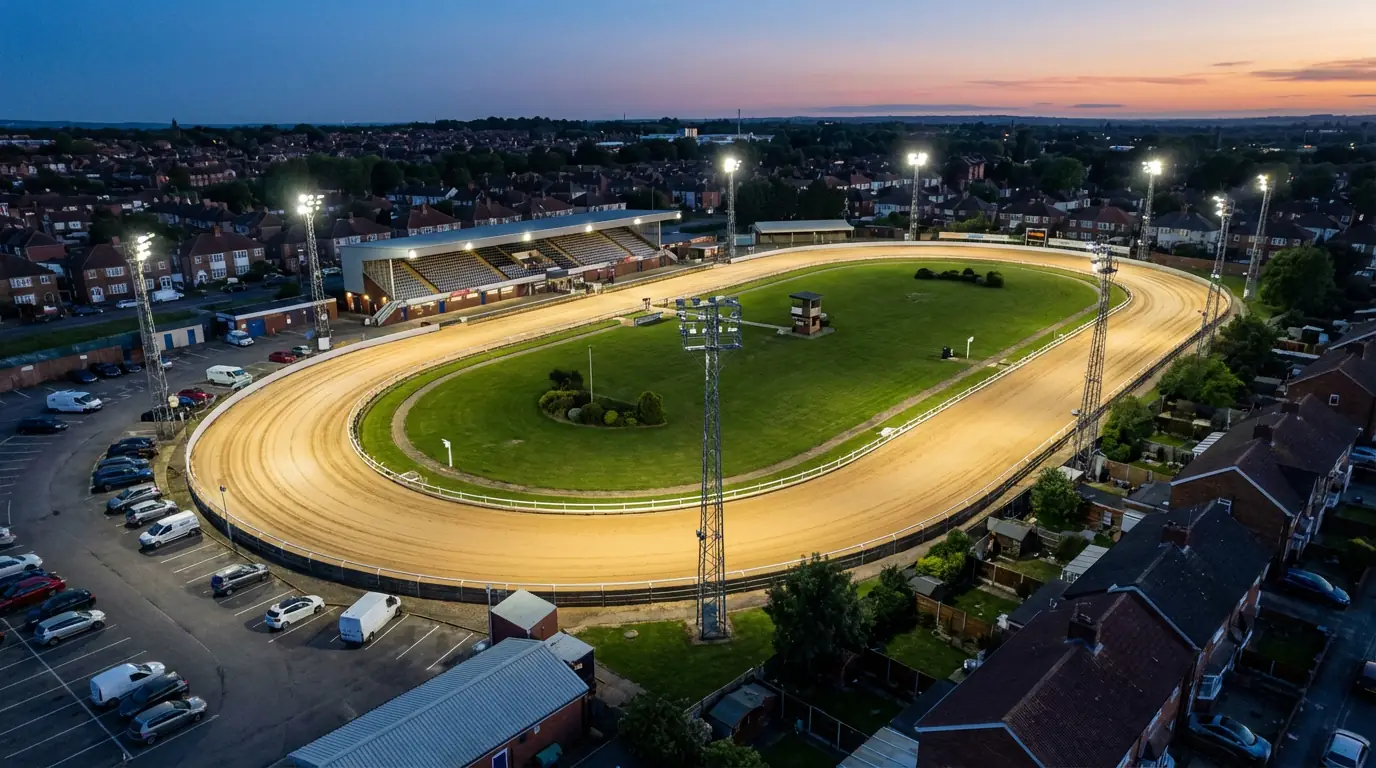
The UK Track Circuit: More Than Just a Venue
Backing a dog without knowing the track is like betting on a footballer without knowing the pitch. Every licensed greyhound stadium in Britain has its own geometry, its own surface characteristics, its own quirks that shape how races unfold. A railer that cruises to victory at Romford might struggle at Towcester. A wide-running stayer that dominates at Nottingham might find itself boxed in at Monmore. The dog hasn’t changed. The track has, and the track changes everything. Find more track guides at dogracingoddsuk.
As of 2026, the Greyhound Board of Great Britain oversees racing at licensed stadiums across England and Wales. These are the regulated venues — tracks that operate under GBGB rules, employ licensed trainers, and submit to veterinary oversight and integrity monitoring. The number has contracted over the decades. Stadiums that once drew thousands on a Saturday night have closed, converted to housing developments or retail parks, and the circuit is smaller than it was a generation ago. What remains, though, is a diverse set of venues ranging from compact inner-city tracks to sweeping rural circuits, each offering a distinct racing experience.
Outside the GBGB network, independent tracks — sometimes called flapping tracks — operate without regulatory oversight. They’re not covered in this guide. While independent racing has its own culture and following, the absence of regulated form data, grading structures, and integrity controls makes it a fundamentally different betting environment. Everything discussed here applies to GBGB-licensed stadiums only, where the data is verifiable, the grading is consistent, and the form you read on the card can be trusted as a legitimate record of each dog’s racing history.
What makes track knowledge valuable for betting purposes isn’t trivia — it’s structural. Each track’s layout determines which running styles are rewarded and which are penalised. Each track’s standard distances determine which dogs are racing within their optimal range and which are stretched or compressed. Each track’s surface condition at any given time affects speed, grip, and the advantage conferred by rail position. The punter who understands these factors at two or three tracks can read a race card with a depth of context that a generalist working across the entire circuit simply cannot match. This guide profiles every major UK venue and identifies the characteristics that matter most when money is at stake.
Track Layouts: Tight Circuits vs Wide Galloping Tracks
Not all ovals are created equal. UK greyhound stadiums fall broadly into two categories: tight, sharp circuits where races are decided on speed and positioning into the bends, and wide, galloping tracks where stamina and the ability to sustain pace over longer straights play a larger role. Understanding which category a track falls into is the first step toward reading a race card with the track’s characteristics in mind.
Tight circuits are defined by shorter straights, sharper bends, and a smaller overall circumference. Romford, Monmore, and Sunderland are archetypal examples. At these venues, the bends arrive quickly and punish dogs that run wide. A dog losing half a length on every bend through drifting outward gives away two lengths over four bends — enough to turn a winning margin into a beaten favourite. This geometry heavily favours railers: dogs that hug the inside rail, take the shortest path through the bends, and rely on early speed to establish position before the first turn. Middle runners and wide runners can win at tight tracks, but they need either exceptional pace to offset the ground lost on the bends, or a clear racing line that lets them swing wide without interference. At tracks like Romford, where first-bend crowding is common due to the short run from traps to the turn, inside draws carry a measurable statistical advantage that persists across hundreds of races.
Wide galloping tracks tell a different story. Towcester, before its periods of closure and reopening, was the classic British example: a large circuit with sweeping bends, long straights, and an uphill finishing stretch that tested stamina as much as speed. Nottingham and Sheffield offer similar space, though with flatter profiles. At these venues, wide runners have room to operate. The bends are more gradual, which reduces the ground advantage of the inside rail and gives outside runners a fairer chance. Closers — dogs that race mid-pack through the early stages and finish strongly — perform better at galloping tracks because the longer straights give them time to make up ground that would be unrecoverable on a tight circuit.
Surface and drainage add further nuance. UK greyhound tracks run on sand, but sand quality varies. A well-maintained, fast surface rewards raw speed. A heavy, rain-affected surface slows the pace and can shift the advantage toward stronger dogs that cope better with drag. Some tracks drain quickly after rain and return to near-normal conditions within a race or two. Others hold moisture for an entire meeting, turning the going soft and changing the complexion of every race on the card. Checking the going report — dry, standard, wet — before a meeting is a basic step that many punters neglect, particularly on afternoon BAGS cards where the weather between morning and first race can change the surface materially.
Bend camber is the last structural element worth noting. Some tracks bank their bends, which helps dogs maintain speed through the turns and reduces the penalty for running wide. Others are flat or nearly flat through the bends, which amplifies the advantage of the inside line. The camber isn’t published on the race card, but it’s visible if you watch replays, and it’s felt in the trap statistics — tracks with flatter bends tend to show a stronger inside-trap bias than those with well-cambered turns.
Standard Distances and What They Mean for Betting
A sprint is settled in 15 seconds. A staying race gives you 40 seconds of chaos. Distance is one of the most underappreciated variables in greyhound betting because, on the surface, it seems like simple information — 480 metres, there it is, move on. But distance determines the type of race you’re watching, the type of dog that thrives, and the type of bet that makes sense.
UK greyhound racing operates across three broad distance categories. Sprints, typically 240 to 285 metres, are the shortest races on the calendar. They’re run over two bends and last under 16 seconds. At sprint distances, early speed is almost everything. There isn’t enough track for a slow starter to recover, and there aren’t enough bends for a wide runner to lose significant ground. The race is a straight blast of acceleration from trap to line, with the first dog out of the boxes usually dictating the result. From a betting perspective, sprints tend to produce the most predictable outcomes — the fastest dog in the field, drawn in a suitable trap, wins more often than at any other distance. Win singles on sprint favourites can be profitable if the price is right, precisely because there’s less room for interference and less time for things to go wrong.
Standard distances — 450 to 500 metres — are the backbone of UK greyhound racing. Most graded races, most BAGS and BEGS fixtures, and most of the races a regular punter encounters run at these distances. Four bends, two straights, and a finishing stretch that typically takes 28 to 30 seconds. At standard distance, the race has stages: the trap start, the first bend, the back straight, the far turns, and the finishing straight. Each stage introduces variables. A dog that breaks fast but fades in the final 50 metres is a different proposition to one that starts mid-pack and closes strongly. This complexity makes standard-distance races harder to predict than sprints but richer in analytical opportunity. Forecasts and each-way bets start to make more sense here because the finishing order is less determined by a single factor and more by the interaction of multiple variables across a longer race.
Staying races — 630 metres and beyond, sometimes reaching 870 metres or longer at venues that offer marathon trips — are a niche within the sport. Six bends, three straights, and times pushing above 40 seconds. At these distances, raw speed is less decisive than stamina, race fitness, and the ability to maintain pace around extra bends. Staying races attract smaller fields at some tracks and can feature dogs that are specialists in the distance rather than graded all-rounders. From a betting standpoint, stayers’ races are often wide open. The longer the race, the more time there is for interference, for pace changes, for front-runners to tire and closers to arrive. Combination forecasts and tricasts become attractive because the difficulty of predicting the exact finishing order increases with every additional bend.
Knowing a dog’s distance preference is essential context for every bet you place. A dog with strong form over 480 metres might be entered in a 270-metre sprint — and its sectional times tell you it lacks the explosive early speed to compete at the shorter trip. Conversely, a proven sprinter entered in a 640-metre staying race may lead early and capitulate in the final straight. The distance column on the race card isn’t decorative. It’s a filter that, applied correctly, eliminates dogs from contention before you’ve read a single form figure.
Profiles: Major UK Tracks and Their Betting Characteristics
Every track has a tell — here’s what to listen for. The profiles below cover ten key venues from the GBGB-licensed circuit. For each, the focus is on what matters to a bettor: circuit shape, standard distances, surface tendencies, and the running styles the track rewards.
Romford
Romford is the heartbeat of London greyhound racing and one of the tightest circuits in Britain. The standard distance is 400 metres over four bends on a compact oval with sharp turns. The geometry is unforgiving: inside traps carry a persistent statistical edge because the bends arrive quickly and the run to the first turn is short. Dogs drawn in Traps 1 and 2 that show early pace dominate here. Wide runners struggle unless they possess exceptional speed to compensate for the ground lost on each bend. Romford hosts regular evening meetings and is one of the busiest tracks for both BAGS and open-race cards. If you specialise in one London track, this is the one with the most form data to work with.
Monmore Green
Monmore in Wolverhampton is another tight circuit, with standard distances at 264, 480, and 630 metres. The sprint trip is sharp and heavily favours fast starters from inside boxes. At the 480-metre standard distance, the track rewards railers and dogs with early pace, though the slightly more generous circumference compared to Romford gives middle runners a marginally better chance. Monmore races frequently across daytime and evening fixtures, which means extensive form data is available. The surface is well-maintained sand that runs fast in dry conditions, and the venue has a reputation for consistent going, which makes time comparisons between meetings more reliable than at tracks where surface quality fluctuates.
Nottingham
Nottingham’s Colwick Park is a larger circuit than Romford or Monmore, with wider bends and longer straights. Standard distances are 305, 500, and 680 metres. The extra space in the turns means wide runners and closers have more opportunity to make ground. Inside draws still carry an advantage, but it’s less pronounced than at tighter venues. Nottingham is a strong open-race venue and regularly hosts feature competitions, which means the quality of fields at flagship meetings is among the highest in the country. For betting purposes, the track’s width makes it slightly less predictable than tight circuits — the reduced rail bias means more race outcomes are decided on stamina and race fitness rather than pure positioning.
Hove
Hove on the Sussex coast runs races over 285, 500, and 695 metres. It’s a medium-to-wide circuit with a good surface and consistent going. The 285-metre sprint is popular and suits fast breakers, while the 500-metre standard distance provides a balanced test of pace and stamina. Hove’s longer staying distance at 695 metres produces wide-open races where tricasts and combination forecasts come into their own. The track is well-regarded for the quality of its graded racing, and it regularly features in the BAGS schedule. Historically, inside traps perform well at the standard distance but the advantage narrows at the staying trip.
Sheffield
Sheffield’s Owlerton Stadium is one of the most distinctive tracks on the UK circuit. It’s a sizeable oval with standard distances at 280, 480, and 660 metres. The bends are wider than at Romford or Monmore but tighter than Nottingham, placing it in a middle category where both railers and strong mid-track runners can compete. Sheffield hosts major open races and has a loyal following in the North. The surface can vary with weather — wet meetings at Owlerton noticeably slow the times and shift the advantage toward stronger dogs that handle heavy going. Checking the going before a Sheffield meeting is worth the thirty seconds it takes.
Sunderland
Sunderland is the principal venue for greyhound racing in the North East. The track runs standard distances at 265, 480, and 640 metres on a circuit that sits somewhere between tight and medium. Inside traps perform solidly at the sprint distance, and the four-bend 480-metre trip rewards early pace in a pattern familiar across most UK venues. The staying distance at 640 metres introduces enough additional running to test fitness and race temperament. Sunderland races regularly across the week, providing a steady flow of form data, and its evening meetings tend to attract competitive fields.
Doncaster
Doncaster runs a medium circuit with standard distances at 270, 450, and 630 metres. The 450-metre standard is slightly shorter than the 480-metre trip seen at most other venues, which means sectional times from Doncaster don’t translate directly to other tracks without adjustment. This is a venue where pace matters — the shorter standard trip compresses the race and reduces the opportunity for closers to overhaul front-runners. Trap 1 wins more than its statistical share at Doncaster, particularly at the sprint distance where the short run to the first bend amplifies the inside advantage.
Yarmouth
Great Yarmouth operates on a flat circuit with standard distances at 277, 462, and 659 metres. The track is exposed to coastal weather, which can affect surface conditions — wind and rain off the North Sea make the going unpredictable, and punters who follow Yarmouth regularly learn to factor in the forecast before the form. In dry conditions, the track runs relatively fast and rewards early speed. In wet conditions, times slow and the rail advantage diminishes as the sand becomes heavier and more uniform. Yarmouth’s cards are primarily BAGS fixtures, which means afternoon racing with the associated thinner fields and less competitive gradings.
Towcester
Towcester in Northamptonshire is the outlier on the UK circuit. It’s a large, undulating track — one of the few in Britain with a discernible gradient — running standard distances at 270, 480, and 680 metres. The uphill finish is Towcester’s defining feature and it punishes dogs that lack stamina. Front-runners that coast to victory at flat tracks can fade in the closing stages at Towcester when the incline saps their finishing speed. This makes the venue friendlier to strong-finishing types and closers than almost any other track in the country. Forecast and tricast dividends at Towcester tend to run higher than average because the uphill finish introduces an extra layer of unpredictability that the market often underprices. Towcester has experienced periods of closure and reopening, so confirming its current schedule before building it into your betting routine is advisable.
Dunstall Park
Dunstall Park in Wolverhampton opened in September 2025 as one of the newest additions to the GBGB circuit. The facility was purpose-built to modern specifications, with a well-drained sand surface and a layout designed for competitive racing across sprint and standard distances. As a recently opened venue, historical trap statistics are still building, which means the usual data-driven approach to draw analysis requires patience. Early indications suggest a fair track where no single trap dominates disproportionately, but the sample size is limited. For punters, a new track is both an opportunity and a caution: the form book is thin, the market is less efficient because data is scarce, and early-mover analytical advantage is available to anyone willing to study the emerging patterns before the crowd catches on.
BAGS, BEGS, and the Meeting Schedule
BAGS meetings pay the bills. Evening meetings are where the sport breathes. If you’re going to bet on UK greyhound racing with any regularity, you need to understand the meeting structure, because the type of meeting shapes the quality of the racing, the competitiveness of the fields, and the reliability of the odds.
BAGS — the Bookmakers’ Afternoon Greyhound Service — provides the daytime fixtures that keep betting shops and online bookmakers stocked with content. These meetings run from late morning through the afternoon, Monday to Saturday, across multiple tracks simultaneously. The purpose of BAGS is commercial: it exists to give punters something to bet on during working hours. The racing is graded, regulated, and genuine, but the field quality at BAGS meetings is generally a step below what you’ll see in the evenings. Trainers often save their better dogs for higher-profile evening cards, which means BAGS fixtures tend to feature mid-to-lower graded races with fields that lack the depth of a feature-night programme.
That doesn’t make BAGS unplayable. In fact, some punters prefer it. The thinner fields and less competitive gradings can create clearer form pictures — when one dog is materially better than the opposition, the data often shows it more plainly in an A7 BAGS race than in an A2 evening open. The markets on BAGS meetings are also less efficiently priced because fewer serious punters are studying them. The recreational money that flows through afternoon racing tends to be less informed, which means the odds are sometimes softer than they should be on dogs with strong, obvious form advantages.
BEGS — the evening equivalent — covers floodlit meetings, typically starting between 6pm and 8pm. Evening cards at venues like Romford, Sheffield, Nottingham, and Hove attract stronger fields, higher grading, and more public attention. Saturday evenings at marquee tracks are the flagship of the weekly schedule: open races with quality fields, meaningful prize money, and competitive markets where the odds more accurately reflect the true chances. The trade-off is that the markets are sharper. More punters are studying the form, more money is flowing, and the bookmaker’s prices are tighter. Finding value at a Saturday evening open race is harder than at a Tuesday afternoon BAGS card — but the racing itself is a better spectacle, and the form data from these meetings is the most reliable in the sport.
Morning meetings are a more recent addition to the schedule. Running from around 10am, they cater primarily to online betting markets and international audiences. Field quality at morning meetings is generally the lowest of the three tiers, and form data can be sparse because the dogs entered are often running at off-peak times at less fashionable grades. The markets are thin, the overround tends to be high, and the analytical opportunity is limited by the available data. Some punters find edges here precisely because the markets are so poorly attended, but the risk of being caught by unreliable form is correspondingly higher. Know which tier of meeting you’re betting into, and adjust your expectations — and your staking — accordingly.
Picking Your Tracks: A Specialisation Strategy
The professional dog punter doesn’t follow the races — they follow the track. With eighteen licensed venues running cards throughout the week, the temptation is to spread your attention across the entire circuit. Afternoon BAGS at Monmore, evening card at Nottingham, Saturday special at Sheffield, a Sunday matinee at Hove. Cover more races, find more bets, make more money. That’s the theory. The practice is the opposite.
Specialising in two or three tracks produces better results than skimming across ten. The reasoning is straightforward: track knowledge compounds. Every meeting you study at Romford adds to your understanding of which traps perform, which trainers run their dogs when they’re ready to win, how the surface changes after rain, and what sectional times are genuinely fast versus merely average for the venue. After six months of focused attention on a single track, you have a database — formal or mental — that no casual observer can match. You know the local dogs. You recognise when a kennel switch produces improvement. You’ve watched enough races to know that Trap 3 at Romford is a death draw for wide runners but perfectly fine for a dog with early speed that can punch through to the rail.
This depth of knowledge creates an edge that scales over time. The punter studying Romford three times a week sees patterns that the punter dipping in once a fortnight misses. They spot the class dropper that’s been waiting for a favourable draw. They notice that a trainer’s recent runners have all been slow away, suggesting a kennel-wide issue with fitness or travel that the market hasn’t priced in yet. These aren’t insights available from a race card alone. They’re insights earned through repetition, accumulated across dozens of meetings at the same venue.
Choosing which tracks to specialise in is partly practical and partly analytical. If you attend meetings in person, pick your nearest venue — familiarity with the physical track, the going, and the atmosphere adds layers of information that remote punters don’t get. If you bet exclusively online, pick tracks with the most form data and the most frequent fixtures: Romford, Monmore, Sheffield, and Nottingham all run regularly and generate the volume of races you need to build a meaningful dataset. Avoid tracks with irregular schedules or limited BAGS coverage unless you have a specific reason to follow them. Also read our greyhound racing distances.
Breadth feels productive. Depth is productive. The punter who knows one track better than the bookmaker’s handicapper prices it has a structural edge that no amount of multi-track dabbling can replicate.