
The Mechanics Behind a Greyhound Price
A greyhound’s price isn’t a prediction — it’s a negotiation between bookmaker risk and punter conviction. Before a single penny is wagered by the public, the number already exists. It starts in the morning, sometimes earlier, when a bookmaker’s handicapper sits down with the race card and builds what the trade calls a tissue price: an internal estimate of each dog’s chance of winning, expressed as odds, factoring in recent form, trap draw, track conditions, and the relative strength of the field. Find more odds guides at dogracingoddsuk.
That tissue is the skeleton of the market. It’s never published, never shared, and almost never accurate — not because the handicapper lacks skill, but because the tissue’s job isn’t to be right. Its job is to be close enough to attract balanced money on both sides of the book. If a tissue prices a dog at 3/1 and early punters hammer it down to 2/1, the bookmaker knows more money is coming for that dog than expected. The rest of the field drifts outward to compensate. This is how a greyhound market breathes: money in on one side, price adjustment on the other, repeated in real time until the traps open.
What makes greyhound odds distinct from horse racing — and this is the part most crossover punters underestimate — is the size and speed of these movements. A six-dog field is a small market. There are fewer runners absorbing money, fewer variables diffusing the flow, and fewer sophisticated punters providing liquidity. The result is volatility. A single large bet on a greyhound can shift the entire market in a way that the same money wouldn’t budge a 16-runner handicap at Ascot. It also means that late information carries disproportionate weight. A whisper about a dog’s trial times, a kennel connection’s confidence, a trainer’s quiet word at trackside — in horse racing, that sort of thing nudges a price. In greyhound racing, it can halve one.
The process from tissue to final pre-race odds typically plays out across two stages. First, the early show: bookmakers post their opening prices, usually an hour or more before the race, inviting early money. These prices are often generous compared to what they’ll become, because the bookmaker is buying information. Every bet placed at the early show tells the market something. Second, the market settles into its final shape in the minutes before the off. This is where volume concentrates, where the dogs that looked like value at the early show are now cramped, and where the genuine drifters — dogs nobody fancies — start to lengthen in price.
Understanding this mechanism matters because it reframes what a greyhound’s odds actually represent. They’re not a fixed label attached to a dog’s ability. They’re a live, evolving product of collective opinion, weighted by money, shaped by market structure, and ultimately settled at the moment the traps spring open. The punter who treats the odds as an invitation to agree or disagree — rather than a fact to accept — is already operating at an advantage. Everything that follows in this guide, from format conversions to margin analysis, builds on this foundation: the price is a conversation, and you’re allowed to have an opinion.
Fractional Odds: The UK Standard
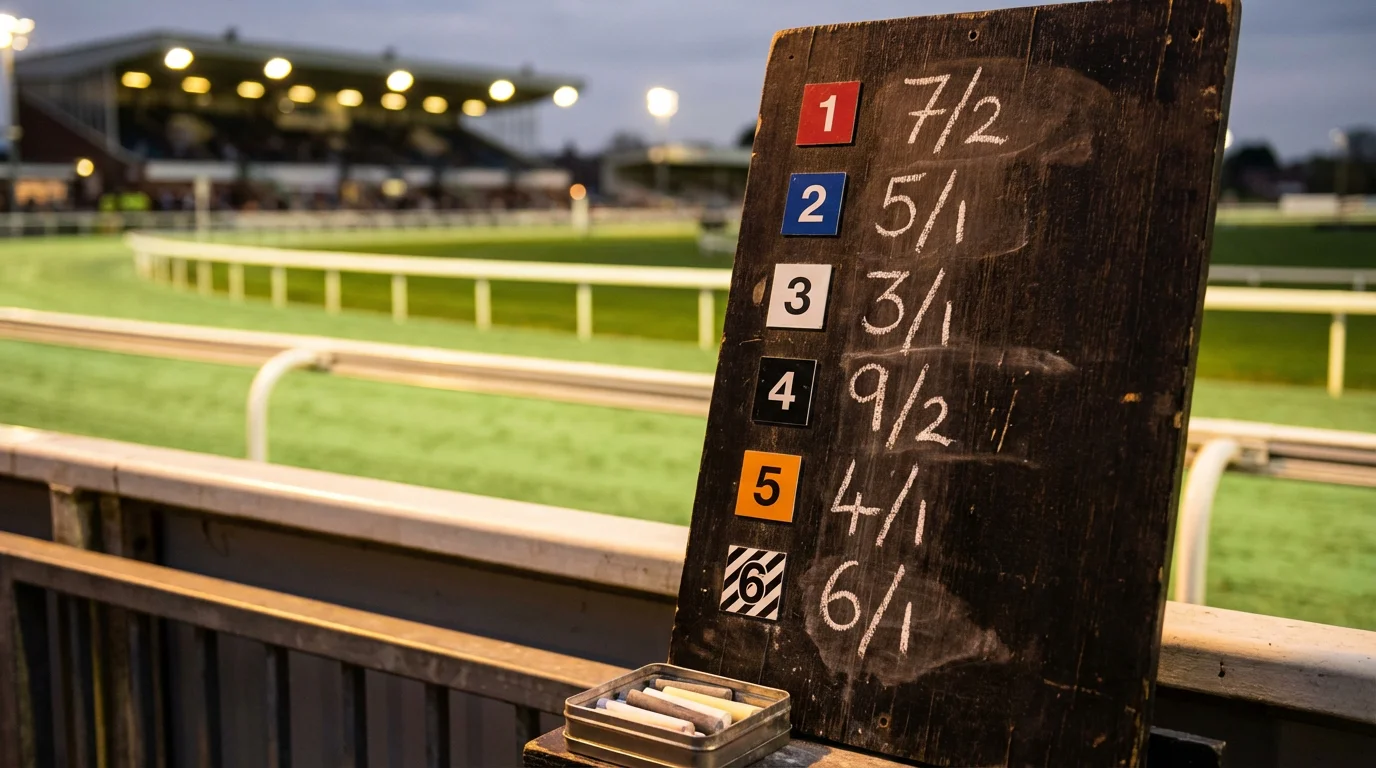
Fractional odds look like relics from a blackboard at a 1970s track — but they still dominate UK dog racing for a reason. They’re intuitive once you grasp the single principle behind them: the number on the left is your profit, the number on the right is your stake. At 7/2, a two-pound bet returns seven pounds profit plus the original stake, for a total of nine. At 5/1, a one-pound bet returns five plus one. Evens, written 1/1, means your profit equals your stake. Simple enough on the surface, but fractional odds carry more information than most punters extract from them.
Converting fractional odds to implied probability is the first analytical step most bettors skip. The formula is straightforward: divide the denominator by the sum of numerator and denominator, then multiply by 100. At 3/1, the implied probability is 1 / (3+1) = 25%. At 5/2, it’s 2 / (5+2) = 28.6%. This conversion matters because it translates the bookmaker’s language into something you can test against your own assessment. If you believe a dog has a 30% chance of winning and the fractional odds imply 25%, there’s a potential value gap. If the odds imply 35%, the bookmaker is more generous than your analysis suggests — and you need to ask why.
Fractional odds persist in UK greyhound racing partly through tradition and partly through venue. On-course bookmakers at tracks like Romford, Towcester, and Monmore still display fractions on their boards. Betting shops show them by default. The Racing Post prints them. For anyone who grew up around UK dog tracks, fractions are the native language of the sport, and switching to decimals feels like reading a translation — technically accurate, but missing something in the rhythm.
The prices punters encounter most often in greyhound racing fall into a familiar range. Odds-on favourites at 4/6 or 8/11 appear in nearly every graded race. The competitive middle market — 5/2, 3/1, 7/2 — is where most of the betting interest and analytical opportunity sits. Outsiders at 8/1, 10/1, or longer pop up in open races or when a dog’s recent form reads badly on paper but disguises extenuating circumstances. Learning to read these fractions fluently, converting them to probability reflexively, is a foundational skill. It won’t make you profitable on its own. But without it, every other analytical tool you apply is built on shaky ground.
Decimal Odds and Exchange Pricing
On Betfair, 4.0 is just 3/1 wearing a different coat. Decimal odds express the total return per unit staked, including the stake itself. A price of 4.0 means that for every pound you risk, four pounds come back if the bet wins — three in profit, one as your original stake returned. It’s the same outcome as 3/1 fractional, but the format does the arithmetic for you. There’s no mental step of adding stake to profit. What you see is what you get.
This is precisely why betting exchanges adopted decimal pricing from the start. When you’re backing and laying in rapid succession, comparing prices across multiple markets, or calculating liability on a lay bet, decimal makes the maths cleaner. A lay bet at 4.0 means you’re risking three pounds to win one from the backer. At 3/1 fractional, you’d need to pause and work that out. On an exchange where margins are measured in ticks and seconds matter, that pause costs money.
The conversion between formats is mechanical. To go from fractional to decimal, divide the numerator by the denominator and add one. So 7/2 becomes (7 / 2) + 1 = 4.50. To go back, subtract one from the decimal and express it as a fraction: 4.50 minus 1 = 3.50, which is 7/2. For odds-on prices, the same rule applies: 4/6 fractional becomes (4 / 6) + 1 = 1.67 decimal. A price of 1.67 tells you instantly that the implied probability is above 50% — the bookmaker considers this dog more likely to win than lose.
Where decimal odds reveal their real advantage is in quick comparison. Line up three bookmakers offering 4.50, 4.20, and 4.00 on the same dog and the ranking is immediate. Do the same in fractions — 7/2, 16/5, 3/1 — and you’re doing mental gymnastics to establish which is best. For punters who shop across multiple bookmakers before placing a bet, decimal pricing saves time and reduces errors.
One subtlety worth noting: exchanges don’t just display decimal odds, they operate on a tick system with defined price increments. Between 2.0 and 3.0, prices move in increments of 0.02. Between 3.0 and 4.0, increments are 0.05. Between 4.0 and 6.0, they jump to 0.1. This means the precision of pricing varies depending on where the price sits. A dog at 2.50 can be offered at 2.48 or 2.52 — a meaningful difference at high stakes. A dog at 5.0 can only move to 4.9 or 5.1. The tick structure shapes strategy in ways that fractional pricing, with its freeform numerator-denominator pairings, simply doesn’t.
American Odds: Why UK Punters Rarely See Them
Unless you’re betting through a US sportsbook, you can file American odds under interesting but irrelevant. But for the sake of completeness — and because an increasing number of UK punters hold accounts with international operators — here’s how they work.
American odds use a plus/minus system anchored around a notional hundred-unit stake. A positive number, say +350, tells you how much profit you’d make on a 100-unit bet. In this case, 350 units of profit, which maps directly to 7/2 fractional or 4.50 decimal. A negative number, say -150, tells you how much you need to stake to win 100 units of profit. That translates to 2/3 fractional or 1.67 decimal. The minus sign means the dog is favoured; the plus sign means it’s an outsider.
To convert American odds to decimal: for positive values, divide by 100 and add 1. So +350 becomes 4.50. For negative values, divide 100 by the absolute value and add 1. So -150 becomes (100/150) + 1 = 1.67. To go from American to implied probability: for positive odds, the formula is 100 / (American odds + 100). For negative odds, it’s absolute value / (absolute value + 100).
In practice, no UK greyhound track, no British bookmaker, and no domestic exchange uses American odds. You’ll encounter them only if you’re comparing prices on a US-facing platform, reading American betting content about international greyhound markets, or using a multi-sport sportsbook that defaults to the format. Know the conversions, keep them in your back pocket, and move on.
Starting Price: How It’s Set and Why It Matters
Starting price is the last word in a greyhound market — and it’s spoken by the men standing on the rails. SP is the official price at which a dog is returned at the moment the traps open. It functions as the default settlement price for any bet placed without locking in a specific number, and it serves as the benchmark against which every early-price punter measures whether they got value or left money on the table.
In UK greyhound racing, SP is determined by on-course bookmakers. At tracks that still have a betting ring — and the number is dwindling — the official SP returner records the prices being offered by on-course layers at the moment the race starts. The SP is an aggregate of those prices, typically reflecting the shortest available odds weighted toward the prevailing market. At meetings without a physical ring, such as many BAGS fixtures, SP is generated by an industry-approved algorithm that uses off-course bookmaker pricing data to produce an equivalent figure.
This distinction matters because the SP you see on a BAGS afternoon race at a provincial track is assembled differently from the SP at a Saturday evening open-race meeting at Nottingham with bookmakers trackside. The mechanics differ, and occasionally the outputs diverge from what the off-course market was showing. Punters who bet SP without understanding the source of that price are handing over control without knowing who’s driving.
The relationship between SP and the early show is where the money is made or lost. If a dog opens at 5/1 in the early show and the market supports that price — meaning balanced money comes in across the field — SP is likely to land close to 5/1. But if heavy money arrives for one dog, shortening it from 5/1 to 3/1, the SP will reflect that late support. Conversely, if a dog is friendless in the market and drifts from 5/1 to 8/1 by the off, the SP captures the drift. The early-price punter who locked in 5/1 on a dog that returned 3/1 SP got value. The one who took 5/1 on a dog that drifted to 8/1 overpaid.
There’s a common misconception that SP always disadvantages the bettor. It doesn’t — not categorically. SP disadvantages you when the dog is a steamer, because you’re paying the compressed final price rather than the more generous opening number. But SP benefits you when the dog is a drifter, because you’re paying the lengthened price rather than the shorter one you might have taken early. The trick, of course, is knowing which scenario you’re walking into. And that requires reading the market in the minutes before the race, not just the form card in the hours before.
For punters who don’t have time or inclination to study market moves, SP is perfectly functional. It ensures you’re paid at a fair reflection of what the market believed at the off. But for those who treat greyhound betting as a discipline rather than a pastime, SP is a reference point — not a destination. It’s the number you measure yourself against to determine whether your price judgement was right, and over hundreds of bets, that measurement is what separates those who profit from those who merely participate.
Best Odds Guaranteed: The Safety Net Explained
BOG is the only free lunch in betting — except most bookmakers don’t serve it at the dog track. Best Odds Guaranteed is a promotion, offered by select bookmakers, that works like this: you take an early price on a greyhound, and if the starting price is higher than the price you took, the bookmaker pays you at the higher number. You get the best of both worlds — the security of locking in a price early, with the upside of SP if the market moves in your favour.
In horse racing, BOG is near-universal among major UK bookmakers. On greyhounds, it’s a different story. Far fewer operators extend the guarantee to dog racing, and those that do often attach conditions. BOG on greyhounds typically applies only to BAGS and BEGS meetings — the bookmaker-funded afternoon and evening fixtures that generate most of the domestic racing schedule. It usually excludes ante-post markets, in-play bets, and sometimes specific promotions or enhanced-odds races. The fine print varies by bookmaker and by season, so checking terms before relying on the guarantee is non-negotiable.
The mathematical value of BOG is asymmetric in the punter’s favour, and that asymmetry is what makes it powerful. Suppose you back a dog at 5/1 early in the day. If the dog drifts to 8/1 by the off and wins, BOG pays you at 8/1 — an extra three points of profit for every pound staked, at no additional cost. If the dog shortens to 3/1, you’re still paid at your locked-in 5/1. The worst case with BOG is that you receive exactly the price you chose. The best case is that you receive a significantly better one. There is no scenario in which BOG makes you worse off than having no guarantee at all.
This makes BOG particularly valuable on greyhounds precisely because of the market volatility discussed earlier. Six-dog fields move fast. A single large bet can shorten a dog by several points, and a dry market can let a dog drift unchecked. In that environment, taking an early price with BOG is not just a safety net — it’s a strategic position. You’re effectively buying an option: the right to benefit from drift without bearing the risk of shortening. In financial markets, that kind of asymmetric payoff costs money. In greyhound betting, the bookmaker gives it away for free — provided you know where to find it and read the conditions before you click.
Overround and Implied Probability
Every greyhound market is tilted — the only question is by how much. The tilt has a name: overround, also called the vig, the juice, or the margin. It’s the bookmaker’s built-in edge, and it’s present in every race, at every track, from every operator. Understanding overround is the single most important analytical step a greyhound punter can take, because it tells you exactly how much of a disadvantage you’re starting from before you even assess a dog’s form.
Here’s how it works. In a perfectly fair six-dog race, the implied probabilities of all runners would sum to exactly 100%. Each dog’s chance would be the true probability, and the bookmaker would take no margin. This market does not exist. In practice, a bookmaker sets prices so that the implied probabilities sum to more than 100% — typically somewhere between 115% and 130% on a UK greyhound race. That excess over 100% is the overround, and it represents the bookmaker’s theoretical profit margin on the race.
To calculate overround, convert each dog’s odds to implied probability and add them up. A dog at 3/1 has an implied probability of 25%. A dog at 2/1 has 33.3%. Work through all six runners, sum the percentages, and compare the total to 100%. If the total comes to 120%, the overround is 20%. This means that for every pound wagered across the entire field, the bookmaker expects to retain roughly 17p in profit (20/120), regardless of which dog wins.
Greyhound racing typically carries a higher overround than horse racing. The reasons are structural: smaller fields mean each dog carries a larger share of the book’s probability, making it easier for bookmakers to inflate prices without it being immediately obvious. Liquidity is lower, so there’s less competitive pressure from sharp money to drive margins down. And the sheer volume of BAGS and BEGS meetings — sometimes thirty or more fixtures a day across the UK — means bookmakers price defensively, building in wider margins because they can’t devote the same analytical resources to every race that they would to a feature horse race at Cheltenham.
For the punter, overround has a direct, quantifiable cost. A market with 120% overround means that a bet at the stated odds is, on average, priced roughly 17% below its true value. To overcome that, you need to be 17% better at identifying winners than the market — or, more practically, you need to find individual bets where the price significantly exceeds the dog’s true probability of winning. This is the essence of value betting: not just picking winners, but picking winners whose odds are generous relative to the embedded margin.
Comparing overround across bookmakers is one of the simplest edges available. Two operators pricing the same race will rarely produce identical margins. One might run at 118%, another at 126%. The punter who consistently bets with the lower-margin bookmaker is paying less for every wager — not in visible fee, but in the implied probability baked into the price. Over hundreds of bets, that difference compounds. It’s not glamorous work. There’s no moment of insight, no brilliant selection. It’s just maths, applied consistently, race after race. And in greyhound betting, where margins are already stacked higher than in most sports, that kind of discipline is worth more than any tip.
How Odds Move: Steamers, Drifters, and Market Signals
When a dog goes from 5/1 to 7/4 in the last two minutes, someone knows something — or thinks they do. Odds movement is the heartbeat of a greyhound market, and learning to read it separates punters who react to prices from punters who anticipate them. Every price shift tells a story. The question is whether you can decode it before the hare starts running.
A steamer is a dog whose price shortens rapidly in the run-up to a race. Money is coming in — sustained, confident, and often from sources the market respects. A greyhound that opens at 5/1 and gets backed down to 2/1 in the space of twenty minutes has attracted serious support. The term comes from the idea of building up steam, and in greyhound markets it happens faster and more violently than in horse racing because the pools are shallower. A few hundred pounds placed on a six-dog BAGS race can move a price by several points. In a 20-runner horse race, the same money would barely register.
The opposite pattern is the drifter: a dog whose price lengthens as the market evolves. A drifter at 4/1 that becomes 7/1 by the off has been abandoned by the money. Nobody wants it at four, nobody wants it at five, and by the time it reaches seven the market has effectively voted no. Drifters lose more often than their adjusted odds would suggest, which makes intuitive sense — the market is driven by information, and information flowing away from a dog is bearish. But drifters also produce some of the most lucrative wins in greyhound racing, because when the market is wrong about a drifter, the inflated price overcompensates for the genuine probability.
Reading these movements in real time requires context. Not every shortening price is a gamble being landed, and not every drifter is a dog to avoid. Sometimes a dog shortens simply because a casual punter saw a name they liked and lumped on. Sometimes a dog drifts because a bookmaker adjusted their tissue and pushed the price out, not because of any market intelligence. The key is pattern recognition: a dog that has steamed in each of its last three starts, with connections known for targeting specific races, is a different prospect from a dog shortening randomly at a Monday afternoon BAGS meeting.
Late money — money arriving in the final sixty seconds before a race — carries the most weight in greyhound markets. It’s the money that tends to come from informed sources: trainers’ associates, kennel staff, serious form students who’ve done the homework and want the best possible price without signalling their intentions too early. When a dog is steady at 4/1 for an hour and then gets slashed to 5/2 in the last minute, pay attention. That pattern is not random.
The practical application is this: don’t just look at the current price. Look at where it’s been and where it’s heading. Most bookmaker websites and apps show price history for greyhound races, at least in the final pre-race period. Compare the opening show to the current market. If a dog has shortened by more than two price points, ask what’s driving it. If a dog has drifted materially, check whether the drift is across all bookmakers or isolated to one — a single-bookmaker drift might just be a book adjustment, while an industry-wide drift is the market speaking. The odds are alive. Treat them that way.
Beyond the Numbers: Where Price Meets Probability
The market is never wrong and never right — it’s just the current consensus, updated every second until the traps open. If you’ve read this far, you understand the architecture of greyhound odds: how prices are born from a handicapper’s tissue, expressed in fractional or decimal form, settled at SP, cushioned by BOG, inflated by overround, and animated by the push and pull of money in a live market. That’s the mechanical knowledge. What matters next is what you do with it.
The gap between what the odds say and what actually happens is where greyhound betting lives. A dog priced at 4/1 has, according to the market, roughly a 20% chance of winning — after you strip out the bookmaker’s margin, perhaps 17% in true probability. That leaves an 83% chance the dog loses. But if your own analysis, grounded in form, trap draw, track bias, and race conditions, gives that dog a 25% chance, the price is wrong in your favour. Not by a dramatic margin. Not by enough to guarantee anything in the short term. But by enough that over hundreds of bets, consistently finding and exploiting those gaps is the difference between a punter who bleeds money slowly and one who grinds out a profit.
This is not a mystical edge. It’s arithmetic, applied with discipline. The tools are available to anyone: implied probability calculators, overround comparisons, price movement trackers, and the form data published freely by every major racing service. What separates serious punters from recreational ones is not access to information — it’s the willingness to use it systematically rather than selectively. Also read our how bookmakers set greyhound odds.
Greyhound odds are an invitation. They say: here is what we believe, priced for our profit, open for your disagreement. The punter who understands how that invitation is constructed — who knows the tissue beneath the price, the margin behind the market, and the flow of money that gives the numbers their final shape — is equipped to accept it on their own terms. The traps will open regardless. The question is whether you’ve done enough work to know what the price is really telling you.