UK Dog Racing Odds: The Complete Greyhound Betting Guide
How greyhound odds work, which bets to place, and how to read form like a professional punter.
 Available in US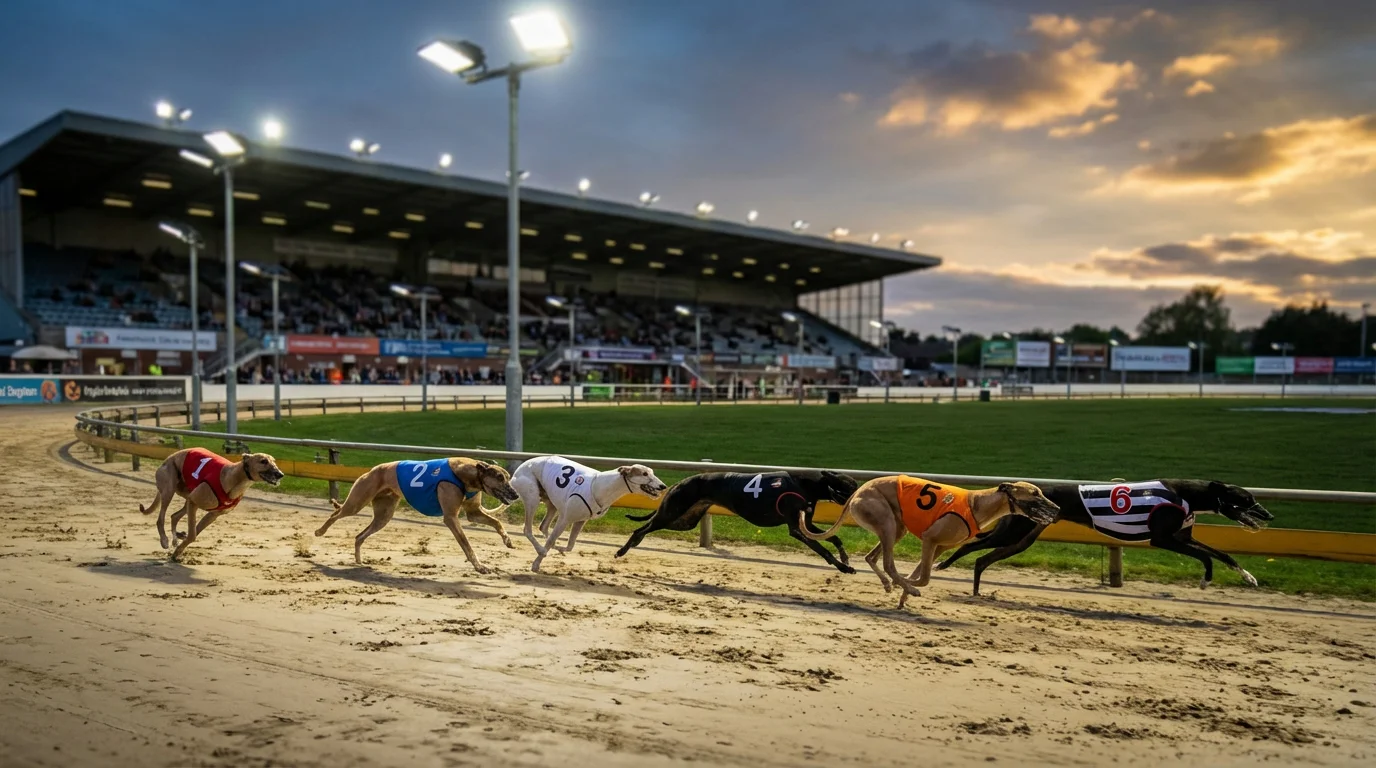
How UK Dog Racing Odds Actually Work
Greyhound odds move faster than the dogs themselves. That is not a throwaway line — it is the first thing any serious dog racing punter in the UK needs to understand. Unlike horse racing, where ante-post markets can simmer for weeks and liquidity deepens gradually, greyhound prices shift in compressed timeframes across small, volatile fields of six runners. A single piece of information — a late weight change, a trap reassignment, a whisper about a dog's trial form — can swing a price from 5/1 to 7/2 before most punters have opened their betting app.
The process starts with the bookmaker's tissue price, an internal estimate of each dog's chance based on recent form, class, trap draw, and track configuration. This tissue is not published. It is the scaffolding behind the opening show — the first set of prices a bookmaker displays to the public, typically appearing an hour or so before the off for BAGS meetings and sometimes earlier for evening cards. From the moment those prices appear, they begin to move. Money flows in from punters, from other bookmakers hedging their positions, and from automated trading algorithms that react to market imbalances. The prices you see at any given moment are the sum of all that activity, filtered through each bookmaker's risk appetite and margin requirements.
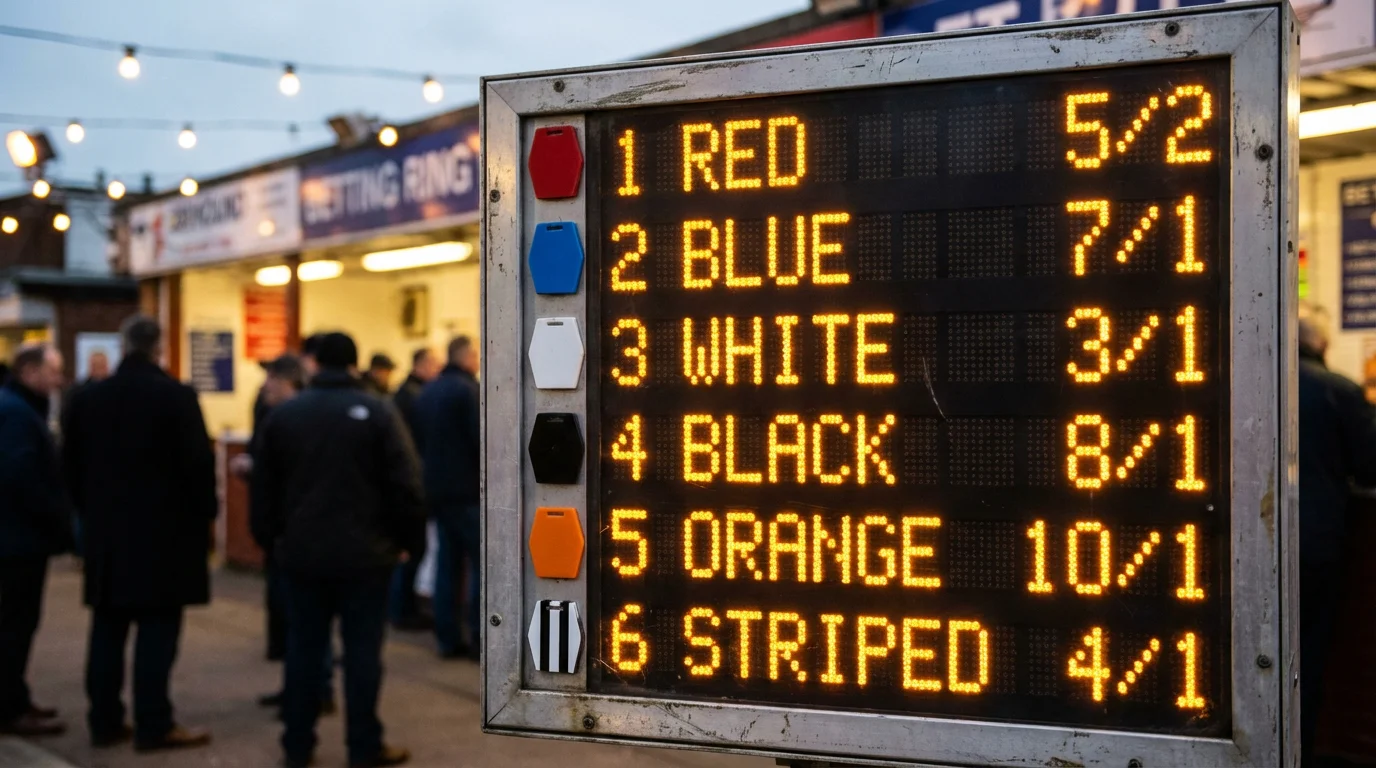
Tissue Price — A bookmaker's private opening assessment of the probable outcome of a race. The tissue is compiled by a trader who weighs form, draw, class, and track data to produce an initial set of odds. These odds are then adjusted by the bookmaker's desired overround (their built-in margin) before being released as the opening show. The tissue is the skeleton; the market is the living body that forms around it.
What makes greyhound odds distinct from horse racing is the combination of small fields and short race times. Six runners mean that any single dog's price has a proportionally large impact on the overall market. When one dog shortens from 3/1 to 2/1, the other five must drift to compensate — and in greyhound racing, that rebalancing happens in minutes, not hours. The market is also less liquid than horse racing. Fewer punters means individual bets carry more weight, which is why sharp money — large, informed stakes from professional bettors — can visibly move greyhound prices in ways it rarely does in a 16-runner handicap at Ascot.
Understanding this mechanism matters because it dictates when and how you bet. Taking an early price locks you in before the market absorbs all available information. Waiting for SP means accepting whatever the market settles on at the off. Neither approach is inherently better — each is a bet on market direction. And that, at its core, is what greyhound odds are: a live negotiation between what the bookmaker believes and what the betting public is willing to pay.
The Settlement Ladder
The same 5/1 can be paid four different ways. Each one quietly demands a different amount of skill from you. This tool prices all four on one ladder — and works out what Best Odds Guaranteed is really worth.
—
The ladder
Right of the spine: how often the starting price lands on each rung. Left of the spine: how much expected value Best Odds Guaranteed actually adds from that rung. The two shapes are not the same shape — that gap is the whole point.
—
Four ways to be paid
Every route is reduced to one number you already understand: the flat price that would leave you exactly as well off. That is the effective price — so all four settlements can be pinned on the same ladder.
| Route | Effective price | Expected P/L on £10 | Skill toll |
|---|
Skill toll = how much better than the market's own closing assessment your opinion has to be, before that route breaks even. It is the margin restated as a demand on you.
What BOG is actually worth
A punter checking their statement sees the average price improvement. That number is real, and it is not the number that matters.
—
| Market heat | BOG pays | EV added | Drift Discount |
|---|
Note the direction. A busier market makes BOG worth more in cash and less per pound of apparent improvement: the bigger the drifts, the more of them land on tickets that were always going to lose.
Method, assumptions and self-checks
The one assumption everything rests on
The starting price, stripped of its overround, is treated as the honest final assessment of the dog's chance. This is the standard efficient-close assumption used in closing-line-value work. It is not a claim that the SP is always right — only that, on average over many races, nothing systematically beats it. If you believe you beat the close, use the skill-toll column: it tells you by how much you would need to.
How the price is allowed to move
Your early price is de-vigged proportionally against the early board's overround to give a fair probability q. The price then wanders in log-odds space between now and the off: the final log-odds is q's log-odds plus a normal step with standard deviation s·√(minutes to the off). The step's mean is not zero — it is solved numerically at every recalculation so that the expected probability is exactly q. Prices are martingales in probability, not in log-odds, and skipping that correction quietly manufactures value out of nothing.
Market heat
s runs 0.020 (Quiet) to 0.058 (Volatile) per √minute, Normal = 0.035. At Normal, 22 minutes out, a 5/1 shot settles between about 9/2 and 11/2 half the time — which is roughly what a six-dog BAGS market does. Heat is a judgement, not a measurement; a single observed move cannot identify it, so it is exposed as a control rather than inferred.
The four settlement rules
Early, no BOG: settles at your price whatever happens. Early with BOG: settles at the better of your price and the SP. SP: settles at the starting price, which carries the SP board's own overround. Exchange: the fair price at the off, moved down the Betfair tick ladder by your liquidity setting, then commission taken on net winnings only.
Two closed forms used as self-checks
With no opinion, a flat early price must return exactly 1/m − 1, and SP exactly 1/mSP − 1, whatever the volatility. The engine integrates these numerically instead of asserting them, and both are printed below. If they drift apart, the quadrature is wrong.
—
What is deliberately not modelled
Non-runners and Rule 4 deductions. Bookmaker-specific BOG restrictions, caps and excluded meetings. Favourite–longshot bias in the de-vig — proportional de-vig slightly overstates the fair chance of a long price, which shifts the levels but barely touches the Drift Discount, because that number is a ratio. Your own account being restricted, which is the real long-run cost of using BOG well.
Nothing here is a tip, a selection or a guarantee. It is arithmetic on settlement rules. 18+ · BeGambleAware · National Gambling Helpline 0808 8020 133.
Fractional vs Decimal: Reading UK Greyhound Prices
A price of 7/2 means one thing on a betting slip and something subtly different on an exchange screen. That distinction trips up more newcomers than any other aspect of UK dog racing odds, so it is worth unpacking properly.
Fractional odds are the traditional format in British betting. A price of 7/2 means that for every two pounds you stake, you receive seven pounds in profit if the bet wins — plus your original stake back. Your total return on a one-pound stake is therefore 4.50 pounds (3.50 profit plus the 1.00 stake). This format dominates on-course tote boards, in printed race cards, and across most high-street bookmaker displays. It is the language British punters grew up with, and at tracks like Romford or Towcester you will still hear regulars calling prices as "seven to two" or "fives" without a second thought.
Decimal odds express the same information differently. Instead of separating profit from stake, the decimal figure represents your total return per unit staked. That same 7/2 becomes 4.50 in decimal — stake one pound, get 4.50 back if you win. Decimal is the standard on betting exchanges like Betfair, across European sportsbooks, and increasingly on the online platforms of UK bookmakers who let you toggle between formats. The appeal is arithmetic simplicity: multiplying stake by decimal odds gives you an instant return figure, no mental gymnastics required.
The conversion formula is straightforward. To go from fractional to decimal: divide the numerator by the denominator, then add one. So 7/2 becomes (7 / 2) + 1 = 4.50. To reverse it: subtract one from the decimal, then express the result as a fraction. 4.50 becomes 3.50/1, which simplifies to 7/2. For quick reference:
| Fractional | Decimal | Implied Probability | Return on 10.00 stake |
|---|---|---|---|
| 1/1 (Evens) | 2.00 | 50.0% | 20.00 |
| 2/1 | 3.00 | 33.3% | 30.00 |
| 7/2 | 4.50 | 22.2% | 45.00 |
| 5/1 | 6.00 | 16.7% | 60.00 |
| 10/1 | 11.00 | 9.1% | 110.00 |
Implied probability is the hidden column every punter should calculate. The formula from decimal odds: (1 / decimal odds) x 100. At 4.50, the implied probability is 22.2%. If your assessment says a dog has a 30% chance but the market prices it at 22%, you have found a value bet. Whether you use fractional or decimal is preference, but understanding both ensures you can move between a trackside tote, an online bookmaker, and an exchange without misreading a single price.
Starting Price, Best Odds Guaranteed, and Early Prices
Taking an early price on greyhounds is a gamble within a gamble. You are betting not only on the dog but on the direction of the market between now and the moment the traps open. To do that intelligently, you need to understand how the starting price is formed — and why Best Odds Guaranteed exists as a safety net.
The starting price, commonly abbreviated to SP, is the official odds returned on a dog at the moment the race begins. In UK greyhound racing, SP is determined by an averaging process based on on-course bookmaker prices at the off. An SP reporter surveys the available on-course prices, discards outliers, and calculates an industry-standard figure. For BAGS (Bookmakers' Afternoon Greyhound Service) meetings — which make up the majority of UK daytime greyhound racing — SP is the default settlement price for any bet placed without a fixed price.
Early prices, by contrast, are the fixed odds a bookmaker offers before the off. These might appear thirty minutes or more before a race. If you take an early price, that number is locked in — your bet is settled at that figure regardless of what happens to the market afterwards. The risk is obvious: if the dog's price drifts from your locked-in 4/1 to 6/1 by the off, you have left money on the table. If it shortens from 4/1 to 2/1, you have beaten the market. The question is whether your information or analysis gives you an edge in predicting price direction.
This is where Best Odds Guaranteed comes in. BOG is a promotion offered by many UK bookmakers — though not all extend it to greyhound racing — that guarantees you the better of your early fixed price or the SP. It eliminates the downside of taking an early price while preserving all the upside.
BOG in action: a step-by-step scenario
You back Ballymac Donut at 5/1 early price, staking 10.00.
The market moves. Other punters do not fancy the dog. By the off, SP has drifted to 7/1.
Without BOG, your bet settles at 5/1 — return of 60.00 (50.00 profit + 10.00 stake).
With BOG, the bookmaker honours the higher price: 7/1 — return of 80.00 (70.00 profit + 10.00 stake).
You gain an extra 20.00 simply because the BOG guarantee converted your early price into a free option on a better one.
The practical implication is clear: when a bookmaker offers BOG on greyhounds, there is almost no reason not to take an early price if you have identified a selection. You capture any market drift and are protected if the price shortens. The only caveat is the fine print — some bookmakers restrict BOG to certain meetings, cap the payout enhancement, or exclude in-play bets. Read the terms, but once they are satisfied, BOG transforms early-price punting into an asymmetric opportunity where the downside is capped and the upside is open.
The Six Traps: How Draw Affects the Odds
Red jacket, inside rail, first to the bend — that is the script every greyhound punter learns first. And like most scripts, it is roughly right but dangerously oversimplified. The trap draw in UK greyhound racing is not random luck. It is a structured allocation governed by the Greyhound Board of Great Britain, based on each dog's running style, and it shapes the market in ways that many casual bettors underestimate.
Every greyhound in a graded race is classified by the racing manager as a railer (R), middle runner (M), or wide runner (W), based on its natural running style. The trap draw is then seeded accordingly: railers are drawn inside, wide runners outside, middle runners fill the centre. In open races the draw may be randomised, which is one reason open-race betting carries additional risk.
Each trap is identified by a jacket colour that every UK punter should know by sight:
Trap 1 — Red
Inside rail. Shortest path to the first bend. Suits railers with early pace. Statistically, Trap 1 produces the highest win rate at many tight, left-handed circuits, but crowding risk is real if the dog breaks slowly.
Trap 2 — Blue
Just off the rail. Still benefits from inside position but with fractionally more room. A strong draw for railers or rail-middle types at tracks with sharp bends.
Trap 3 — White
Centre-inside. The transition zone. A dog drawn here needs clean early speed to avoid being pinched by runners from both sides converging on the first bend.
Trap 4 — Black
Centre-outside. Similar to Trap 3 but with marginally more room on the outside. Middle runners with tactical speed tend to perform well from here.
Trap 5 — Orange
Wide. Longer path to the first bend, but less interference. Favours wide runners with strong early pace who can hold their ground without drifting too far off the racing line.
Trap 6 — Striped (Black and White)
Widest draw. The longest route to the first bend. Best suited to confirmed wide runners who have the pace to lead or the stamina to sustain a wider run. Poor draw for railers — a fast railer drawn in 6 often wastes energy crossing the field.
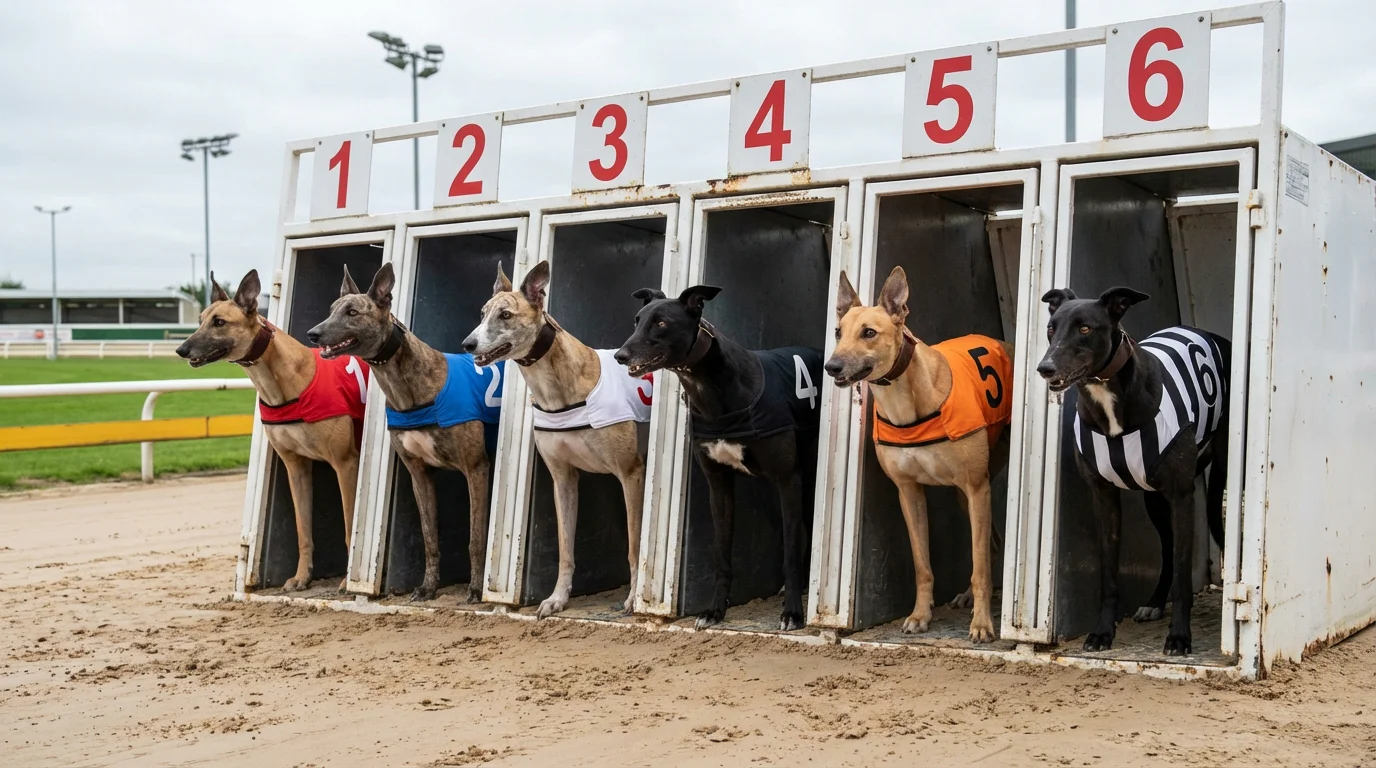
The market reacts to the draw before it reacts to anything else. A known railer with rapid early speed drawn in Trap 1 at a tight circuit like Romford will shorten almost immediately. A railer drawn in Trap 6 will drift, sometimes significantly. This is not superstition — it is geometry. The inside of a curved track is physically shorter, and the first bend is where the majority of interference and crowding occurs. A dog's trap position determines its angle of approach to that first bend, which determines its chances of a clean run.
Knowing the jacket colours, understanding the seeding system, and recognising when a draw favours or undermines a dog's natural running style is foundational. It will not win every bet, but ignoring the draw will certainly lose some that should have been skipped entirely.
Bet Types Every Dog Racing Punter Should Know
Most punters stick to win singles. The ones who profit tend to think wider. UK greyhound racing offers a broader range of bet types than many bettors ever explore — from the straightforward win and place to the mathematically rich territory of forecasts, tricasts, and combination wagers. The key is not to learn them all for the sake of it, but to understand which bet type fits which race scenario. A six-dog field with a clear favourite demands a different approach than a wide-open A5 graded race where any of four dogs could reasonably finish in the first two. The bet type you choose should reflect the race you are looking at, not the bet you habitually place.
What follows is a walk through the spectrum, from the simplest wager to the most complex. Each has a place. Each has a trap — and not the kind with a jacket colour.
Win, Place, and Each-Way Bets on Greyhounds
Each-way on an odds-on favourite is just burning half your stake. That is the blunt truth, and the maths supports it unambiguously. But to understand why, you need to see how the three basic bet types relate to each other.
A win bet is the purest wager: back a dog to finish first, collect at the agreed odds, or lose your stake. A place bet pays out if your dog finishes first or second in a six-runner race, at one quarter of the win odds (so a dog at 8/1 pays 2/1 for the place). Each-way combines these into a single slip — two equal bets, one on the win, one on the place. A five-pound each-way bet costs ten pounds total. If the dog wins, you collect on both halves. If it finishes second, you lose the win half but collect the place return. Third or worse, you lose everything.
Win-Only
Dog at 6/1. Stake: 10.00.
Win: return 70.00. Second: return 0.00.
Each-Way
Dog at 6/1. Stake: 5.00 EW (10.00 total).
Win: return 47.50 (35.00 win + 12.50 place). Second: return 12.50 (net loss 7.50 overall, versus 10.00 loss win-only).
The critical question is when each-way adds value. The answer centres on the price. At short odds — anything below 4/1 — the place portion of an each-way bet returns so little that it barely justifies the doubled stake. A dog at 2/1 pays just 1/2 for the place. Your five-pound place bet returns 7.50 on a place finish: 2.50 profit against a 10.00 total outlay. You are still down 2.50 overall. Each-way only starts to make mathematical sense at 4/1 or above, where the place return is meaningful enough to offset the doubled stake. At 8/1, 10/1, and above, each-way becomes a genuine hedging tool — a way to stay in profit even when your selection misses the win but hits the frame. Below that threshold, win-only at a bigger stake is almost always the sharper play.
Forecasts, Tricasts, and Combination Bets
Forecast dividends are not set by a bookmaker — they are computed after the race, and the maths does not care about your feelings. Unlike a win bet where you agree a price before the off, forecast and tricast returns are calculated by a computer formula based on the starting prices and field size. The same 1st-2nd result can pay wildly different dividends at different meetings.
A straight forecast requires you to predict the first and second dog in exact finishing order. In a six-runner greyhound race, there are 30 possible first-second combinations (6 dogs x 5 remaining dogs). A reverse forecast covers both orders of your two selected dogs — A first, B second, or B first, A second — doubling your stake but dramatically increasing your chance of collecting. A combination forecast lets you select three or more dogs and covers every possible first-second permutation among them. Three dogs produce six permutations (3 x 2), so a combination forecast on three dogs costs six times your unit stake. Four dogs produce twelve permutations.
Tricasts raise the complexity further. A straight tricast demands the exact first, second, and third in order — one correct outcome from 120 possible permutations in a six-dog field. Dividends routinely run into the hundreds of pounds from a one-pound stake when longer-priced dogs fill the frame. A combination tricast lets you box three or more dogs: boxing three costs six units, boxing four costs 24. The cost escalates quickly, making selection discipline paramount.
The question of when to use each type comes down to the race profile. In a graded race with a clear favourite and a second dog who should also be competitive, a straight or reverse forecast can offer better expected value than a simple win bet — you are being paid for providing more information (the exact order) at relatively short effective odds. In open races, where the quality gap between dogs is narrow, combination tricasts can capture big dividends if you correctly identify three of the six runners to fill the frame, even if you cannot determine the exact order. The worst approach is to play forecasts and tricasts indiscriminately on every race. These are precision tools, and the punters who profit from them are the ones who wait for the right race card rather than forcing the bet type onto the wrong scenario.
Reading the Race Card Like a Professional
A race card is a compressed biography — six dogs, six stories, one bend where everything collides. Learning to read it properly is the single skill that separates punters who bet on opinions from punters who bet on evidence. Every piece of data on the card is there for a reason, and once you understand what each element tells you, the card becomes a tool for eliminating non-contenders before you even consider a price.
Start with the basics. Each dog's entry on the card includes a name, a trap number, a jacket colour, a trainer, and the dog's weight. The name is self-explanatory. The trap and jacket tell you where the dog starts and in which coloured jacket — useful for tracking the race visually if you are watching a live stream. The trainer is more informative than many beginners realise. Certain trainers have excellent records at specific tracks, and kennel form (how all of a trainer's dogs are running, not just the one you are looking at) can signal whether a kennel is in or out of form.
The form figures are the heart of the card — a sequence of numbers representing the dog's finishing positions in its most recent races, typically the last six runs. A 1 means the dog won, 2 means second, and so on. Letters also appear: F for fell, T for trapped at the start, and O for a run-on. The sequence reads chronologically left to right, with the most recent run on the far right.
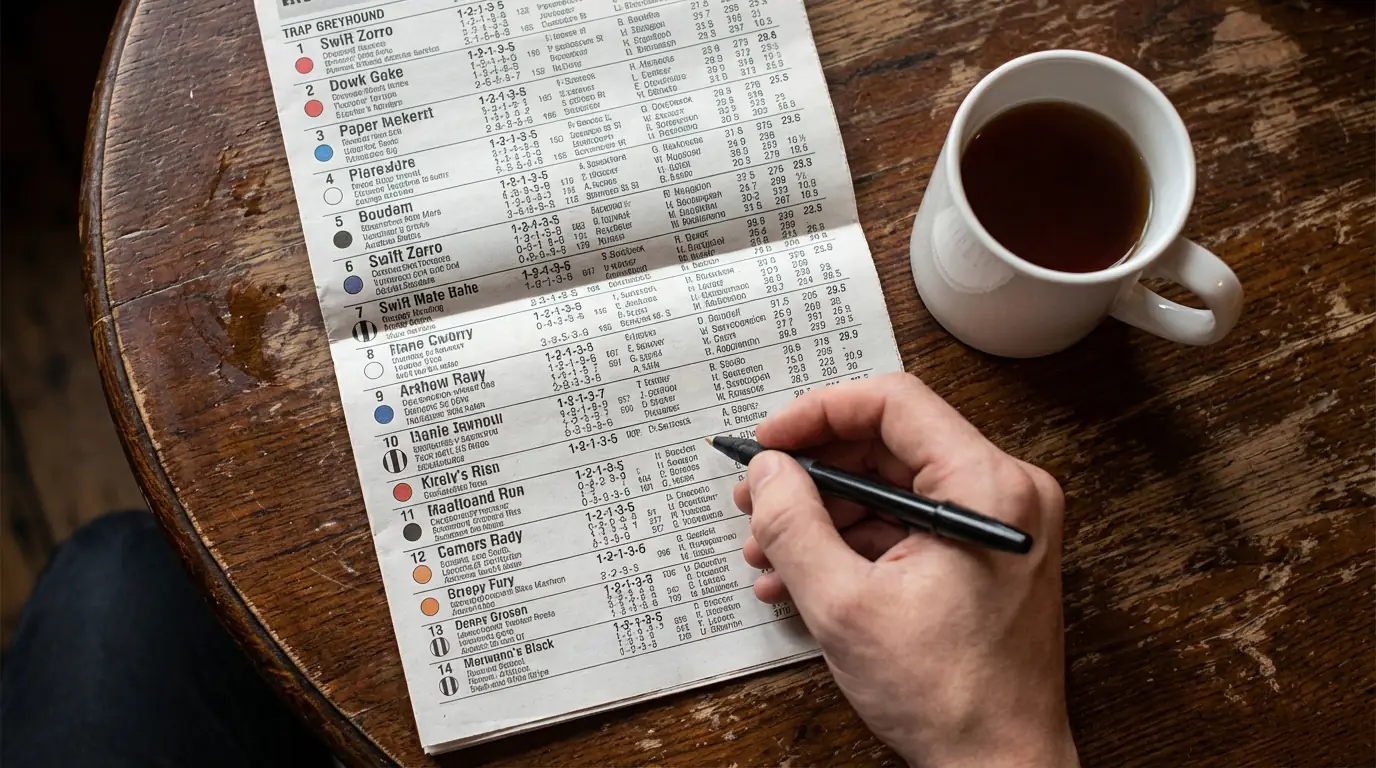
IMPORTANT: Form figures read right to left when assessing recent trends. The most recent run is always the rightmost number. A sequence of 112134 shows a dog who was winning three and four races ago but finished fourth last time out — a possible signal of declining form or simply a bad draw.
Beyond raw finishing positions, the card provides sectional times and calculated race times. Sectional times — typically measured to the first bend or at intermediate points — reveal a dog's early speed, which is one of the strongest predictors of race outcome in greyhound racing. Calculated times adjust the raw finishing time for factors like going and grade, allowing you to compare performances across different days and meetings.
Race comments and abbreviations add the final layer of narrative. These compact codes describe how a dog ran: SAw (slow away), BMP1 (bumped first bend), RLRU (railed, ran on under pressure), MSBK (mid-division, slow back). A dog that finished third but had SAw and BMP1 ran into early trouble and may well have won with a clean break. A dog that finished first but was "unchallenged" beat a weak field without pressure. Reading the comments alongside the finishing position is what separates analysis from assumption.
The professional approach is to synthesise all of this — form, sectionals, comments, draw, trainer, and weight — into a picture of each dog's likely performance in this specific race. Not yesterday's race, not a race at a different track, but today, at this distance, from this trap, against these opponents.
Form, Class, and Early Speed: Three Pillars of Selection
Strip away the noise and every greyhound selection comes down to three questions. Is the dog running well? Is it in the right grade? And can it get to the first bend in front? Form, class, and early speed are not a checklist to tick off before placing a bet. They are a decision framework — a way of thinking about a race that forces you to weigh evidence rather than follow hunches or stare at odds until a number feels right.
Form tells you what the dog has done recently. Class tells you who it has done it against. Early speed tells you whether it can do it again today, from this trap, against these particular rivals. Each pillar modifies the others. A dog in superb recent form but rising sharply in class is not the same proposition as a dog in moderate form dropping to a lower grade where it becomes the clear speed figure. And a dog with blistering early pace drawn on the wrong side of the track may as well be running in treacle.
The dog that leads at the first bend wins roughly 60% of UK graded races. Early speed is not one factor among many — it is the factor.
The sections that follow break down form assessment, grading dynamics, and the interplay between trap draw and track bias. Think of them as three lenses through which to view the same race. Used together, they turn a six-dog field into a hierarchy — and a hierarchy into a bet.
How Form and Grading Shape the Market
A dog dropping two grades after a bad draw is not necessarily worse — it might just be better hidden. That sentence encapsulates the central insight of form-and-grading analysis: the market reacts to what a dog has done, but value lives in understanding why it did it and what has changed since.
Recent form in UK greyhound racing is typically assessed over the last six runs. A string of ones and twos looks impressive until you check the grade those results were achieved in. A dog winning its last three in A6 at Nottingham is a different animal from a dog winning its last three in A2 at Romford. The grade stamps a quality benchmark on every result, and ignoring it is one of the most common mistakes in greyhound betting. When a dog wins, it is promoted to a higher grade — facing faster, more competitive opponents. When it loses, it drops, facing weaker fields. This escalator system means that every dog is constantly being tested against progressively harder or easier opposition.
The value opportunity lies in the transitions. A dog dropping in class after a couple of poor runs caused by bad draws or interference — rather than genuine decline — enters a weaker race at a longer price than its ability warrants. The market sees the form figures and prices the dog accordingly. The informed punter sees the race comments (SAw, BMP1, CrowdedWide) and recognises the finishing positions do not reflect current capability.
Seasonal patterns add another layer. Bitches can show dramatic form swings depending on their reproductive cycle, sometimes declining for weeks before physical signs are apparent. Dogs returning from a break may need two or three runs to regain race fitness. Kennelling changes — a dog moving from one trainer to another — can reset the form picture entirely, and early runs after a transfer often catch the market off guard.
The grading ladder itself runs from A1 (the highest standard of graded racing at a given track) down through A2, A3, and so on — some tracks grade as deep as A10 or A11. Open races sit outside the grading system entirely and are typically invitation-only events for the best dogs. Understanding where a dog sits on this ladder, which direction it is moving, and whether the movement reflects genuine ability or circumstantial noise is the foundation of form analysis.
Trap Draw and Track Bias: Data Over Gut Feel
Towcester Trap 1 and Romford Trap 1 are not the same bet — the geometry is different. Track bias is real, measurable, and varies significantly between venues. The punter who treats the draw as a universal factor rather than a track-specific one makes a systematic error that compounds across hundreds of bets.
Every UK greyhound track has a unique configuration: the distance from traps to the first bend, the radius of the bends, the width of the running surface, and whether the track is a standard oval or has a more pronounced shape. At a tight circuit with a short run to a sharp first bend — Romford is the classic example — inside traps have a pronounced advantage because the first bend arrives quickly and the inside path is significantly shorter. At a more galloping track with a longer run to a sweeping first bend, the inside advantage diminishes because dogs from wider draws have more time and space to find position.
You can access track-specific trap statistics through services such as Timeform, RPGTV, and the Racing Post's greyhound data platform. These show historical win percentages by trap number at each venue, broken down by distance. The data regularly confirms that some tracks heavily favour inside draws while others produce a more even distribution. More interesting are the anomalies: certain tracks at certain distances produce an outsized win rate from Trap 6, usually because the track geometry and run-up distance allow wide runners to establish position before the first bend.
Weather and going conditions add a dynamic variable. A dry, fast track generally amplifies existing biases. A wet, heavy track can shift the balance — rain-soaked sand near the inside rail often becomes deeper and more churned, which can slow inside runners and reduce the Trap 1 advantage. These shifts are temporary, but checking the going report and adjusting your trap-draw assessment accordingly provides a small, genuine edge.
The practical takeaway is simple: never assume a trap draw is inherently good or bad without checking the track. Consult the data, note the going, and overlay the specific dogs' running styles onto the specific track configuration. What looks like an advantageous draw at one venue may be neutral or detrimental at another.
Bankroll and Staking: Protecting Your Edge
You can pick winners all night and still go home broke if your staking is reckless. Staking discipline is the structural support that holds a profitable selection method together. Without it, even a genuine edge in reading form and draw will eventually be destroyed by the variance inherent in a sport where a first-bend bump can turn a certainty into fourth place.
Three staking plans dominate serious greyhound betting.
Level stakes is the simplest approach. You bet the same amount on every selection regardless of confidence. It removes the emotional variable entirely and forces your profitability to depend on selection quality and prices taken, not on your ability to calibrate conviction — which, for most punters, is unreliable.
Percentage-of-bankroll staking ties each stake to a fixed percentage of your current bankroll, typically 1-3%. A bankroll of 500 pounds at 2% means every bet is 10 pounds. After losses reduce the bankroll to 400, the stake drops to 8, automatically slowing losses during bad patches and accelerating growth during good ones.
Kelly criterion staking adjusts the stake based on both the perceived edge and the price, allocating more when the edge is larger. In theory, it maximises long-term growth. In practice, full Kelly is dangerously volatile because it relies on accurate probability estimates. Half-Kelly or quarter-Kelly smooths the variance while still weighting stakes toward stronger-perceived bets.
Greyhound racing is uniquely dangerous for bankroll management because of its frequency. A typical evening card runs 12 or more races in under three hours. The temptation to bet every race is enormous, and the punter who walks in planning two selections but bets ten has demonstrated the absence of a session limit, not enthusiasm.
Do
- Set a session loss limit before the first race — and honour it without negotiation.
- Use level stakes until you have a profitable record over at least 100 tracked bets.
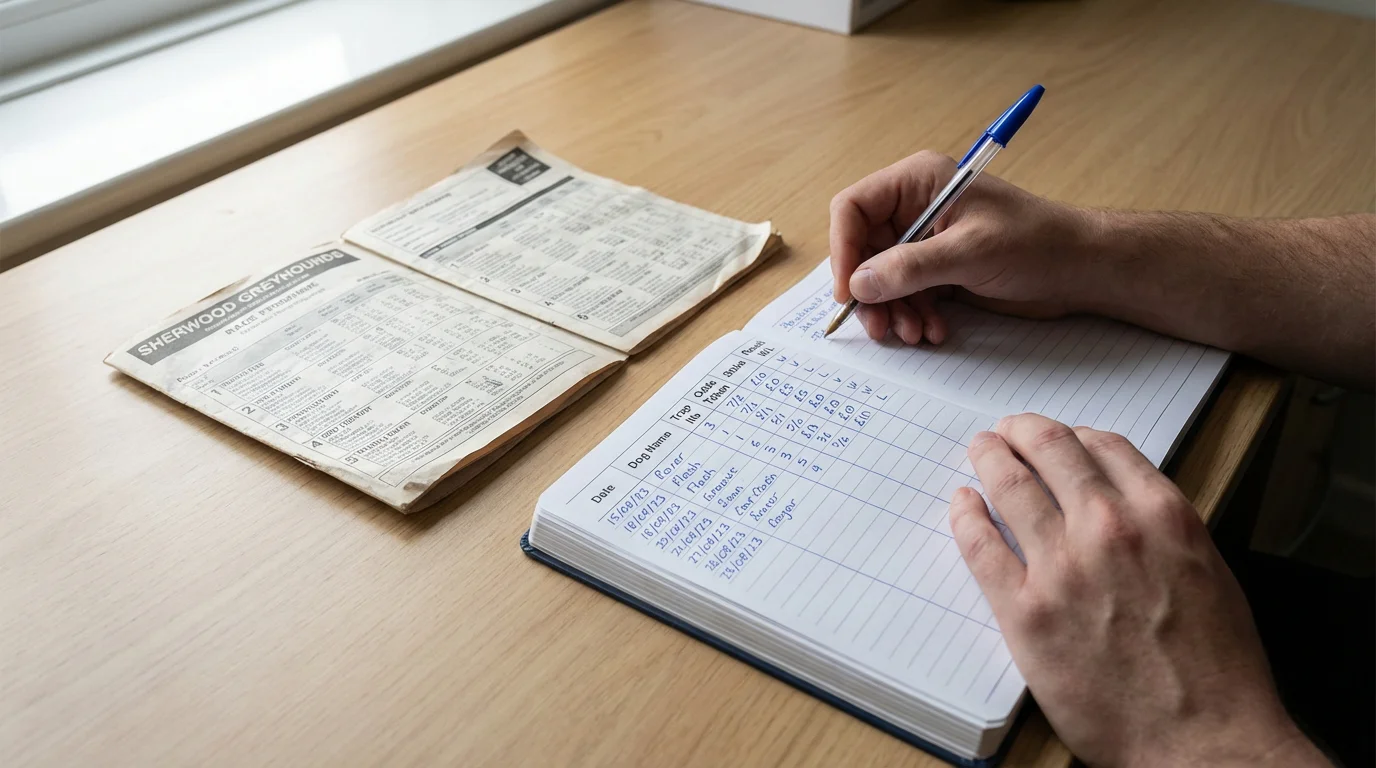
- Record every bet: selection, price taken, result, and running commentary. Without data, you are guessing about whether your method works.
- Separate your betting bankroll from your daily finances entirely.
Don't
- Chase losses by doubling stakes after a losing bet. The next race does not know or care what happened in the last one.
- Use tote or bookmaker returns from a winning bet to fund a bigger stake on the next race in the same session.
- Increase stakes because you "feel due" a winner. Variance does not operate on a schedule.
- Bet on a race simply because it is next. If your pre-race analysis does not produce a selection, the correct stake is zero.
Where the Smart Money Bets: Exchanges, Tote, and Fixed-Odds
Betfair greyhound markets are a ghost town compared to horse racing — and that tells you something about where the value sits. The three main channels for placing a greyhound bet in the UK each have distinct characteristics, and the channel you choose matters as much as the selection itself.
Fixed-odds bookmakers are the default channel for most UK greyhound punters. You request a price, the bookmaker offers one, and if you accept, your return is locked in at that figure. The advantage is certainty — you know exactly what you will receive if the dog wins. BOG adds a further layer of protection on early prices. The disadvantage is the overround: the bookmaker builds a margin into every market, meaning the combined implied probabilities of all six dogs will exceed 100%, typically by 15-20% on UK greyhound racing. You are paying for the certainty of a fixed price through a structural disadvantage in the odds.
Tote (pool) betting operates on a different model entirely. You contribute to a pool rather than agreeing a price. After the race, the total pool is divided among winning tickets, minus the tote's deduction (around 14-16% on greyhound win pools). If the crowd has piled onto the favourite, the tote dividend on outsiders will be proportionally higher than anything a bookmaker offered. On-course at a track with a small crowd and a low pool, a single outsider win can produce extraordinary returns.
Betting exchanges, primarily Betfair, let you bet against other punters rather than a bookmaker. You can back or lay a dog, and prices are set by the market — theoretically no overround, with Betfair's commission (typically 5% on net winnings) generally lower than a bookmaker's built-in margin. The problem for greyhound punters is liquidity. Betfair's greyhound markets are thinly traded. On a Tuesday afternoon BAGS meeting, you may find only a few hundred pounds matched across the entire market, making it difficult to get a meaningful stake placed at your preferred price. For major events — the English Greyhound Derby, open races at Romford or Nottingham — liquidity improves and exchange prices often represent the sharpest market view. For daily graded racing, fixed-odds bookmakers remain more practical.
In-play betting on greyhounds is theoretically possible on exchanges but practically near-impossible. A race lasts roughly 29 seconds — by the time you assess the first-bend position and attempt an in-play bet, it is over. This space belongs to automated bots, not manual punters.
Before placing a greyhound bet
- Confirm all runners and check for non-runners or reserves replacing a withdrawn dog.
- Verify the trap draw against the dog's seeding — railer in an inside trap, or wide runner stranded on the rail?
- Compare BOG availability across your bookmaker accounts; not all extend BOG to every meeting.
- Review the dog's last three runs at a similar distance, noting sectional times and race comments, not just finishing positions.
- Set your stake before opening the bet slip. Deciding the stake after seeing the price invites emotional inflation.
UK Greyhound Racing Calendar and Major Events
The English Greyhound Derby is to dogs what the Cheltenham Gold Cup is to horses — except it happens in 29 seconds. But the Derby is just the headline event in a year-round racing calendar that operates almost every day across the UK's 18 GBGB-licensed stadiums. Understanding the calendar's structure helps you identify the meetings where the strongest fields assemble, the periods where form is most reliable, and the moments where major-event odds offer a different type of betting opportunity.
Daily racing in the UK is divided into two main categories. BAGS meetings run during the day, primarily to service the off-course betting market. These are the bread-and-butter fixtures at tracks across the country — standard graded races, steady fields, and prices available through high-street bookmakers and online operators. BEGS (Bookmakers' Evening Greyhound Service) meetings serve the same function in the evening slot. The quality of fields varies by track and by day, but as a general rule, Saturday evening cards and midweek features at larger venues like Nottingham, Romford, and Towcester tend to attract stronger fields than a quiet Tuesday afternoon at a smaller circuit.
The major events represent a different world. The Star Sports Orchestrate English Greyhound Derby, which returns to Towcester for its sixth consecutive year in 2026, runs over six rounds from late April through to the final on 6 June. The competition draws 192 of the fastest dogs from across the UK and Ireland, all entered in the hope of lifting a first prize that currently stands at 125,000 pounds. The Derby format — heats, quarter-finals, semi-finals, and the six-dog final — creates a multi-week betting narrative where ante-post prices evolve as the field is whittled down. Betting on the Derby differs from standard graded racing because you are assessing a dog's ability to sustain form across multiple rounds, not just one race.
Beyond the Derby, the UK calendar features several other Category One events: the Select Stakes at Nottingham, the St Leger, the Arc Puppy Classic, and the English Oaks. The GBGB's updated Rules of Racing, effective from January 2026, now require racecourses to maintain formal homing and injury retirement policies — a regulatory development that reflects the sport's ongoing welfare commitments under the broader framework of the Welfare of Racing Greyhounds Regulations 2010 and the Animal Welfare Act 2006.
Seasonal patterns also merit attention. Spring and early summer tend to produce the most competitive racing as trainers prepare their best dogs for the major competitions. Late autumn and winter can see a dip in quality at some tracks, though the sheer volume of BAGS meetings means there is never a shortage of races to bet on. Bitches cycling in and out of season create form disruptions that are more pronounced at certain times of year, particularly spring. Punters who factor seasonal rhythms into their form analysis gain a subtle but genuine edge over those who treat every card as identical.
FAQ: UK Dog Racing Odds
How do greyhound racing odds work in the UK?
UK greyhound racing odds represent the bookmaker's assessment of each dog's chance of winning, expressed as either fractional or decimal prices. The process begins with a tissue price — an internal estimate set by the bookmaker's trader — which becomes the opening show. From that point, prices move in response to money entering the market. The starting price (SP) is the official price at the moment the traps open, determined by averaging on-course bookmaker odds. If you take an early fixed price, your bet is settled at that figure regardless of subsequent market movement. If you bet at SP, you receive whatever the market has settled on by the off. Many bookmakers offer Best Odds Guaranteed, which pays the higher of your early price or the SP — effectively the best of both worlds on qualifying meetings.
What is the best trap position in greyhound racing?
There is no universally best trap. The advantage of each position depends on the track's configuration, the run-up distance to the first bend, and the bend radius. At tight circuits with sharp bends and a short run to the first turn, inside traps (particularly Trap 1 and Trap 2) tend to produce a statistically higher win rate because the inside path is shorter and a quick break gives the dog an unobstructed rail run. At more galloping tracks with sweeping bends, the inside advantage narrows, and wider traps can perform equally well. The most important factor is whether the draw matches the dog's natural running style: a railer drawn inside is a positive, while a railer drawn in Trap 6 faces a significant disadvantage. Always check track-specific trap statistics rather than relying on generic assumptions about inside versus outside.
Is each-way betting worth it on greyhounds?
Each-way betting on greyhounds only offers genuine value when the win odds are 4/1 or above. In standard UK six-runner greyhound races, place terms are typically one quarter of the win odds for the first two places. At short prices — anything below 4/1 — the place return is so small relative to the doubled stake that it barely offsets the cost. At 2/1, for example, the place portion pays just 1/2, giving minimal protection. At 4/1 and above, the place return becomes meaningful enough to provide a genuine cushion when your dog finishes second. Each-way works best in open, competitive races where several dogs have a realistic chance of finishing in the first two, rather than in races dominated by a short-priced favourite.
The Final Bend: What the Odds Won't Tell You
Every race card is a promise of certainty. Every first bend is a reminder that it lied.
You can master the tissue price, decode the form figures, memorise every jacket colour and trap tendency, calculate implied probabilities to the second decimal place, and still find yourself watching a 12/1 outsider lead from trap to line while your carefully selected favourite gets bumped at the first bend and trails in fourth. That is not a failure of method. It is the nature of the product. Greyhound racing compresses uncertainty into 29 seconds of action, and no amount of analysis eliminates the variables that live in those seconds — the trap that swings a fraction late, the dog that finds an extra gear on the run-in, the moment of crowding at the first turn that rearranges the entire field.
The best punters do not fight this uncertainty. They price it. They understand that a 20% edge means winning one extra time in five, not winning every bet. They accept that losing runs of eight or ten bets are statistically inevitable. They know that emotional discipline is harder than intellectual analysis. And they accept that a good bet and a winning bet are not always the same thing.
The odds will tell you what the market believes. Your job is to decide, calmly and with evidence, where the market is wrong — and to bet accordingly, within limits you have set before the first race begins. The rest is the sport. And the sport, for all its data and structure and commercial machinery, remains six dogs chasing a mechanical hare around an oval of sand, with the outcome genuinely in doubt until the moment one of them crosses the line.
Bet with what you can afford to learn with, not just lose. That is the rule that sits above every strategy, every staking plan, and every selection framework in this guide. If you are learning — about odds, about form, about yourself as a punter — the money is well spent. If you are not, the money is just gone.
