

From Tissue to Show: How a Greyhound Market Is Built
Every set of greyhound odds begins with one person: the handicapper. Before a race is offered for betting, a bookmaker’s odds compiler — or an independent handicapper whose assessments the bookmaker subscribes to — analyses the field and produces a tissue price. The tissue is the compiler’s private assessment of each dog’s chance, expressed as a set of odds. It is not published. It is not offered to the public. It is the internal starting point from which the public market is constructed. Find more odds guides at dogracingoddsuk.
The tissue is built from the same data available to any punter: form figures, race comments, grading, trap draw, track record, and trainer form. The difference is speed and routine. Professional handicappers assess dozens of races per day, and they work from standardised models that weight these factors according to historical performance data. A typical greyhound tissue price is generated in a few minutes per race, drawing on a database of past results, time comparisons, and draw statistics that the compiler has refined over years of practice.
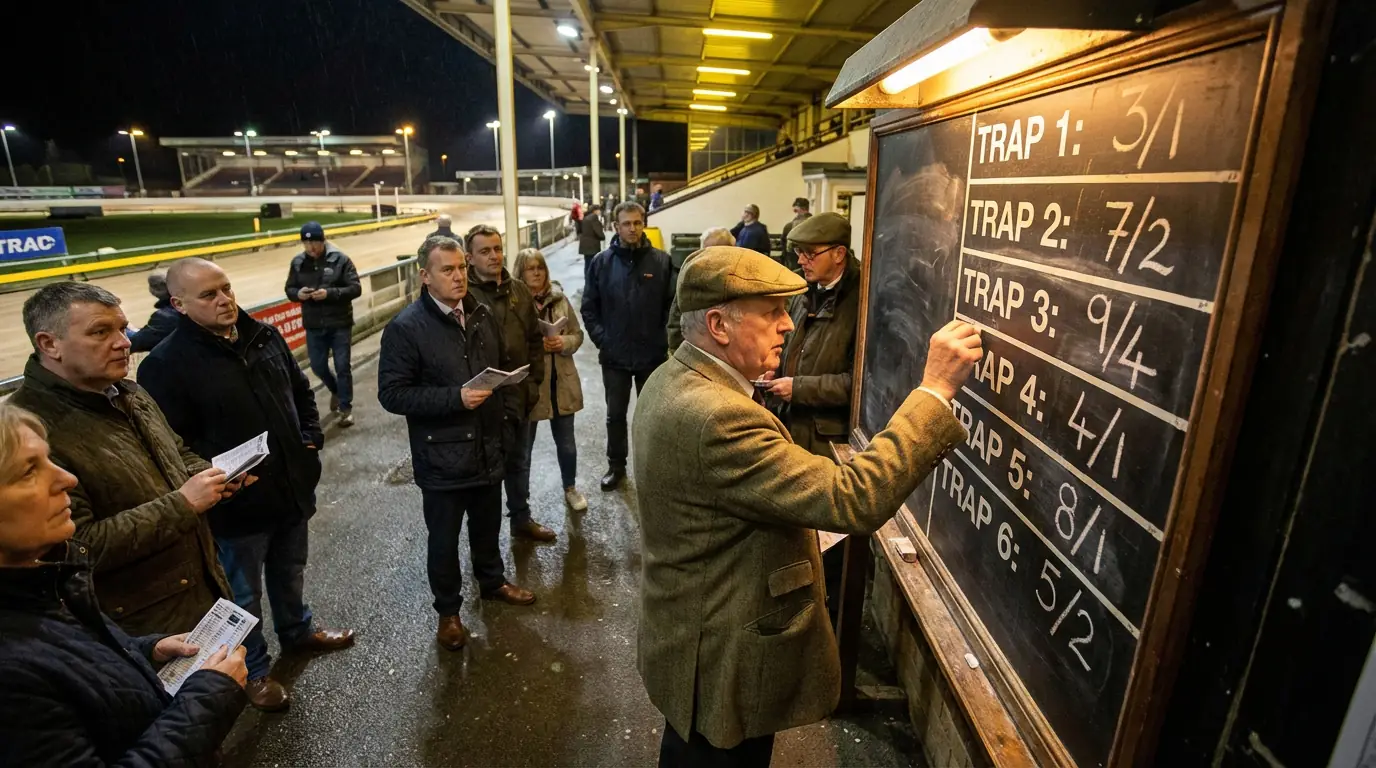
From the tissue, the bookmaker constructs the opening show — the first set of public odds displayed for the race. The opening show is not identical to the tissue. The bookmaker adjusts the tissue prices to build in the overround — the profit margin — and to account for expected market behaviour. If the tissue rates a dog at a true 3/1 chance, the opening show might price it at 5/2, shaving half a point to create margin. Across all six dogs, these adjustments produce a book that sums to more than one hundred percent implied probability, with the excess representing the bookmaker’s theoretical edge.
The size of the overround varies by bookmaker, by meeting, and by the competitive dynamics of the betting market. Major evening meetings with heavy betting volume tend to carry lower overrounds because competition between bookmakers forces tighter margins. Quiet afternoon BAGS meetings with lower public interest carry higher overrounds because there is less competitive pressure to offer generous prices. As a general figure, the overround on a UK greyhound race sits between fifteen and twenty-five percent, compared to eight to fifteen percent for a comparable horse race.
One detail that surprises many punters: the opening show is not the same across all bookmakers. Each operator builds their market from their own tissue (or a shared industry tissue that they adjust independently), applies their own margin policy, and accounts for their own anticipated liabilities. The result is that opening prices for the same dog in the same race can differ by a full point or more between bookmakers. This variance is the origin of line shopping — comparing prices across operators to find the best available number — which is one of the simplest and most effective habits a greyhound punter can develop.
Market Reaction: How Bets Shape the Final Price
The opening show is where the market begins. What happens next is determined by money — specifically, by where the punting public, the professional bettors, and the bookmakers’ own risk management systems direct the flow of stakes.
When money arrives on a specific dog, the bookmaker shortens its price. This is not a reaction to information — the bookmaker does not know why the money is coming in. It is a risk management response: the liability on that dog is growing, and shortening the price reduces the potential payout while simultaneously lengthening the prices on the other runners, making them more attractive to balance the book. The process is largely automated in the modern online market, with algorithms adjusting prices in response to the volume and velocity of incoming bets.
A steamer is a dog attracting sustained, heavy backing that drives its price significantly shorter than the opening show. A dog that opens at 5/1 and is backed down to 3/1 before the off is steaming. The causes can vary: inside knowledge from connections, a well-publicised tip, a trial time that circulates among sharp bettors, or simply a consensus view forming among the public that the dog represents value at the opening price. Steamers do win more often than their opening price suggests — the market movement is, on average, informationally accurate — but they also attract a bandwagon effect where later backers are getting a much worse price than the early movers.
A drifter is the opposite: a dog whose price lengthens as the market decides it is less likely to win than the opening show suggested. Money that might have gone on the drifter flows elsewhere, and the bookmaker responds by pushing its price out. Drifters are informative in a negative sense — sustained drift usually indicates that knowledgeable money is going elsewhere — but they are not reliable oppositions. A dog can drift from 3/1 to 5/1 and still win if the drift was caused by money moving to a rival that ultimately underperforms.
The final price — the SP — is determined by the on-course bookmakers’ boards at the moment the traps open. The online market feeds into this process indirectly: on-course bookmakers are aware of the online market’s prices and adjust their own positions accordingly, though the on-course ring has its own dynamics driven by the smaller pool of money wagered at the track. The SP can differ from the last online price by a meaningful margin, particularly at meetings with a thin on-course ring.
For the punter, the practical implication is clear: the price you take matters as much as the dog you back. The same selection at 4/1 and at 3/1 has the same probability of winning but a dramatically different expected return. Monitoring market movements, taking early prices when you expect shortening, and comparing prices across bookmakers before committing are not advanced techniques — they are fundamental practices that separate the serious greyhound bettor from the casual one.
The House Always Has an Edge — But You Can Narrow It
Understanding how bookmakers set greyhound odds is the first step to exploiting the process — or, more precisely, to identifying the moments when the process produces prices that are wrong. The bookmaker’s pricing is good. It is not perfect. And the imperfections tend to cluster in predictable places.
The overround is the bookmaker’s primary structural advantage, and you cannot eliminate it. But you can reduce its impact. Line shopping — comparing prices across three or four bookmakers for every bet — captures an extra half-point or full point of odds frequently enough to materially improve your returns over a season. Using Best Odds Guaranteed where available further reduces the effective margin by ensuring you always receive the better of your taken price and the SP.
The tissue is the bookmaker’s starting assessment, and it is most likely to be wrong in situations where the standard data inputs do not capture the full picture. Class drops where the form figures look bad but the context is favourable, track switches where a dog’s venue-specific form is not reflected in its recent results, and trainer form runs that have not yet been priced into individual selections — these are the situations where the tissue underweights relevant information and the opening show carries a mispricing into the public market.
Market reaction amplifies some mispricings and corrects others. A steamer on a dog that the tissue already rated accurately will compress the price below its true value, creating negative value for late backers and potential value on the other runners in the field whose prices have drifted in response. Conversely, a drifter that the tissue overrated may reach a point where the lengthened price exceeds the dog’s true chance, creating value for the contrarian punter willing to back against the market flow. Also read our how greyhound betting odds work.
The bookmaker is not your adversary in a personal sense. It is a pricing mechanism with a built-in margin, and your task is to identify the moments when that mechanism produces a price that is wrong in your favour. The process is transparent if you know how to read it: the tissue sets the starting point, money moves the market, and the final price reflects the sum of all those forces. The punter who understands each step of this process does not need inside information. They need the discipline to compare prices, the knowledge to spot mispriced situations, and the patience to act only when the edge is real.