
What Happens When a Dog Is Withdrawn
A non-runner in greyhound racing disrupts the race in ways that extend far beyond an empty trap. When a dog is withdrawn before the off — due to injury, illness, being in season, or failing the pre-race veterinary inspection — the race is restructured. The remaining field drops to five runners, and the rules governing how bets are settled change depending on when the withdrawal occurred and whether a reserve runner replaces the absent dog. Find more betting rules at dogracingoddsuk.
At most UK greyhound tracks, a reserve dog is listed for each race precisely for this eventuality. If a runner is withdrawn before a certain deadline — typically before the final declarations or weigh-in — the reserve takes its place, inheriting the vacant trap number and wearing the corresponding jacket colour. From a betting perspective, if the reserve replaces the non-runner before the market has opened, the race proceeds as a standard six-dog field and existing bets on the withdrawn dog are void and stakes refunded.
When a replacement is not available, or when the withdrawal occurs too close to the off for a reserve to be introduced, the race runs with five dogs. This is where the settlement rules become important. If you backed the withdrawn dog, your bet is void and your stake is returned — straightforward enough. But if you backed one of the remaining dogs, your bet stands and is subject to a Rule 4 deduction.
Rule 4, formally Tattersalls Rule 4(c), is a deduction applied to winning bets to compensate for the absence of a runner whose withdrawal has shortened the odds on the remaining field. The deduction is calculated based on the price of the withdrawn dog at the time of withdrawal. If the non-runner was the 2/1 favourite, the Rule 4 deduction is thirty pence in the pound — a thirty percent reduction in your winnings. If the non-runner was an 8/1 outsider, the deduction is ten pence in the pound. The shorter the price of the withdrawn dog, the larger the deduction applied to your winnings.
The deduction scale is standardised. At odds of 1/9 or shorter, the deduction is ninety pence in the pound. At 2/5 to 1/3, it is seventy pence. At evens to 6/5, it is forty-five. At 9/2 to 11/2, it drops to fifteen. At 10/1 to 14/1, it is five pence. And at longer than 14/1, no deduction is made. These deductions apply to the profit portion of your return, not the full payout. Your stake is returned in full; only the winnings are reduced.
For each-way bets on remaining runners, the Rule 4 deduction applies to both the win and place portions separately. Forecast and tricast bets in a five-dog race are typically settled at a reduced-field dividend, calculated by the computer using the SPs of the remaining runners. The dividend is usually lower than it would have been in a six-dog race, reflecting the reduced number of permutations.
How Non-Runners Reshape the Market
The withdrawal of a single dog does not just remove one option — it reconfigures the entire competitive picture. When a runner is withdrawn, the remaining five dogs are running in a different race from the one the market originally priced. A non-runner changes the dynamics of the first bend, alters the trap draw implications, and shifts the relative chances of every other dog in the field.
The most significant reshaping occurs when the withdrawn dog was the market favourite or one of the leading contenders. The favourite’s absence removes the dog that was expected to lead or dominate, and the remaining field is suddenly more open. Prices on the other runners shorten to fill the probability gap, but the adjustment is not always efficient. Bookmakers recalculate the odds quickly, but the speed of the adjustment does not guarantee accuracy — the new prices are estimates based on the old market with one runner removed, not a fresh assessment of the revised race.
This is where opportunities arise. When a strong early-pace dog is withdrawn, the first-bend picture changes entirely. A dog that was expected to be crowded at the first bend by the non-runner now has a clear run. A dog in a neighbouring trap that was going to be squeezed for room suddenly inherits space. These positional effects are not always reflected in the repriced market, because the price adjustments are typically mechanical — based on the non-runner’s odds — rather than analytical, based on the specific race dynamics the withdrawal creates.
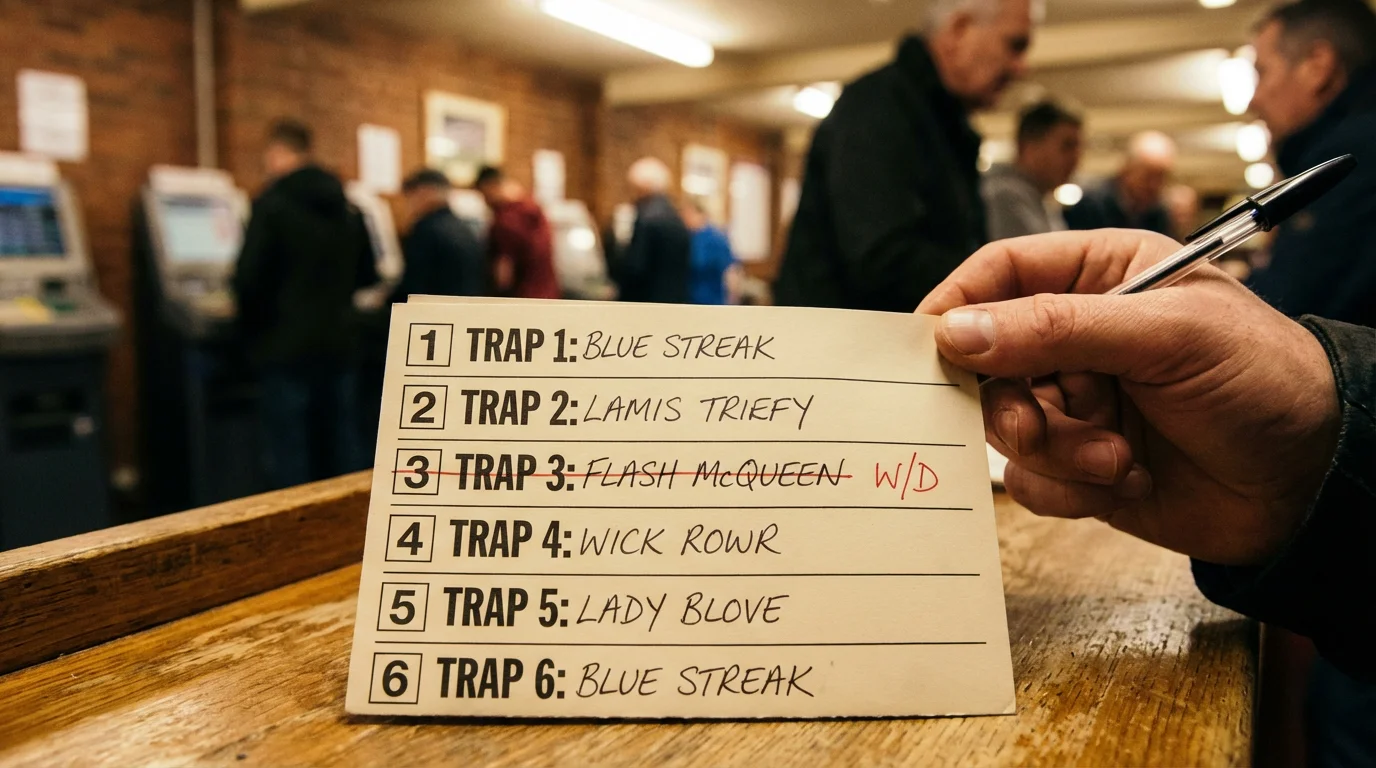
The draw implications are particularly acute. In a standard six-dog race, if the trap 3 runner is withdrawn, traps 2 and 4 benefit from additional room at the first bend. Trap 1 and 2 runners are no longer crowded from the middle, and trap 4 through 6 runners face less competition for the outside line. If the withdrawn dog was a fast breaker seeded as a middle runner, its absence removes a source of first-bend congestion that was suppressing the chances of its immediate neighbours.
The punter who reacts to a non-runner by re-evaluating the race from scratch — rather than simply accepting the repriced odds — has an edge. Check the withdrawn dog’s running style. Was it a railer, a middle, or a wide runner? Which remaining dogs benefit from the freed space? Which dogs were expecting to use the non-runner as a pace reference and now face a different tactical picture? The answers to these questions are not embedded in the repriced odds. They require the same race-reading skills you apply to a full six-dog field, but with the additional advantage that the market has already set a price before accounting for the full implications.
Turning Disruption Into Opportunity
Non-runners are a disruption, and disruption is where inefficiency lives. Most punters react to a non-runner with annoyance — particularly if they backed the withdrawn dog and now have a void bet and a disrupted plan. The sharper response is to treat every non-runner as a prompt to reassess the race with fresh eyes.
The practical workflow is quick. When a non-runner is announced, immediately identify the withdrawn dog’s running style and trap position. Then mentally re-draw the first-bend picture: who leads now, who has space, who is suddenly crowded or freed. Compare your revised assessment against the repriced market. If you see a dog whose chance has improved more than the new price reflects, you have a value bet created by the disruption itself.
These opportunities have a short window. The market adjusts, other punters recalculate, and the prices move towards a new equilibrium. On-course, this window might last two or three minutes. Online, it can be even shorter as automated systems and sharp bettors react quickly. The punter who has a standing framework for assessing non-runner impact — who understands draw effects and first-bend dynamics instinctively — can act in this window while others are still processing the news.
The Rule 4 deduction reduces the potential return on any bet placed before the withdrawal. If you already have a bet on a remaining runner and the favourite is withdrawn, you will receive your winnings minus the applicable deduction. There is nothing you can do about this after the fact. But if you are placing a new bet after the withdrawal has been announced, the Rule 4 does not apply — you are betting into a five-dog race at the repriced odds, and the full return on those odds is yours if the dog wins. Also read our dead heats in greyhound racing.
Non-runners are an unavoidable feature of greyhound racing. They are frustrating when they void your bet and inconvenient when they reduce your payout via Rule 4. But for the punter who approaches them analytically rather than emotionally, they are also one of the most reliable sources of short-term market inefficiency in the sport. The race changes. The question is whether you change your analysis with it.