How Trap Draws Are Allocated in UK Graded Racing
The draw isn’t luck — it’s a structured allocation based on how each dog runs. In UK graded greyhound racing, the trap position each dog starts from is determined by a seeding system managed by the track’s racing manager under Greyhound Board of Great Britain regulations. Every greyhound is classified according to its preferred running line: railer, middle, or wide. These classifications dictate which traps the dog is eligible to be drawn in, and the draw itself follows a formal procedure designed to match each dog’s running style with an appropriate starting position. Get more race analysis at dogracingoddsuk.
Railers — dogs that naturally hug the inside rail — are allocated the lowest-numbered traps, typically 1 and 2. Middle runners, who favour the central part of the track, are drawn into traps 3 and 4. Wide runners, who prefer the outside, are assigned traps 5 and 6. Within each pair, the specific trap is then drawn by the racing manager. The result is a field where every dog starts from a position that broadly aligns with its natural racing line, reducing the probability of interference at the first bend.
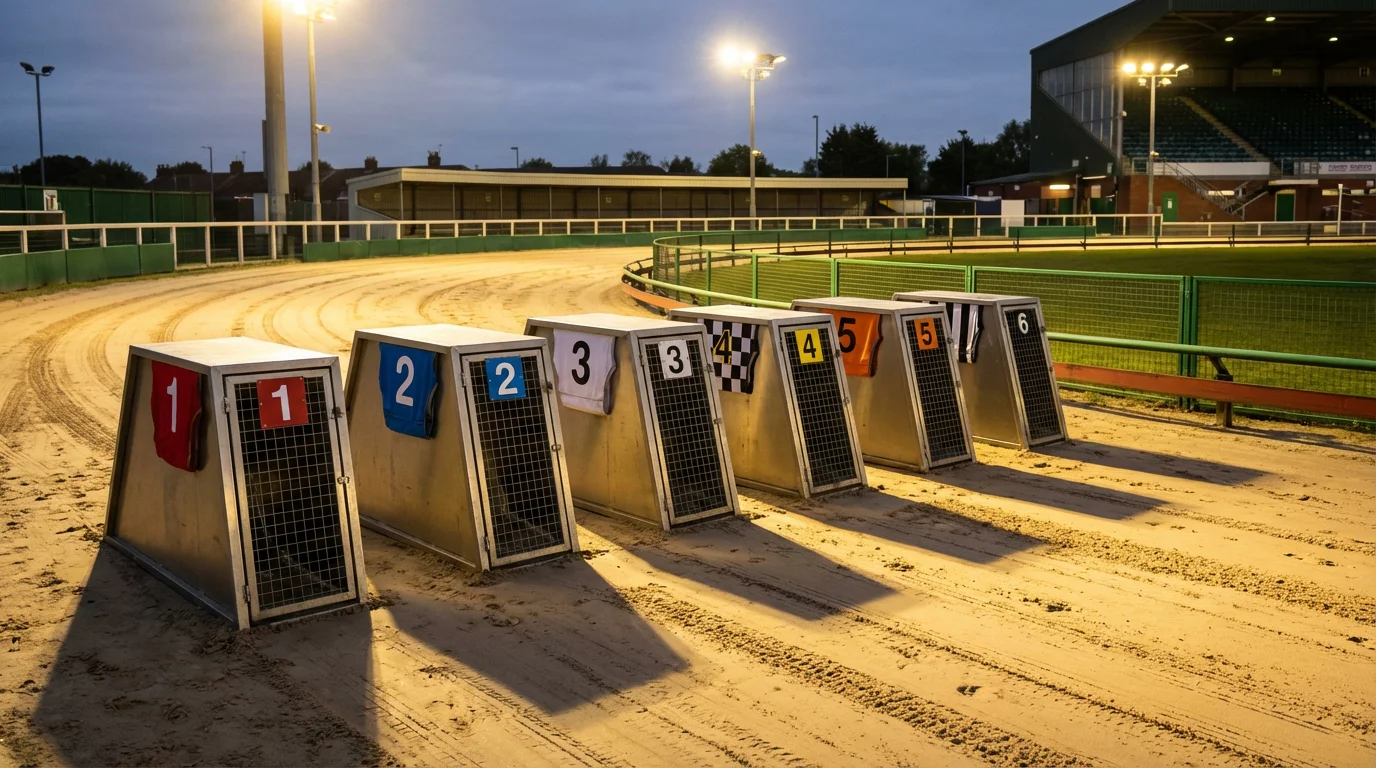
The jacket colour system provides immediate identification during the race. Trap 1 wears red, Trap 2 blue, Trap 3 white, Trap 4 black, Trap 5 orange, and Trap 6 the distinctive black and white stripes. These colours are standardised across all GBGB-licensed tracks in the UK and have remained unchanged for decades. For the punter watching the race unfold — whether trackside, on a stream, or via a results service — the colours are the visual shorthand for tracking which dog is where at every point on the circuit.
Open races follow a different procedure. In OR events, the draw is conducted under the GBGB’s equal distribution rules, which aim to spread railers, middles, and wides across the heats as evenly as possible. Because open races attract higher-quality fields, the draw in these events carries even greater weight — a small positional advantage can be decisive when the margins between dogs are razor-thin.
Understanding this allocation system is the starting point for analysing any race. A dog drawn in its preferred position is running with the geometry of the track in its favour. A dog drawn against its natural line is fighting the draw from the moment the traps open. That distinction shapes the race before a single stride is taken.
Inside vs Outside: Statistical Edge by Trap
Trap 1 has a reputation, but the data is more nuanced than the cliche. The conventional wisdom in greyhound racing is that inside traps — particularly trap 1 — hold a statistical advantage. There is truth in this, but the picture varies dramatically depending on the track, the distance, and the quality of the field.
On tight, short-circumference tracks like Romford and Crayford, inside traps do produce a higher percentage of winners. The geometry favours it. The inside rail offers the shortest path to the first bend, and a dog that breaks cleanly from trap 1 can establish a rail position that is physically difficult for wider-drawn dogs to overcome without interference. On these tracks, the trap 1 win rate over a large sample typically sits between twenty and twenty-five percent — meaningfully above the random expectation of roughly seventeen percent in a six-dog race.
Wider tracks tell a different story. At venues like Nottingham, where the bends are more sweeping and the running surface gives wider-drawn dogs more room to find their stride, the inside trap advantage diminishes or disappears entirely. At some wide-track venues, traps 5 and 6 win as frequently as trap 1, because the wider draw allows the dog to avoid first-bend crowding and run its natural race without interference.
The statistics are further complicated by the seeding system itself. Because railers are drawn inside and wides are drawn outside, the trap win rates do not just reflect positional advantage — they also reflect the quality and style of the dogs assigned to each position. A high win rate for trap 1 might partly be a function of strong railers being concentrated there, not solely a geometric benefit.
The practical application for punters is to avoid blanket assumptions about trap advantage and instead build track-specific knowledge. If you specialise in two or three tracks — a strategy most profitable greyhound punters eventually adopt — you develop an intuitive sense of which positions consistently outperform at each venue. That granular knowledge, layered on top of form and class analysis, produces selections that the broader market, which tends to apply generic trap bias, frequently misprices.
When the Draw Overrides Everything Else
A good dog in the wrong trap is a bad bet. There are races where the draw is the dominant factor — more important than recent form, class, or even early speed. Recognising these situations before the market fully adjusts is one of the most reliable edges in greyhound betting.
The most common draw disaster is a wide runner drawn inside. When a dog that naturally veers towards the outside of the track is placed in trap 1 or 2, it faces a mechanical problem at the first bend. Its instinct is to move wide, but the dogs drawn in traps 3 through 6 are already occupying that space. The wide runner either gets boxed in on the rail — running a line it hates — or attempts to move out through traffic, losing lengths and increasing the risk of interference. Either outcome dramatically reduces its winning chance, regardless of how impressive its recent form looks.
The mirror image — a railer drawn in trap 5 or 6 — is equally problematic. A dog that wants to be on the inside rail has to cross the path of four or five other dogs to get there. In the few seconds between the traps opening and the field reaching the first bend, that crossing manoeuvre creates chaos for the railer and for every dog it cuts across. The form book might show five consecutive wins, but if those wins all came from trap 1 or 2 and the dog is now drawn in 6, the market should price it accordingly. Sometimes it does not.
Draw mismatches become even more pronounced in open races where the draw is randomised rather than seeded. In OR events, a railer can legitimately end up in trap 6 through the luck of the draw. These are the situations where alert punters find value on the other side: the dog correctly drawn in trap 1 might drift in the market because its form looks modest, but with the strongest railer in the field drawn out of position, the path to the first bend is suddenly clearer than the price suggests.
The rule of thumb: when you see a dog drawn against its seeding — a railer outside or a wide runner inside — apply a significant discount to its chance, regardless of what the form figures suggest. And when you see its rivals benefiting from the resulting disruption, consider whether the market has fully priced in that advantage. Often, it has not.
Reading the Draw Like a Handicapper
Before the traps open, the draw has already written the first bend. The skill of draw reading is not about identifying which trap has the best historical win rate at a venue. It is about constructing a mental picture of how the first bend will unfold in a specific race, with specific dogs, drawn in specific positions.
Start with early speed. Identify which dogs are likely to break fastest from the traps — the race card’s sectional times and comments tell you this. QAw, EP, and Led1 are your markers. Then map those dogs onto their trap positions. If the two quickest breakers are drawn in traps 1 and 2, the inside rail is likely contested and the first bend could be messy for those dogs. If the quickest breaker is in trap 6 and the inside traps hold slow beginners, the wide runner has a clear run to the first bend with no interference from inside.
Next, consider running lines. A race where three railers are drawn inside and three wides are drawn outside will flow relatively smoothly through the first bend — each dog runs its preferred line without crossing another. A race where the seedings are jumbled — railers outside, wides inside — is a crowding risk from the first stride. These messy configurations produce more interference, more unpredictable results, and typically better forecast and tricast dividends because the finishing order is harder for the market to anticipate.
The final layer is track and distance context. A tight circuit amplifies draw effects; a wide, galloping track mutes them. A sprint race gives dogs less time to recover from a bad start or a first-bend check; a staying race allows closers to make up lost ground over the additional distance. The draw is not destiny, but it sets the parameters within which everything else unfolds. Also read our greyhound sectional times explained.
The punter who reads the draw as a narrative — not just a number — sees opportunities the odds have not reflected. A mismatch here, a clear run there, a crowding risk that the market has overlooked. The draw does not guarantee outcomes. But it is the opening chapter of every greyhound race, and the punter who reads it carefully enters the next chapter better prepared than the one who skipped it.