

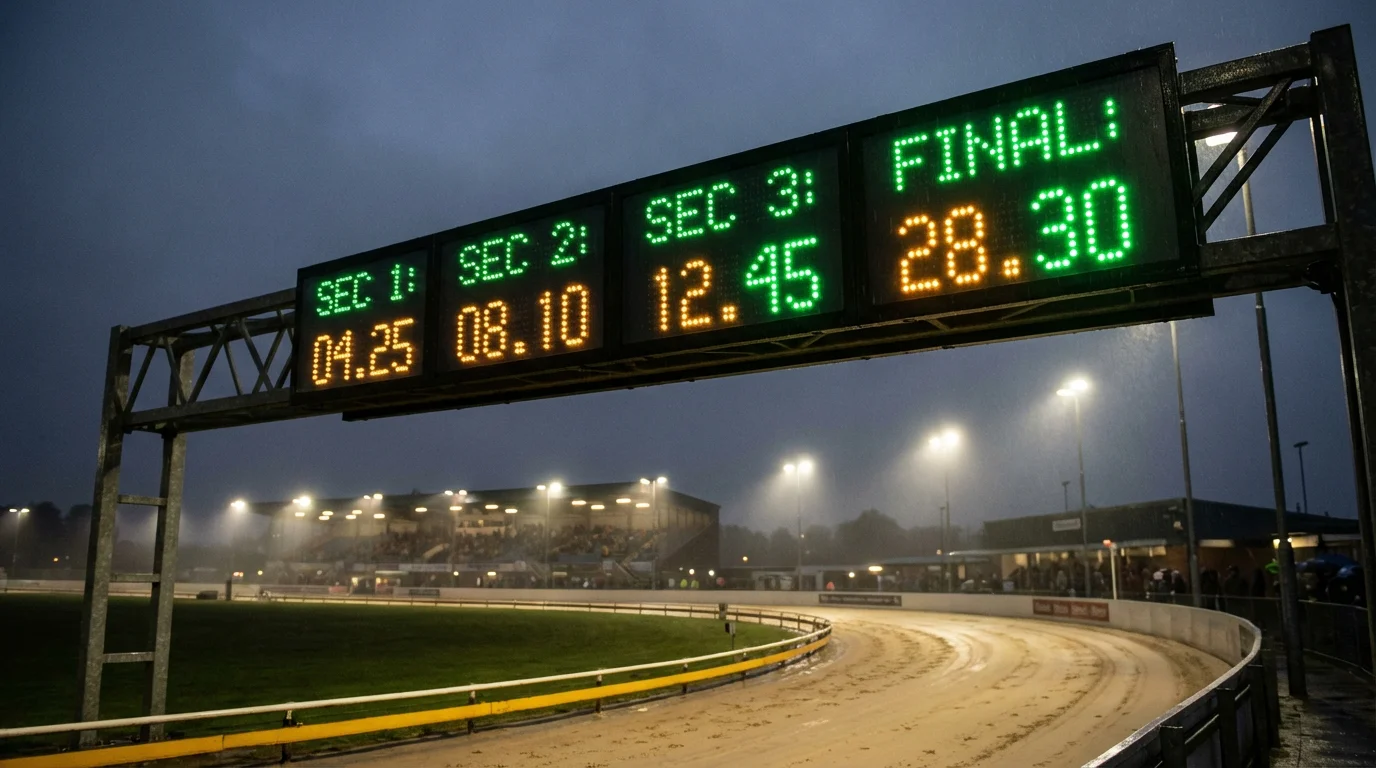
What Sectional Times Measure
A finishing time tells you how fast a dog ran. Sectional times tell you how it ran — and that distinction is where the analytical edge lives. A greyhound’s overall race time is the most commonly cited speed metric, but it is also the least informative. Two dogs can record identical finishing times while running completely different races: one leading from the traps and hanging on through the final bend, the other starting slowly, recovering through mid-race, and finishing with a burst. The finishing time treats both as equivalent. Sectional times reveal the truth the aggregate number conceals. Get more race analysis at dogracingoddsuk.
Sectional times divide the race into segments, each measured by timing equipment positioned at fixed points around the track. The most common sectional breakdown at UK tracks records three segments: the run to the first bend (sometimes called the run-up or first sectional), the middle section covering the bends, and the closing sectional from the final bend to the finishing line. Some tracks and data providers offer more granular splits — bend-by-bend timings — though the availability of this detail varies by venue and by the data service you use.
The first sectional — trap release to the first bend — is the most valuable for betting purposes. It measures a dog’s early speed in isolation, stripped of the interference, crowding, and positional jockeying that affect the later stages of the race. A dog that consistently records fast first sectionals is a genuine early-pace runner, regardless of what its finishing position might suggest. The finishing position can be distorted by trouble on the bends. The first sectional cannot be distorted by anything except the dog’s own speed out of the traps.
The closing sectional — final bend to the line — measures finishing speed. A fast closing sectional indicates a dog that is either accelerating through the final phase (a closer running on) or maintaining speed that the rest of the field has lost (a leader holding form). Interpreting the closing sectional requires context: a fast close from a dog that was mid-division all race is a sign of strong sustained pace. A fast close from a dog that was last and still finished last just means it ran quickly while losing.
The middle section is the most difficult to interpret because it is influenced by positioning, bend geometry, and interference. A dog running wide through the bends covers more ground and records a slower middle sectional than a dog on the rail — even if both dogs are running at identical speed. Mid-race sectionals are useful for identifying dogs that were checked or impeded (a sudden spike in the sectional time for a specific bend), but they are less reliable as standalone indicators of quality than the first and closing sectionals.
Using Sectional Data to Predict Race Pace
Sectional times are the most precise tool available for predicting how a race will unfold. While race comments tell you whether a dog showed early pace (QAw, EP) or finished strongly (RnOn, FinWl), sectional times quantify those qualities with numbers you can compare directly across dogs in the same field.
The primary application is first-bend prediction. Pull the first-sectional times for all six dogs from their recent races at the same track and distance. The dog with the consistently fastest first sectional is the most likely leader to the first bend. If two dogs show similar first sectionals — say 3.88 and 3.90 seconds — they are likely to contest the lead, creating a first-bend battle that may produce interference for both. If one dog’s first sectional is noticeably faster than the rest — 3.82 against a field of 3.95 to 4.05 — it will probably lead by a margin, avoiding crowding and establishing an uncontested advantage.
The second application is identifying closers with genuine finishing ability rather than dogs that merely run on into tired opponents. Compare the closing sectionals. A dog that records a fast closing sectional when the pace was strong throughout the race — meaning the other dogs were also running fast — is a higher-quality closer than one that records a similar closing sectional in a race where the early pace was slow and the leaders were already fading. The same numerical value has different meaning depending on the context of the overall pace.
Combining first and closing sectionals produces a pace profile for each dog. A fast-first, slow-close dog is a front-runner that fades if not left alone. A slow-first, fast-close dog is a closer that needs trouble ahead to get into the race. A fast-first, fast-close dog is the complete package — rare, and usually the class act of the field. The betting value often lies in identifying the dog whose pace profile best fits the likely race scenario. If the race is full of front-runners, the closers benefit from the early-pace battle. If only one dog shows genuine early speed, it should lead uncontested and the closing pace of the field becomes less relevant.
One important caution: sectional times must be compared within the same track and distance. A first sectional of 3.90 seconds at Romford over 400 metres is not comparable to 3.90 at Nottingham over 500 metres because the run-up distance, bend angle, and track surface are all different. Cross-track comparisons using raw sectionals are meaningless. If a dog is switching tracks, you need to assess its sectional profile in relative terms — was it the fastest in its field, or the slowest — rather than comparing the absolute numbers against dogs at a different venue.
Raw Times vs Adjusted Times: The Comparison Trap
The most common mistake in greyhound time analysis is treating raw times as universal benchmarks. A finishing time of 29.40 seconds sounds fast. But 29.40 at a track running on a slow surface in wet conditions is a completely different performance from 29.40 on a fast surface in dry weather. The raw number is identical. The effort required to produce it is not.
Going — the condition of the track surface — is the largest variable affecting raw times. A sandy track running on its normal surface in dry conditions will produce times approximately half a second to a full second faster than the same track after heavy rain. This variation means that a dog recording 29.80 on a slow surface might be running at a level equivalent to 29.20 on a fast surface. Without adjusting for the going, you would conclude the dog is slow. With the adjustment, you recognise it produced a strong performance that the raw number obscures.
Some data services and racing publications provide adjusted or calculated times that account for the going. These adjusted figures attempt to standardise performances to a common baseline, allowing more meaningful comparisons between dogs that raced on different days and in different conditions. Where available, adjusted times are significantly more useful than raw times for cross-meeting comparisons.
Even with adjustments, comparing times across different tracks remains problematic. Each venue has a unique circuit — different bend radii, different lengths of straight, different surface compositions — and these physical differences mean that two tracks producing apparently similar times may be testing fundamentally different qualities in the dogs. A 29.50 at a tight, fast-bending track is produced by early speed and cornering ability. A 29.50 at a wide, galloping track is produced by sustained stride length and stamina. The dogs that achieve those times may have entirely different skill sets.
The practical lesson for the punter is to use times as a within-track tool and treat cross-track comparisons with deep scepticism. When assessing a dog at its home track, compare its recent times to those of the other dogs in today’s race at the same venue. Are its times improving, declining, or consistent? How do they rank against the field? That relative assessment is reliable. When a dog switches tracks, discard the times entirely and focus on other indicators — form figures, race comments, class, and draw — until it has enough runs at the new venue to establish a meaningful time baseline. Also read our early speed in greyhound racing.
Sectional times are the richest data source available in greyhound racing for the punter willing to work with numbers. They reveal pace profiles the market ignores, predict first-bend scenarios the form figures only hint at, and expose performances that raw finishing times conceal. But they are only useful if handled with respect for their limitations. Times are measured on specific tracks, in specific conditions, on specific days. Taken in context, they are powerful. Taken out of context, they are noise dressed as precision.