
The First-Bend Statistic Every Punter Should Know
More than half of all graded UK greyhound races are over by the first bend. That is not rhetoric — it is the single most important statistical reality in dog racing, and it should reshape how you assess every race card, evaluate every form figure, and structure every bet. Get more race analysis at dogracingoddsuk.
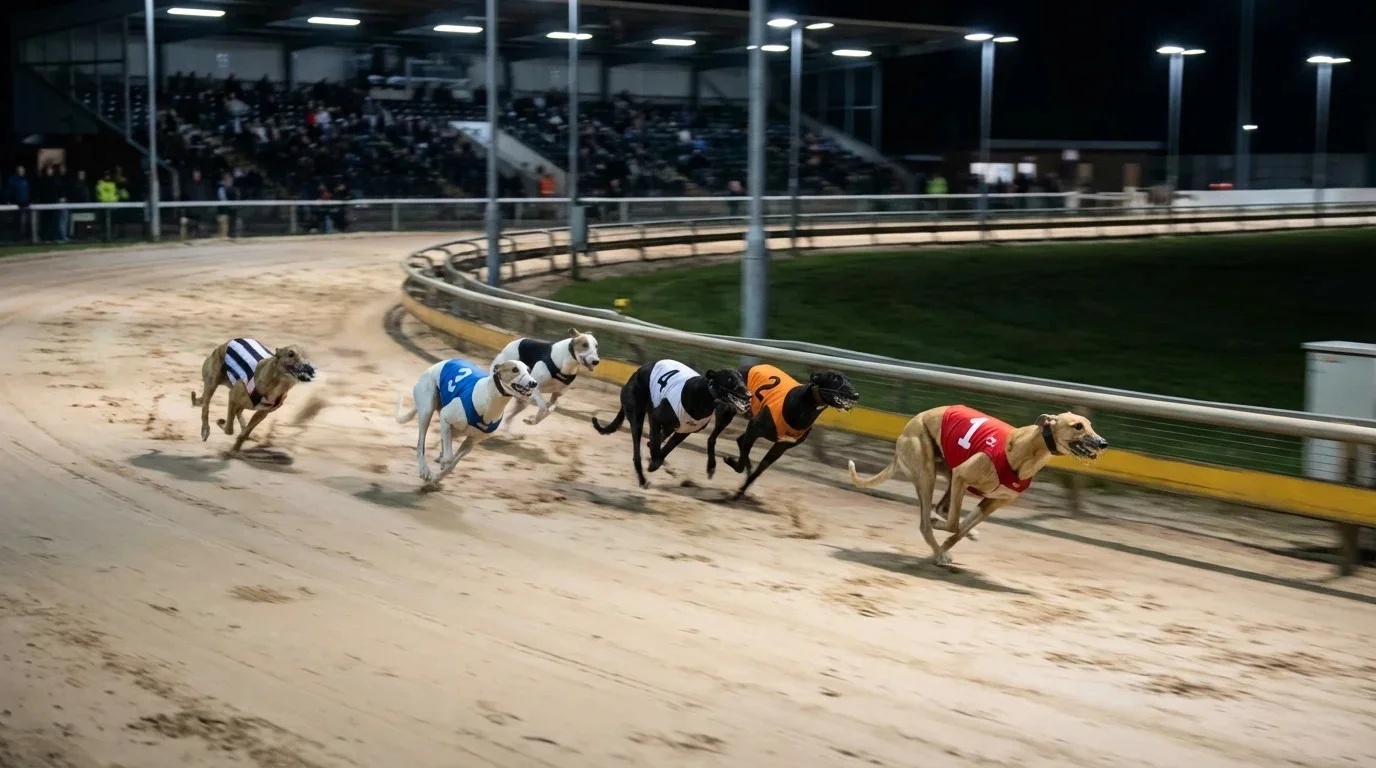
The data varies by track and sample period, but the consistent finding across UK greyhound racing is that the dog leading at the first bend wins approximately sixty percent of standard-distance graded races. At some tighter circuits, the figure climbs higher. At wider, more galloping tracks with longer distances, it drops closer to fifty. But even at the venues most favourable to closers, the first-bend leader wins more often than any other dog in the field.
The reasons are structural, not accidental. A greyhound race is short — the standard 480-metre trip takes roughly twenty-nine to thirty seconds at most UK tracks. In that window, there is limited time for a dog running in second or third to make up ground on a leader that has established a clear first-bend advantage. Unlike a two-thousand-metre horse race, where pace collapses happen regularly and closers have multiple opportunities to strike, a greyhound sprint offers the leader a straight run home from the second bend with minimal distance for pursuers to close the gap.
Track geometry reinforces the pattern. At the first bend, the dog on the lead has a clear run along its preferred racing line. Dogs behind must either follow in its wake — accepting the leader’s pace and hoping it fades — or attempt to pass on the outside, which adds distance and requires superior speed to overcome the geometric disadvantage. The first bend effectively sets a hierarchy that the remaining three hundred metres rarely overturn.
For punters, this statistic carries a direct implication: the dog most likely to lead at the first bend deserves significantly more weight in your analysis than a dog with strong finishing speed that typically comes from behind. A dog that consistently leads at the first bend and shows Led1, Won across its recent form is not merely a consistent winner — it is leveraging the most predictive factor in the sport. A dog that runs on for third in its last three outings may have ability, but it is fighting against the structural bias of the race every time it lines up.
This does not mean the first-bend leader always wins. The forty percent of races where it does not represent genuine opportunities. But the starting point for all race analysis should be this: who leads at the first bend? Answer that question reliably, and most of the questions that follow become significantly easier.
How to Identify Early Pace From the Race Card
The race card tells you who’ll lead — if you know where to look. Predicting which dog will reach the first bend in front is not guesswork. The data on the card, properly read, provides a highly reliable picture of each dog’s early speed, and from there, the likely shape of the opening phase.
The most direct indicator is the race comment abbreviations. QAw — Quick Away — is the clearest signal that a dog breaks fast from the traps. A dog showing QAw in four or five of its last six runs is a consistently fast starter. VQAw — Very Quick Away — is stronger still, marking a dog that not only breaks well but breaks faster than the field in a decisive manner. EP — Early Pace — indicates speed in the initial phase, even if the dog did not necessarily lead at the first bend.
The negative indicators are equally valuable. SAw — Slow Away — marks a dog that was beaten for speed at the break. A single SAw in six runs is a minor concern. Three or four SAw entries in recent form is a pattern: the trap start is unreliable, and any assessment of the dog’s first-bend chances must account for the probability that it misses the break again.
Led1 is the most definitive confirmation of early speed, but a dog can show early pace without leading at the first bend. A comment reading EP, Disp to 1st, Led2 tells you the dog was quick away but was outpaced to the first bend by an even faster rival, then took the lead at the second bend. That dog has early speed — but it is second-fastest in its recent race, not fastest.
Sectional times offer the most objective measurement. Some race card providers and data services publish the time from trap release to the first bend — the first sectional. This is a direct record of how quickly each dog covers the early portion of the race. Comparing first-sectional times across dogs in the same race allows you to rank them by early speed with numerical precision rather than relying on abbreviated comments. A dog that consistently records a first sectional of 3.90 seconds against rivals at 4.10 and 4.15 is going to lead to the first bend unless something unusual happens at the traps.
Trap position interacts with early speed in a way that can amplify or negate it. A dog with strong early pace drawn in trap 1 has the shortest path to the first bend and the inside rail to hold. The same dog drawn in trap 6 has more ground to cover and may need to run wider to avoid traffic. Early speed from an inside draw is a compounding advantage. Early speed from an outside draw is an advantage with a caveat: it is only useful if the dog can navigate across the field cleanly.
The practical synthesis is to build a first-bend prediction for every race. Rank the dogs by early speed using comments, sectional times, and trap-start history. Overlay their trap positions. Identify who reaches the first bend first with a clear run. That dog is your primary contender. If two dogs have similar early speed but one has a significantly better draw, the draw breaks the tie. If two dogs have similar speed and similar draws, the first bend will be contested — creating interference that benefits the dogs sitting behind them.
When Closers Win: Exceptions to the Rule
Early speed wins most of the time. The punter who knows when it won’t wins the rest. The sixty-percent first-bend-leader win rate means that forty percent of the time, something else happens. The leader tires, the bend disrupts the order, or a dog with a superior sustained turn of foot runs it down from behind. Understanding the conditions that favour closers matters for two reasons: it identifies the minority of races where backing a closer is the correct play, and it reveals when a front-runner is more vulnerable than the market assumes.
Staying races are the most common closer-friendly scenario. Over longer distances — 630 metres and above — early pace burns more energy, and the final two bends become a test of stamina rather than positional advantage. Dogs that lead comfortably over 480 metres may not sustain the same intensity over 630, especially on demanding circuits where the track geometry saps energy through every turn. In staying races, the closing speed recorded in race comments — RnOn, FinWl, Styd — becomes a much stronger predictor of success, and the first-bend leader’s historical win rate drops noticeably.
First-bend interference is the second major closer-enabler. When two or more dogs with strong early pace are drawn adjacently — particularly when an inside railer and a middle runner are both fast breakers — the first bend becomes a collision point. The dogs on the lead check each other, lose momentum, and the field compresses. Dogs that were running third, fourth, or fifth find themselves level with the disrupted leaders, and the race effectively restarts from the second bend. A closer that avoids the first-bend traffic inherits a winning position without having needed exceptional early speed itself.
The race card gives you the tools to predict this. If you identify two dogs with QAw and EP drawn in adjacent inside traps, and both are seeded railers, there is a meaningful probability of first-bend crowding. The wider-drawn dogs, running their natural lines without interference, become more attractive propositions. This is where draw analysis and pace prediction combine to reveal opportunities the form figures alone cannot.
Track-specific patterns also play a role. Tracks with tighter bends create more bunching and more interference on the turns, giving closers more opportunities to make ground where leaders are forced to decelerate. Tracks with wide, sweeping bends allow leaders to maintain speed through the turns and shrink the closer’s window. Also read our greyhound sectional times explained.
The synthesis is straightforward: early speed is the dominant factor in greyhound racing, and any serious approach to the sport must begin with identifying and backing dogs that can lead at the first bend. But the punter who treats this as an absolute law, rather than a strong probability, will miss the forty percent of races where conditions favour a different outcome. The skill is in reading each race individually — assessing the specific pace dynamics, the draw interaction, the distance, the track geometry — and adjusting your weighting accordingly. The first bend writes most race results. Knowing when it will not is what separates the competent punter from the sharp one.