
How UK Greyhound Grades Work
The grading system decides who runs against whom — and understanding it gives you an edge the grade itself doesn’t intend. Every licensed greyhound track in the UK operates a grading structure that organises dogs into races of broadly equivalent ability. The sporting purpose is fairness: competitive fields where each dog has a realistic chance. For punters, the grading system is something more. It is a structured framework that, once understood, reveals patterns the betting market regularly misprices. Find more race guides at dogracingoddsuk.
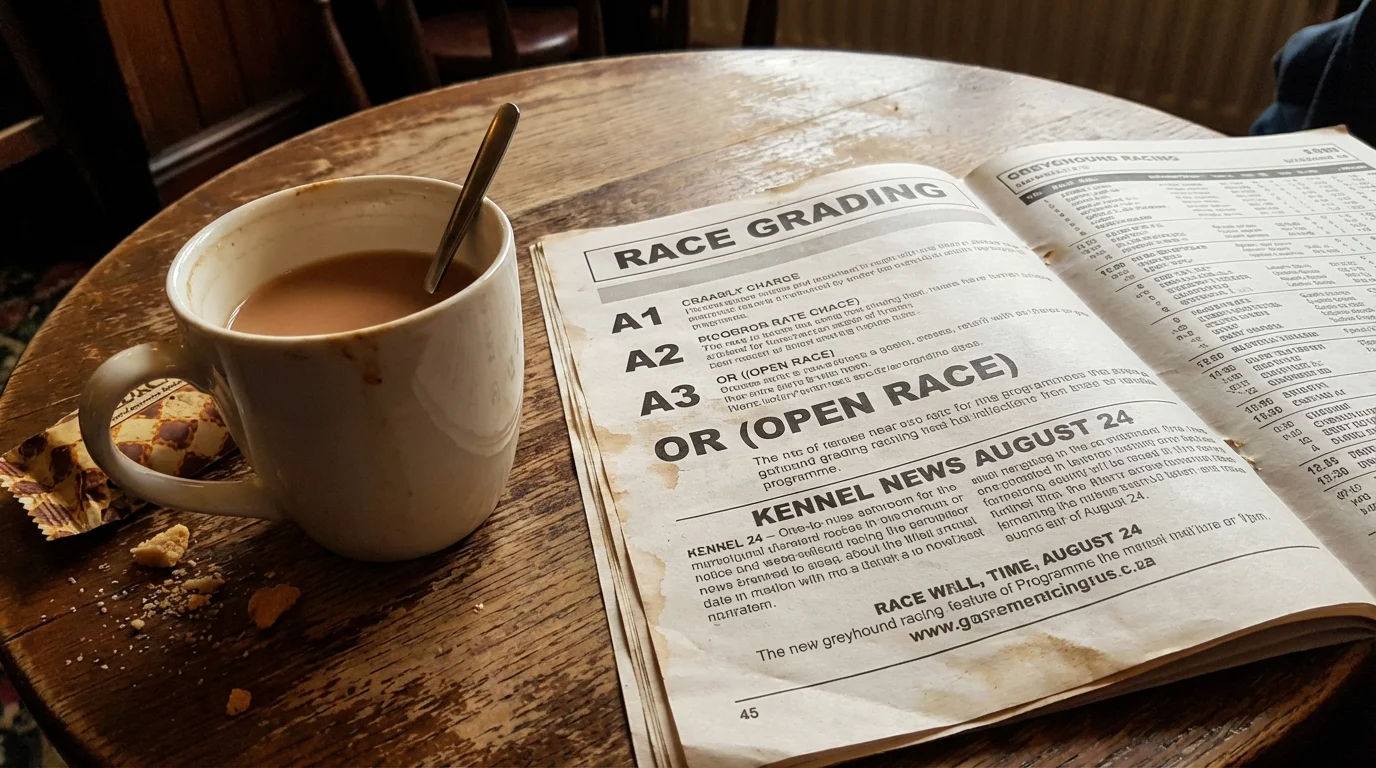
The standard UK grading ladder runs from A1 at the top to A11 at the bottom, though not every track uses the full range. Larger venues with deeper pools of active dogs — Romford, Monmore, Sheffield — might operate grades from A1 through A9 or A10. Smaller tracks compress the scale to A1 through A5 or A6, depending on the number of dogs available for racing.
Above the A-grade structure sit Open Races, designated OR on the race card. These are the highest-quality events at a track, featuring the best dogs from across the grading spectrum and, in the case of feature events, from other venues as well. Open race fields are drawn differently — the trap draw is randomised rather than seeded — and the competition is significantly stiffer. OR events include major competitions like the English Greyhound Derby heats, the Golden Jacket, and track-specific feature races.
Below the A-grades, additional categories exist for dogs early in their racing careers. Puppy races are restricted to dogs under a certain age, typically twenty-four months. Maiden races are for dogs that have not yet won at the track. These categories serve as entry points to the grading ladder: a maiden winner is allocated an initial A-grade based on the winning time of its race.
The promotion and relegation mechanism is the engine of the entire system. When a dog wins, it is typically promoted one grade — from A5 to A4, for example. When a dog finishes unplaced in consecutive races, it is relegated one grade. The exact rules vary between tracks, and the racing manager retains some discretion, but the general principle is consistent: winners go up, losers come down.
This mechanical promotion and relegation is where the betting opportunities emerge. A dog on a winning run is promoted into progressively tougher company until it reaches its level — the grade where it is competitive but no longer dominant. A dog on a losing run drops into weaker fields until it becomes competitive again. The transitions between grades — the moment a dog is promoted into a grade where it is outmatched, or relegated into one where it is the class act — produce the most significant pricing inefficiencies in the market.
One subtlety is often overlooked: grading is track-specific. A dog graded A3 at Romford is not automatically A3 at Monmore. If a dog transfers between tracks, it is reassessed and allocated a new grade by the receiving track’s grading committee. This means a dog can be effectively promoted or relegated simply by changing venue, and form earned at the old track may not reflect its competitive position at the new one.
Class Drops and Class Rises: Where the Value Hides
A class drop isn’t a demotion — it’s an opportunity the market often underprices. The grading system’s promotion and relegation mechanism creates two recurring situations that are among the most profitable in greyhound betting: the class drop and the class rise. Each carries distinct implications for the dog’s chance and, more importantly, for how the market prices that chance.
A class drop occurs when a dog is relegated after a run of poor results. On the surface, it looks like a dog in decline — it has been losing, and the system has responded by placing it in weaker company. But the surface reading misses crucial detail. The dog may have been performing poorly because it was facing opposition above its natural level after an artificial promotion. Winning a couple of races in quick succession does not always mean the dog belongs two grades higher. The relegation returns it to a grade where its speed, fitness, and style are competitive again.
The market tends to anchor on recent results. A dog with form figures of 4, 5, 6 over its last three outings looks like a dog in trouble, and the price reflects that pessimism — 5/1 or 6/1 when it should arguably be 3/1 or 7/2 given the weaker field it now faces. The form figures are accurate but misleading: the dog was not bad, it was outclassed. In the lower grade, it is the best runner in the race by a margin the odds do not recognise.
The most valuable class drops share specific characteristics. The dog was previously competitive or winning at the grade to which it is returning. The recent poor form can be attributed to the higher grade rather than to injury, loss of fitness, or genuine decline. And the race comments from the losing runs are encouraging — RnOn, FinWl, or Crd suggesting the dog was trying but facing too much quality, rather than Tired or NrDn suggesting a fundamental problem.
Class rises present the opposite dynamic. When a dog is promoted after winning, it moves into a race where every opponent is better than the field it just beat. The market, still warm from the winning form, often prices the dog shorter than its true chance warrants. A dog that won its last two at A6 and is now running in A4 for the first time might be priced at 5/2 on the strength of those victories. But A4 is a different proposition, and the times recorded in A6 do not guarantee competitiveness two grades higher.
The sharp approach in class-rise situations is not necessarily to oppose the promoted dog immediately — though that can work — but to wait. Let the dog run its first race at the higher grade. If it is beaten, the market adjusts, and the dog may be available at significantly longer odds for its second attempt. If it wins again, it was genuinely above the class, and you have learned something for the future. Either way, the first race at a new grade is often an information-gathering exercise rather than a betting opportunity.
The compound play — backing class drops and opposing class rises in the same race — can be particularly effective. When a freshly relegated dog meets a freshly promoted rival, the market often overvalues the promoted runner’s recent form and undervalues the relegated runner’s return to a grade where it belongs. These are the races where grade-aware punters find their most consistent edge.
Grading Isn’t the Full Picture
Grades organise the field. Your job is to disorganise the market’s assumptions about it. The grading system is a powerful analytical tool, but it has limitations that punters must recognise to avoid being misled by it.
The most fundamental limitation is that grading is mechanical. It responds to results — wins trigger promotion, poor finishes trigger relegation — without accounting for the reasons behind those results. A dog that lost three races because it drew against its preferred trap each time is relegated on the same basis as a dog that lost three because it is genuinely not fast enough. The system treats both identically. The punter should not.
Grading also does not account for the quality of specific opposition within a grade. An A4 race at Romford on a Saturday evening, with a strong field at the top of the grade, is a stiffer test than an A4 race at a quieter venue on a Tuesday afternoon. A dog that finishes fourth in the former might be a better dog than one that wins the latter, but the system only sees the finishing positions.
The practical approach is to use grading as one of three core inputs in your analysis, alongside form and draw. Grade tells you the approximate competitive level. Form tells you recent performance and trajectory. Draw tells you whether the race configuration suits the dog’s running style. A dog that scores well on all three — dropping in class, improving in form, drawn in its preferred trap — is the textbook selection. A dog that scores well on grade but poorly on the other two is a trap for punters who overweight a single factor.
Dogs can also be what experienced punters call misgraded — dogs whose current grade does not accurately reflect their ability due to the mechanical nature of the system. A dog that has been injured, returned from a season break, or switched tracks might hold a grade that is too high or too low relative to its actual racing level. Identifying misgraded dogs before the market corrects the pricing is one of the most reliable sources of value in greyhound betting. Also read our greyhound racing distances.
The grading system is the skeleton of UK greyhound racing. It provides structure, context, and a framework for competition. But the punter who builds analysis on grades alone is building on one leg of a three-legged structure. Form, draw, and race pace — assessed independently and then integrated — produce a complete picture that grades alone cannot provide. The grade tells you who the dog is racing against. Everything else tells you whether it can beat them.