
The Race Card Is Your Edge — If You Can Read It
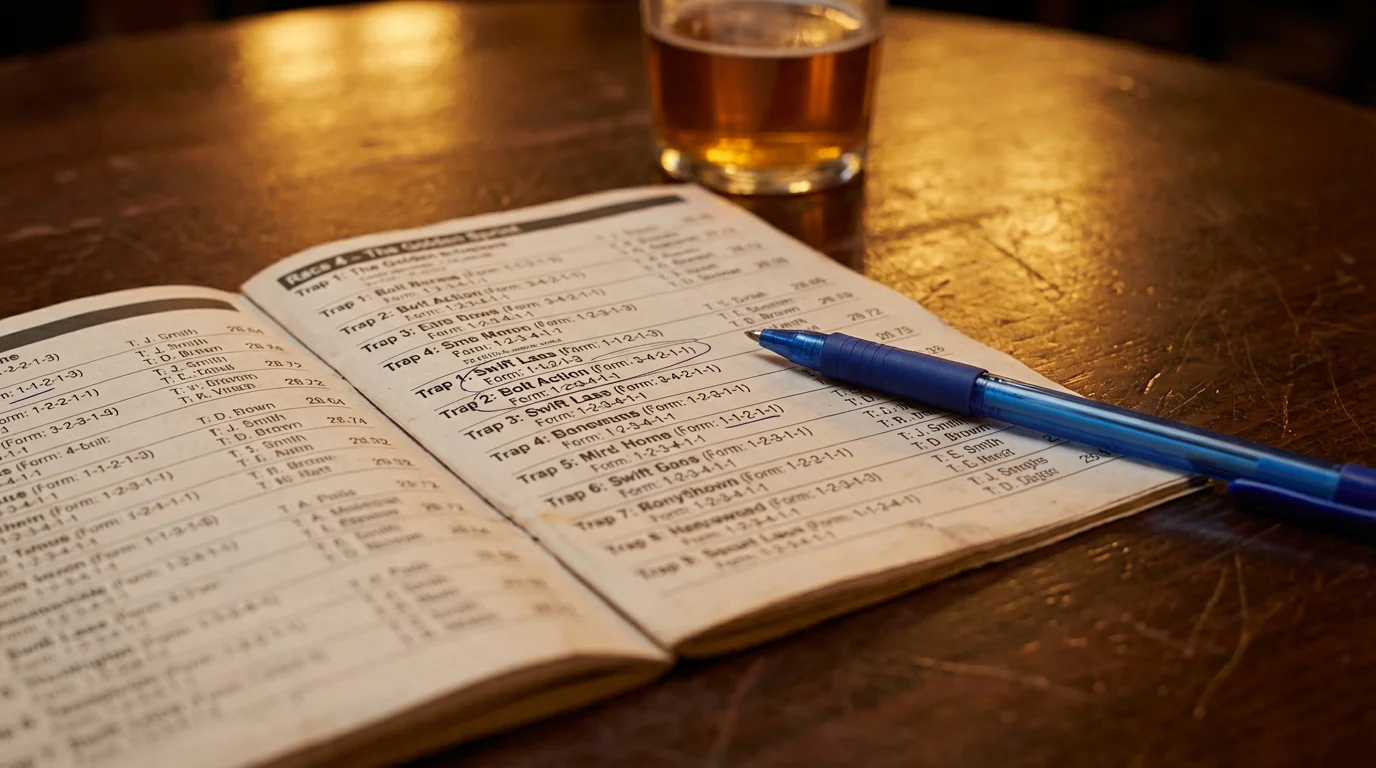
A greyhound race card looks like noise until you learn the language. Open a card for the first time and you’re hit with a wall of numbers, abbreviations, trainer names, times, weights, and form sequences that mean nothing unless you know how to decode them. Most casual punters don’t bother. They glance at the dog names, maybe check which ones have recent wins, and make a decision based on something between instinct and guesswork. The race card sits right there on the screen, loaded with information that could sharpen the decision — and they scroll past it. Get more form guides at dogracingoddsuk.
Professional greyhound punters don’t scroll past. They read every line, and they read it with purpose. A race card is a compressed biography of six dogs, each reduced to a few lines of structured data that, when properly interpreted, tell you how fast the dog is, how it starts, where it runs, what class it’s been competing at, and what happened in its most recent outings. It’s the most information-dense document in greyhound betting, and every element on it is there for a reason.
The card won’t tell you everything. It won’t tell you that a dog was unsettled in the kennelling area before a race, or that a trainer has quietly adjusted a dog’s feeding routine to sharpen its early speed. It won’t capture the subtle confidence in a kennel hand’s voice when they load a dog they know is ready to perform. But it tells you more than enough to form an analytical view of the race — one that, in many cases, is more reliable than the gut feeling most punters are trading on.
What this article does is take that wall of data apart, piece by piece. Every element on a UK greyhound race card is explained: what it means, why it’s there, and how to use it when building a betting view. The form figures that most punters glance at without context. The race comments that compress an entire race narrative into four or five abbreviations. The sectional times that reveal not just how fast a dog ran but how it ran — whether it led from the traps or closed from behind, whether its speed was concentrated in the first half of the race or distributed evenly. The trainer information that signals conditioning, intent, and kennel form.
Each section builds on the last. Form figures are the headline; race comments are the article beneath them. Sectional times add precision to the story that form and comments begin to tell. Trainer stats provide the background context that shapes how you weight the rest. And the final section ties them together into a practical workflow — a step-by-step process for turning raw race card data into a structured opinion on which dog represents value in the market.
If you’re betting on greyhounds and you’re not reading the card properly, you’re making decisions without the information that’s freely available to everyone who takes two minutes to look. The card doesn’t charge a subscription fee. It doesn’t require specialist software. It just requires attention, a basic understanding of the language it uses, and the discipline to read it before you place a bet rather than after you’ve lost one.
Race Card Anatomy: Every Element Decoded
Let’s take one line of a race card and pull it apart. A typical entry for a single dog in a UK graded race might look something like this: Trap 2, blue jacket, dog name, trainer name, form figures 231142, best time 29.54, weight 32.8kg, brindle dog, age 3y, with race comments and sectional data beneath. Every one of those elements tells you something specific, and together they form a portrait of the dog’s recent racing life.
The trap number and jacket colour come first. Trap 1 is red, Trap 2 is blue, Trap 3 is white, Trap 4 is black, Trap 5 is orange, and Trap 6 wears stripes. The trap assignment is determined by the racing manager based on the dog’s running style — ideally matching railers to inside boxes, wide runners to outside, and middle runners to the central traps. The trap number matters for every race analysis you’ll ever do, because it determines the dog’s starting position, its likely racing line, and its exposure to first-bend interference.
The dog’s name, trainer, and owner are listed next. The trainer is the more analytically useful piece of information. Different trainers have different track records — literally. Some trainers win consistently at specific venues. Others have poor records at certain tracks but excel elsewhere. The trainer also controls the dog’s preparation: fitness, diet, race selection, and trial schedule. A dog’s form is partly a reflection of its ability and partly a reflection of its trainer’s management.
Form figures appear as a sequence of numbers — typically the last six finishing positions, read from left to right with the rightmost being the most recent. A sequence like 231142 tells you the dog finished second three starts ago, first two starts ago, and second most recently. The numbers give you the trajectory — improving, declining, or inconsistent — but they don’t give you context. A first-place finish in an A8 race is not the same as a first in an A3. The grade column, listed separately on the card, provides that context.
The best time is the fastest time the dog has recorded at the given track and distance. It’s a useful benchmark for raw ability but needs careful handling. A best time run three months ago on fast ground may not reflect the dog’s current form or the track’s current condition. Times at different tracks are not directly comparable — 29.50 at one venue might represent a faster performance than 29.30 at another, depending on circuit size and surface speed. Adjusted times, where available, provide a truer comparison.
Weight is recorded in kilograms and typically appears to one decimal place. Greyhounds race at varying weights, and fluctuations can signal changes in condition. A dog that has gained a kilogram since its last run might be carrying extra condition, which can slow it slightly over sprint distances. A dog that has lost weight might be sharper — or might be underfed and lacking power. Small changes of 0.2 to 0.3 kilograms are generally insignificant. Shifts of a kilogram or more warrant attention, particularly if the trend is consistent across multiple runs.
The dog’s colour, sex, and age fill in the biological profile. Colour is rarely relevant to performance analysis, but sex and age are. Bitches can be affected by season cycles, and a bitch returning from a season break may need a run or two to regain peak fitness. Age is a factor at the extremes: young dogs under two are still developing and may be inconsistent, while dogs over four may be past their physical peak, especially in sprint races where explosive speed deteriorates earlier than endurance.
Sire and dam information is sometimes included, particularly for open-race cards. Breeding lines can indicate a dog’s likely distance preference and running style — some sires produce sprinters, others stayers, and the form services occasionally flag these tendencies in their analysis. For graded races with established form, breeding data is less useful than actual performance data. For maiden races or first-time runners, it’s sometimes the only guide you have.
Form Figures: Reading the Story Right to Left
Form figures are the headline. Race comments are the article. If you read only the headline, you’ll get the gist — but you’ll miss the nuance that changes the meaning entirely. Still, the headline is where everyone starts, and reading it properly is a skill in itself.
The most important rule: the rightmost number is the most recent run. A form line of 111123 reads, from left to right, as: first, first, first, first, second, third. The dog won four consecutive races and then finished second and third in its last two outings. That’s a dog whose form is declining — still competitive, but no longer winning. The key question is whether the decline is genuine or circumstantial. Was the dog promoted in grade after those four wins, running against better opposition in the last two starts? Was it drawn badly? Did something happen in running?
An improving form line looks like 654321 — the dog was finishing mid-pack four runs ago and has progressed to winning its most recent start. This is the profile that interests value-seekers, because improving form combined with a grade appropriate to the dog’s current ability often produces prices that haven’t fully caught up with the trajectory. The market reacts to recent results but sometimes lags behind a clear improvement trend, especially if the early poor results are still visible in the sequence and pulling the price longer.
Inconsistency — a line like 316241 — is the most challenging pattern. The dog can win but can also finish last. The numbers alone don’t explain why. You need the race comments to decode whether the poor runs were caused by trouble in running, bad draws, unsuitable distances, or simply an unreliable dog that turns up when it feels like it. Consistent dogs make comfortable betting propositions. Inconsistent dogs offer higher prices but demand more investigative work to determine whether a pattern exists beneath the chaos.
Numbers that don’t appear in the standard form sequence also carry meaning. A dash (–) typically indicates a rest or absence: the dog didn’t race in that slot. The letter F can denote a fall. A zero sometimes indicates a non-finish or disqualification, depending on the convention used by the card provider. These outliers are worth investigating because they break the narrative. A form line of 11–211 suggests a dog that was winning, took a break, and came back still winning. That’s a stronger profile than 111211, because the break might have been planned conditioning by a trainer confident the dog would return in form.
What form figures fundamentally cannot tell you is the quality of opposition beaten or the circumstances of each race. A dog with a form line of 111111 that has been racing exclusively at A10 grade is a different animal from a dog showing 332211 at A3. The first dog wins its races but has never been tested against serious competition. The second has been competitive at a high level and is now on an improving run. The form figures look better for the first dog. The performance level is higher for the second. Without checking the grade column and the race comments, the numbers mislead you into the wrong conclusion.
Race Comments and Abbreviations
SAw, Crd2, Bmp3, RnOn — that’s not gibberish, that’s a dog’s race in four words. Race comments are the most information-dense element on a greyhound card, and they’re written entirely in abbreviations because there isn’t room for anything else. Each comment compresses the story of a thirty-second race into a shorthand narrative: how the dog started, where it ran, what trouble it encountered, and how it finished. Learning to read these abbreviations fluently is the single biggest analytical upgrade available to any greyhound punter, because the comments contain the context that form figures alone cannot provide.
Start comments describe what happened at the traps. QAw means quick away — the dog broke sharply and was in a forward position from the first stride. SAw is the opposite: slow away, a dog that lost ground at the start. SAw is one of the most important flags on a card because it identifies a habitual problem. A dog that shows SAw in four of its last six races has a trap start issue that’s unlikely to resolve itself spontaneously. Backing it as a front-runner is risky because the data says it doesn’t lead from the traps. EP means early pace, indicating the dog showed speed in the early stages of the race without necessarily leading — it was prominent, pushing the pace, and involved from the start.
Positional comments describe where the dog ran during the race. Ld1 means led from the first bend — the dog was in front by the time the field reached the first turn and held that position. Ld2, Ld3, and Ld4 indicate when a dog took the lead at the second, third, or fourth bend respectively. Rls means the dog ran on the rails — hugging the inside line, taking the shortest route. Wide indicates the dog raced wide, either by choice (its natural running style) or by circumstance (forced out by other runners). Mid means it ran in the middle of the track, neither rail-hugging nor swinging wide.
Interference comments are critical for contextualising poor form figures. Bmp stands for bumped — the dog made contact with another runner. Bmp1 means bumped at the first bend, Bmp2 at the second, and so on. Crd means crowded — the dog was squeezed for room without necessarily making contact. CrdRnIn means crowded and ran in (pushed toward the rail). CrdRnUp means crowded and ran up (pushed forward by pressure from behind). MsUp, sometimes written as MsdUp, means messed up — the dog encountered interference that disrupted its stride and racing position. BCrd is badly crowded, a more severe version of Crd that usually indicates significant impact on the dog’s finishing position.
Finishing comments tell you how the race ended for that dog. RnOn means ran on — the dog was still making ground at the line, finishing strongly without quite getting there. This is a bullish comment: it suggests the dog might have won with a slightly longer trip or a cleaner run. FinWl means finished well, a similar indicator of closing speed. Trd is tired — the dog faded in the closing stages, suggesting it either lacks stamina at this distance or was not fully fit. StdLt is stumbled late, meaning the dog lost momentum in the final stages through a physical stumble rather than lack of pace.
The value in race comments lies in combining them across multiple runs. A dog whose last three race comments read SAw-Crd1-RnOn, SAw-Bmp2-RnOn, SAw-Mid-RnOn shows a clear pattern: it’s slow out of the traps every time, gets into trouble because of that slow start, but finishes strongly regardless. That dog doesn’t lack ability. It lacks a clean beginning. If it breaks cleanly next time — or if it’s drawn in a position where a slow start matters less, such as a wide trap with room to recover — the in-running comments suggest it has the pace to be competitive from a better position.
Conversely, a dog whose comments consistently read QAw-Ld1-Trd is fast out of the boxes and leads early but tires in the closing stages. That pattern suits sprint distances where the finish line arrives before stamina becomes an issue, but it’s a red flag at standard or staying distances where the final straight exposes the lack of endurance. The comments spell it out. You just need to read them.
Sectional Times and Speed Ratings
Sectional times don’t just tell you how fast a dog ran — they tell you how it ran. A finishing time of 29.50 over 480 metres gives you one number. Sectional times break that number into segments: the time to the first bend, the split across the back straight, and the time through the closing stages. Two dogs can post identical overall times while running completely different races — one blazing to the front and holding on, the other tracking the pace and finishing fast. The overall time hides the difference. The sectionals reveal it.
The most commonly available sectional is the split to the first bend, sometimes called the run-up time. This measures how quickly a dog reaches the first turn from the traps, and it’s the purest indicator of early speed available on the card. A dog that consistently records the fastest first-bend split in its races is a confirmed front-runner. A dog with slower splits that still posts competitive overall times is a closer — it makes up ground after the first bend, relying on sustained pace rather than explosive acceleration. Both running styles can win, but they win different types of races and respond differently to draw positions, track layouts, and field compositions.
Mid-race and closing sectionals, where available, add further resolution. A dog that runs a fast first-bend split but then posts a slow closing split is front-loading its effort — burning energy early and fading late. That profile suits short races and tight tracks where the finish line arrives before stamina is tested. A dog with a moderate first-bend split and a fast closing split is doing the opposite — conserving early and accelerating late. That profile suits longer distances and galloping tracks where there’s straight to make up ground.
Comparing sectional times across tracks requires adjustment. A time to the first bend at Romford is not equivalent to the same time at Nottingham because the distance from traps to the first turn differs, as do the bend angles and the surface speed. Some form services provide adjusted or calculated sectional times that standardise these differences, allowing you to compare a dog’s early speed at one venue against its early speed at another on a like-for-like basis. Timeform and the Racing Post are the two most widely used sources for this type of data in UK greyhound racing.
Speed ratings take the standardisation further. Instead of raw times, a speed rating assigns a single number to a dog’s performance relative to the standard for its grade, track, and distance. A rating of 95 at one track is directly comparable to a rating of 95 at another — the adjustment has already been done. Speed ratings are most useful for assessing class: a dog rated 90 running in an A5 race where the average rating is 85 has a quantifiable advantage over the field. They’re also useful for identifying dogs that have been competing below their rating level — potential class droppers whose numerical ability hasn’t been reflected in recent finishing positions because of draw issues, interference, or unlucky running.
The practical application of all this timing data comes back to a simple question: does this dog’s speed profile suit today’s race? A front-runner with fast sectionals to the first bend, drawn in Trap 1 at a tight track, in a race where no other dog shows comparable early speed, is a strong candidate. The same dog drawn in Trap 5 at a wide track against two other confirmed front-runners is a recipe for first-bend congestion and a compromised run. The times provide the evidence. The draw and the field provide the context. The combination of both is what turns data into a betting opinion.
Trainer Stats and Kennel Form
A dog is only as good as its preparation — and preparation is the trainer’s job. The trainer is the person who conditions the greyhound, manages its diet, selects its races, decides when it’s fit to run, and determines the distance and track that best suit its ability. Two dogs of identical raw talent can produce very different form sequences depending on the quality of their training. The trainer line on the race card is not administrative information. It’s an analytical variable.
Trainer win percentage is the most accessible metric. The Racing Post and other form services publish trainer statistics that show overall win rates, track-specific records, and recent form. A trainer with a 25% win rate across all runners is performing well above the average. A trainer with a 10% win rate is below par. These numbers need context — a trainer who specialises in open-race dogs at high grades will have a lower win rate than one running lower-graded dogs against weaker fields — but they establish a baseline. All else being equal, a dog trained by a consistently successful handler is a safer proposition than one trained by a handler whose record is poor.
Track-specific trainer records are more valuable than overall statistics. Some trainers have an affinity for particular venues. They know the track surface, they know the racing manager, they trial their dogs there regularly, and they enter them when conditions suit. A trainer with a 30% win rate at Romford but a 12% rate everywhere else is telling you something: their dogs are prepared for Romford. When that trainer enters a runner at Romford, the track-specific record should carry more weight in your analysis than the blended national average.
Kennel form refers to the collective performance of all dogs under a trainer’s management over a recent period. When a trainer’s entire kennel is firing — multiple winners across different tracks in the same week — it often indicates that the conditioning and preparation across the operation are at a high level. Kennel form tends to run in cycles. A trainer whose dogs are winning consistently is likely feeding well, trialling effectively, and selecting races astutely. A trainer whose dogs are collectively underperforming might be dealing with illness in the kennel, a change in feeding routine, or simply a dip in the quality of dogs under their care.
Trainer changes are among the most undervalued signals on a race card. When a dog transfers from one trainer to another, the form book effectively resets. A dog that has been finishing mid-pack under a struggling trainer may improve dramatically under new management — different conditioning, different race selection, different trial routine. The market often underreacts to trainer changes because the form figures still reflect the old trainer’s results. A dog showing 4, 5, 6 under its previous handler but now running its first or second start for a trainer with a strong record at the relevant track is exactly the kind of profile that value bettors look for: visible information that the market has not yet priced correctly.
Checking trainer stats adds sixty seconds to your race card analysis. It’s one of the highest-return investments of time available to any greyhound punter.
Putting It Together: From Raw Data to a Betting View
The card gives you the data. What you build from it is the bet. Everything in this article — the anatomy of the card, the form figures, the race comments, the sectional times, the trainer stats — converges into a practical workflow that you can apply to every race you consider betting on. It doesn’t need to be complicated, but it does need to be systematic.
Start by scanning the full card. All six dogs, all the data. Don’t fixate on a single name. Read through the form figures, note the grades, register the trap draws, and build a first-pass impression of the race shape. Which dogs show early speed? Which are likely to be prominent at the first bend? Which look outclassed, which look value for money?
Next, eliminate. In most graded races, one or two dogs can be dismissed relatively quickly on the basis of poor form at a relevant grade, a mismatch between running style and draw, or a clear lack of competitive speed compared to the rest of the field. Removing the non-contenders narrows your focus and sharpens your analysis. You’re not trying to rank all six. You’re trying to identify the two or three that have a genuine chance of winning.
For the remaining contenders, go deeper. Check the race comments from their last three or four starts. Are there interference patterns? Trap start issues? Signs of improving finish speed? Cross-reference the sectional times if available: who has the fastest run-up split, who closes strongest, who’s posting times that sit above the grade average? Check the trainer stats: is the handler in form, and does the handler’s track record at this specific venue support confidence?
Now assess the race pace. If multiple contenders are confirmed front-runners drawn in adjacent traps, the first bend is going to be contested and interference is likely. That changes the race dynamics and might favour a closer or a dog drawn away from the congestion. If one dog has clear early speed and no rival for the lead, the pace map favours it heavily — an unchallenged front-runner at a track that rewards rail position is about as close to a banker bet as greyhound racing produces. Also read our how to read a greyhound race card.
Finally, compare your view to the market. You’ve identified your top selection. You’ve assessed the pace, the draw, the class, and the trainer form. What price does the bookmaker offer? If the market aligns with your view or is even slightly more generous than you expected, the bet is on. If the market has already compressed the price below where you think value exists, there’s no bet. Move to the next race.
And that’s the last, hardest lesson the race card teaches: it doesn’t owe you a bet every race. Sometimes the data is inconclusive. Sometimes the value isn’t there. The card tells you what it knows. Your discipline decides what you do with it.