
What a Greyhound Race Card Contains
Every line on the card is there for a reason — and this is what they all mean. A greyhound race card is a compressed data sheet for each runner in a race. It packs an extraordinary amount of information into a small space, using abbreviations, numbers, and formatting conventions that are intuitive to experienced punters but impenetrable to newcomers. Learning to read the card fluently is the single most valuable skill a greyhound bettor can develop, because every piece of analysis — form, class, draw, pace — starts with the data printed on it. Get more form guides at dogracingoddsuk.
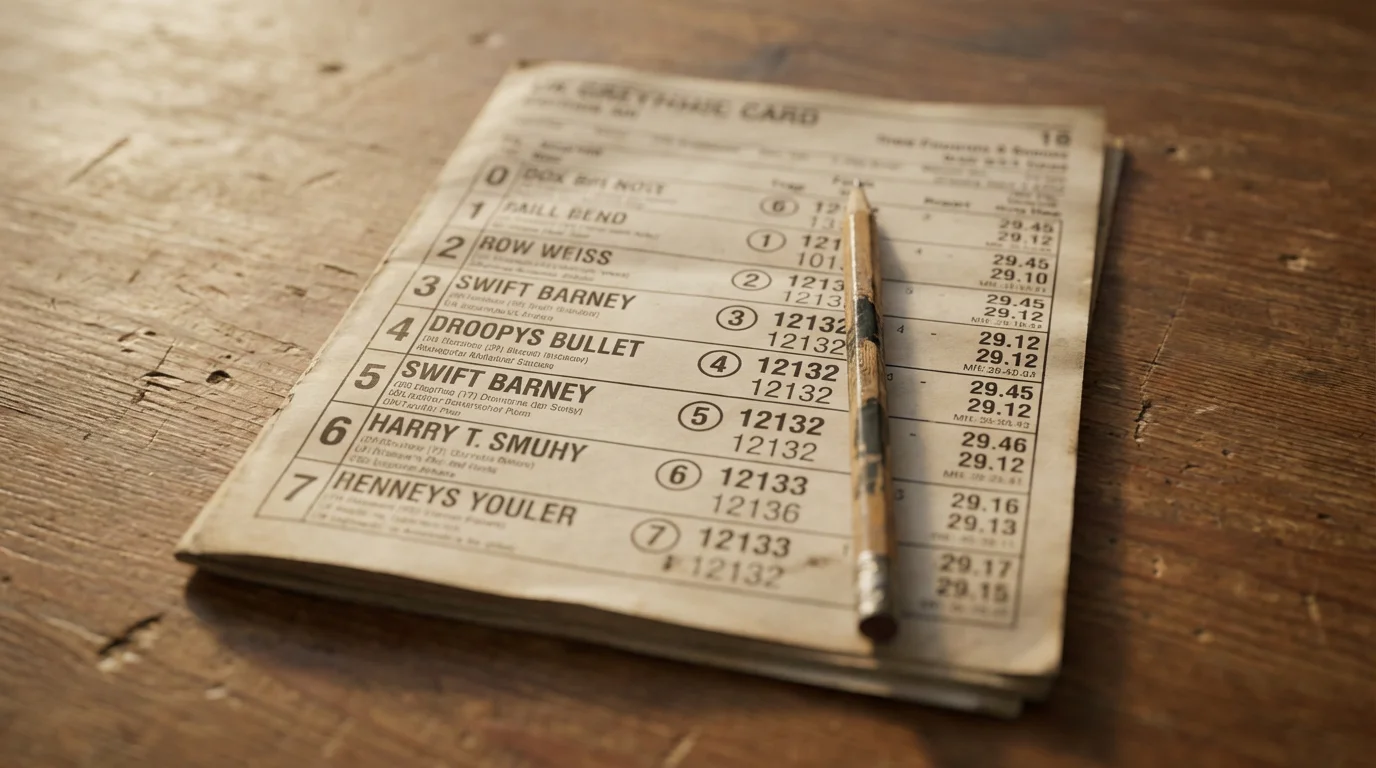
The card for each race lists every dog entered, in trap order from 1 to 6. For each dog, the following elements are presented.
Trap number and jacket colour. Trap 1 red, Trap 2 blue, Trap 3 white, Trap 4 black, Trap 5 orange, Trap 6 black and white stripes. This identifies the starting position and allows you to track the dog during the race.
Dog name and seeding. Greyhound names are registered with the GBGB and are unique. An R after the name indicates the dog is seeded as a railer, M for a middle runner, W for a wide runner. This seeding code is essential for evaluating whether the dog is drawn in its preferred position.
Trainer. The licensed trainer responsible for conditioning the dog. Trainer names become significant once you start tracking kennel form — patterns of sustained performance, or dips, across a trainer’s entire string of dogs.
Form figures. A sequence of numbers representing the dog’s finishing positions in its most recent races, typically the last six runs. The most recent run is the rightmost number. A form line of 2 3 1 1 4 1 means the dog won its last race, finished fourth before that, won the two before that, and placed third and second in its earliest recorded runs. A dash indicates a run that is unavailable or where the dog was unplaced beyond the figures shown.
Race grade. The grade of each recent race is shown alongside or below the form figures. Grades range from A1 at the top of graded racing down to A11, with OR denoting Open Race — the highest tier of competition. Puppy and Maiden grades indicate younger or less experienced dogs. Grade context is critical: a first-place finish in A8 is not the same achievement as a first in A2.
Times. The dog’s best recorded time over the track’s standard distance and its times in recent outings, expressed in seconds to two decimal places. These allow raw speed comparison, though they must be interpreted carefully — different tracks, distances, and going conditions make direct comparisons unreliable without adjustment.
Weight. Shown in kilograms, this is the dog’s racing weight at its most recent run. Significant changes between races can indicate fitness shifts. A dog gaining weight between runs may be post-season or recovering from injury. A loss might indicate peak fitness or, less optimistically, an underlying problem.
Race comments. Abbreviated descriptions of how the dog ran in each recent race. These are dense, coded, and enormously informative — covered in detail in the next section.
Distance and track. The distance and venue of each recent run. Vital for assessing whether the dog’s form is relevant to today’s conditions. A dog whose form was earned over 480m at Romford faces different demands at 500m at Nottingham.
Race Comments: Abbreviations Decoded
Four letters can tell you everything about how a dog’s race unfolded. Race comments are the narrative layer beneath the form figures. Where the finishing position tells you the result, the comment tells you the story — how the dog broke, where it ran, whether it encountered trouble, and how it finished. Learning this abbreviation system turns the race card from a set of numbers into a detailed picture of each dog’s recent performances.
Trap start and early pace. QAw means Quick Away — broke fast from the traps. SAw is Slow Away — missed the break. VQAw is Very Quick Away, an exceptionally fast start. EP means Early Pace, speed in the initial phase. EvPc indicates Even Pace, a consistent speed throughout.
Running position. Led1, Led2, Led3, Led4 tell you when the dog took the lead — from the first, second, third, or fourth bend respectively. Disp means it disputed the lead with another runner. Mid indicates mid-division. Rls means raced on the inside rail. Wide means raced on the outside of the field.
Interference and trouble. Bmp1, Bmp2, Bmp3 record bumping at the first, second, or third bend — physical contact with another runner. Crd means Crowded, hemmed in by surrounding dogs. BCrd is Badly Crowded, significant interference that materially affected the run. Blk is Baulked, where the dog’s path was blocked. CkHBnd means the dog was checked on the bend, losing momentum.
Finishing and run style. RnOn means Ran On — finished strongly, gaining ground in the closing stages. FinWl is Finished Well, a strong finishing effort. Tired indicates the dog faded. NrDn means Never Dangerous, never in contention for the places.
Other common abbreviations. MsUp is Messed Up, general trouble during the race. RLRU is Railed on Run-Up, running close to the rail on the approach to the first bend. MidTk is Middle Track, racing in the middle section throughout. WRunUp means Wide on the Run-Up, going wide approaching the first bend.
The real power of these abbreviations emerges when you read them as sequences across multiple races. A dog showing SAw in four of its last six runs has a consistent trap-start problem that will persist regardless of its other qualities. A dog showing RnOn in recent comments is a closer that finishes strongly but needs the race to unfold in its favour. A dog that has been Crd and Bmp in consecutive races has been unlucky, and its finishing positions may understate its true ability.
Combining abbreviations into a narrative is where reading becomes analysis. A line reading QAw, Led1, Rls, Won describes a textbook front-running victory from the inside. A line reading SAw, Crd2, Bmp3, RnOn, 3rd describes a dog that missed the break, got into trouble on the bends, but still ran on for third — suggesting it is considerably better than the bare form figure of 3 implies. The comment tells you whether the result was earned cleanly or distorted by circumstance, and that distinction is fundamental to every selection decision.
From Card to Bet: Using What You’ve Learned
Reading the card is research. What you do next is the bet. Knowing what every element of the race card means is necessary but not sufficient. The edge comes from synthesising that information into a selection view and comparing it against the market.
A practical workflow runs through five steps. First, scan the entire field. Read the form figures, comments, and grades for all six dogs. Do not start with a favourite in mind — let the data present the contenders rather than looking for evidence to support an existing preference.
Second, eliminate non-contenders. In most graded races, one or two dogs can be quickly ruled out: poor recent form, wrong distance, drawn against their running line, or significantly outclassed. Reducing the field to three or four genuine contenders focuses your attention where it matters.
Third, compare the remaining dogs on three axes. Form trajectory: improving, consistent, or declining. Draw suitability: is the dog in its preferred trap. Class context: is it well graded, dropping in class, or rising. The dog that scores well on all three is your primary selection. If two dogs score equally, that is a race suited to a forecast rather than a win single.
Fourth, assess the likely race pace. Using the comments — QAw, SAw, EP, Led1 — construct a picture of how the first bend will unfold. Which dog leads? Which gets crowded? Which has a clear run? The pace prediction, built entirely from card data, often identifies the likeliest winner more reliably than form figures alone.
Fifth, check the market. Compare your assessment to the available odds. If the dog you have identified as the strongest contender is shorter than expected — 6/4 when your analysis says 2/1 — the value is not there and you pass. If it is longer — 3/1 when your analysis says 2/1 — you have a value bet. The card gave you the data. The market gives you the price. The gap between them is where profitable betting lives. Also explore our how to read greyhound race cards.
Not every race produces a bet. The card does not owe you an opportunity on every race of the evening. The discipline to walk away when no clear edge presents itself is what separates the punter who reads race cards from the punter who merely collects them. The former treats the card as a filter. The latter treats it as a shopping list. Over a full season of racing, the filter approach wins.