
Strategy Starts Before You Open a Bet Slip
The races run in under 30 seconds, but the work that matters happens in the hours before. Most greyhound punters don’t lose because they lack instinct or knowledge. They lose because they skip the preparation stage entirely, roll up to the evening card with nothing but a vague sense of which dogs look good, and start placing bets the moment the first race card loads. That approach turns greyhound betting into a guessing game — one the bookmaker wins by default. Find more strategy guides at dogracingoddsuk.
A serious greyhound betting strategy operates in three phases, and the first two happen before a single race is run. Phase one is pre-meeting research. This is the desk work: pulling up the race card, studying form figures, checking trap draws against each dog’s running style, reviewing class levels, and cross-referencing recent performances at the specific track hosting the meeting. It’s the phase that most punters either rush or ignore, and it’s the phase that produces the clearest edge. A punter who spends thirty minutes studying a twelve-race card before the first trap opens will make sharper selections than one who reads the form for sixty seconds between races.
Phase two is live race assessment. The card is studied, selections are noted, but the market is live and things change. A non-runner reshuffles the race dynamics. The opening show reveals where the money is going. A dog you fancied shortens from 5/1 to 5/2, and the value you identified has evaporated. Live assessment means adjusting your pre-meeting view in response to new information without abandoning your framework. It’s the discipline of knowing when a price change invalidates your bet and when it confirms it.
Phase three is post-meeting review, and it’s the one almost nobody does. After the last race, most punters check their balance and move on. The ones who improve check their decisions. Did the dogs they selected perform as expected? Were the losses due to bad selections or bad luck — a bumping incident at the first bend, a slow trap — and how do they distinguish between the two? Did the bet types they chose suit the races? This review doesn’t need to be elaborate. A simple log of selections, odds, results, and a one-line note on why the bet was placed is enough to build a picture over time.
What follows in this article covers the analytical tools that make each phase effective: form reading, class assessment, early speed analysis, trap draw evaluation, value identification, and bankroll discipline. None of these tools works in isolation. Form without class context is misleading. Trap draw without track knowledge is incomplete. Value without bankroll management is unsustainable. The strategy is the system — the habit of doing the work before, during, and after every meeting, treating each race as a data point rather than a lottery ticket. The punters who profit from greyhound racing aren’t luckier than the rest. They’re more prepared.
Form Analysis: What Six Numbers Tell You
A string of firsts means nothing if you don’t know what grade they were running in. Form figures — the sequence of finishing positions from a dog’s recent races, typically the last six — are the most widely consulted piece of data on a greyhound race card. They’re also the most commonly misread. A form line of 111213 looks like a near-perfect dog. But if those wins came in A8 races and the dog is now running in A5, those numbers describe a different animal in a different context. Form figures are the starting point, not the verdict.
The convention in UK greyhound racing is to read form right to left: the rightmost number is the most recent run. A form line of 654321 tells you the dog is improving — sixth four runs ago, first last time out, with a clear upward trajectory. That’s the kind of sequence that catches a shrewd punter’s eye, because improving form at consistent grade levels suggests the dog is finding its best condition. A line of 123456, by contrast, is a dog in decline — recent runs getting progressively worse, and the market will usually reflect that by pushing the price out.
Inconsistency is harder to interpret. A form line like 316241 shows a dog that can win but can also finish last. The question is whether the bad runs are explainable. This is where context transforms raw numbers into useful intelligence. Check the race comments for those poor finishes. Was the dog slow out of the trap? Did it get crowded at the first bend? Was it running at an unfamiliar distance? A dog that finished sixth because it was bumped wide at the second bend is a very different proposition from a dog that finished sixth because it simply wasn’t fast enough.
Times matter as much as positions, sometimes more. Two dogs might both show a finishing position of second, but one ran 29.40 seconds over 480 metres at Nottingham and the other ran 30.10 over the same distance at a different track. The raw positions are identical; the performances are not. Cross-referencing finishing times with track and distance gives a more granular picture of ability than positions alone. Some form services, such as Timeform and the Racing Post, provide adjusted or standard times that account for track variation, making direct comparison easier.
There are situations where recent form is unreliable or misleading. A dog returning from injury or a break in season may show poor recent form that reflects fitness rather than ability — the last two runs were comeback races, and the real performance level is closer to what the dog showed before the layoff. Track switches are another source of noise: a dog with strong form at a tight circuit like Romford may produce a mediocre run at a wide galloping track like Towcester simply because the race profile doesn’t suit its running style. And kennel changes — a transfer from one trainer to another — can reset the form picture entirely. A dog that’s been underperforming under one trainer may improve dramatically under new management, but the form figures won’t show that until the new run sequence builds up.
The discipline of form analysis is to treat every number as a question, not an answer. What grade? What track? What distance? What happened in running? Strip the context away and the numbers lie. Add it back and they start to talk.
Class and Grading: The Hidden Variable
The grading system is a ladder — and the most profitable step is always the one a dog just fell down. UK greyhound racing operates on a hierarchical grading structure managed by each track’s racing manager. At most venues, graded races run from A1 at the top down through A2, A3, and so on to A10 or A11, depending on the stadium. Open races sit above the graded system, featuring the best dogs regardless of grade, while Puppy and Maiden races cater to younger or less experienced runners at the bottom end.
The mechanism is simple: win and you go up, lose and you come down. A dog that wins an A6 race will typically be promoted to A5 for its next outing. A dog that finishes in the bottom half repeatedly will be dropped a grade, facing weaker opposition next time. This creates a constant churn of dogs moving through the system, and that churn is where the smart money finds its openings.
A class drop is one of the most reliable value signals in greyhound betting. When a dog falls from A4 to A5, it’s now running against slower opposition. Its recent form may look poor — perhaps a fourth and a fifth at A4 — but those results came against stronger dogs. At A5, the same dog may be significantly faster than the field on raw ability, even if its recent finishing positions don’t reflect that. The market often undervalues class droppers because casual punters read the form figures (4, 5) without checking the grade those runs came in. The dog’s price opens longer than its true chance warrants, and the value sits there for anyone paying attention.
The reverse applies with class rises. A dog promoted from A7 to A6 after a win might look like a form horse — recent first, momentum on its side. But it’s now facing dogs it’s never run against at this level, and the step up in pace can be severe. Two-tenths of a second over 480 metres is the difference between winning and finishing mid-pack, and a one-grade rise can easily account for that gap. Backing a recently promoted dog at a short price is one of the most common traps in greyhound betting, and the bookmakers know it.
The dogs that offer the most value are those the grading system has temporarily misplaced. A quality A3 dog that suffered two bad runs — both explainable by trap problems or interference — gets dropped to A5. Its ability hasn’t changed. Its grade has. The market may still price it cautiously because the recent form reads badly, but anyone who dug into the race comments knows those two poor runs were environmental, not indicative of declining quality. This is what misgrading looks like in practice: a structural mismatch between a dog’s current grade and its genuine ability, created by the rigid up-down mechanics of the system.
Grading is the variable most casual punters overlook entirely. They see form figures and odds. They don’t see that a dog’s last three races were at three different grades, each with a materially different standard of opposition. The punter who checks the grade column on the race card, every time, for every dog, is already filtering out one of the market’s most common blind spots.
Early Speed and First-Bend Dynamics
Greyhound racing isn’t won on the back straight — it’s won in the first two seconds out of the traps. That statement sounds like hyperbole, but the numbers back it up. Across UK graded races, the dog that leads at the first bend wins somewhere in the region of 60% of the time. That figure varies by track — tighter circuits push it higher, wider galloping tracks bring it closer to 50% — but the underlying pattern is consistent. Early speed is the single most predictive factor in greyhound racing, and any strategy that doesn’t account for it is building on an incomplete foundation.
Identifying early pace starts with the race card. The most direct indicator is the race comment from recent runs. A dog described as QAw (quick away) and EP (early pace) in its last three outings has a demonstrated ability to break fast and take the lead. A dog marked as SAw (slow away) in multiple starts has a trap exit problem that no amount of mid-race speed can reliably compensate for. Sectional times to the first bend — available through services like Timeform — provide a numerical measure of this trait. A dog that consistently reaches the first bend in the quickest split of the field is a front-runner, and in greyhound racing, front-runners carry a statistical edge that no other running style matches.
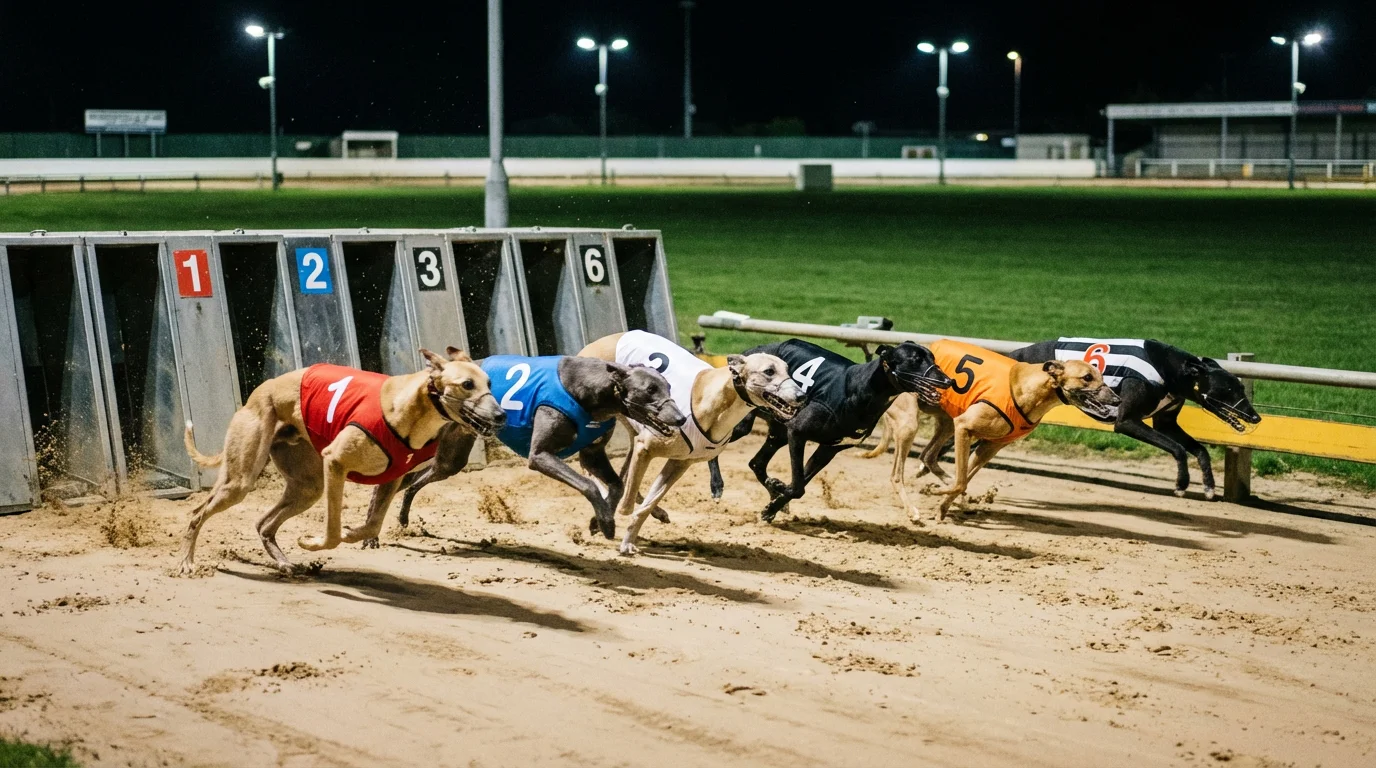
The first bend itself is where the race takes shape and, often, where it’s decided. Six dogs converging on the same piece of track at roughly 40 miles per hour creates a bottleneck. The dog with early speed and a clear racing line — typically a railer from Trap 1 or 2, or a wide runner from Trap 5 or 6 with room to swing around the outside — has the best chance of navigating the bend without interference. Dogs drawn in the middle traps, particularly 3 and 4, face the highest risk of crowding. They’re squeezed between the railers cutting in and the wide runners drifting out, and even a fraction of a second lost to checking or bumping at the first bend can turn a contender into an also-ran.
This is why trap draw and early speed must be assessed together, not separately. A dog with strong early pace drawn in Trap 1 at a tight track like Romford is in a premium position — inside rail, first bend advantage, minimal interference risk. The same dog drawn in Trap 4 faces a different equation: it still has the speed, but the racing line is compromised. It needs to either outpace the inside dogs to the bend or accept a position behind them and hope for racing room. The market should price these two scenarios differently, and often it does — but not always, and not by enough.
Race pace prediction is the next analytical layer. If three dogs in a six-runner field show strong early speed, the first bend is going to be contested. That contest introduces interference risk for all three, and the dog most likely to benefit is the one with a clean run in behind — a closer who avoids the carnage and picks up the pieces on the back straight. Conversely, if only one dog shows genuine early pace and the rest are mid-pack or closing types, the front-runner’s advantage is magnified. It leads unchallenged, sets its own tempo, and the race is effectively over before the field reaches the third bend. Reading the pace map — who wants to lead, who’s likely to chase, who needs space — is how form analysis and trap draw analysis converge into a practical race view.
Trap Draw Analysis: Beyond the Basics
The draw isn’t destiny, but it sets the terms of engagement. Every punter who’s spent five minutes studying greyhound racing knows that Trap 1 is the red jacket and favours railers. That’s table-stakes knowledge. The edge comes from going deeper: overlaying each dog’s running style with its actual draw, identifying mismatches, and understanding how the draw interacts with specific track geometry.
Each greyhound in the UK system is seeded by the racing manager based on its preferred running style. The three categories are railer (R), middle runner (M), and wide runner (W). In an ideal draw, a railer gets Trap 1 or 2, a middle runner gets 3 or 4, and a wide runner gets 5 or 6. The dog runs its natural line, avoids interference, and its form is a fair reflection of ability. But draws aren’t always ideal. When a railer is drawn in Trap 5, it has to cross the path of three or four other dogs to reach the rail — and in a race that lasts thirty seconds, that crossing costs time it may not recover. A wide runner in Trap 1 faces the opposite problem: it wants to swing wide but is hemmed in by the rail, forced to race in a style that doesn’t suit it.
These mismatches are where betting value hides. A railer drawn wide may produce a poor performance not because the dog lacks ability but because the draw forced it into an unnatural position. If it returns to an inside box next time, the form figures from the bad draw will depress its price — the market sees the recent poor finish, not the reason behind it. That’s a structural inefficiency you can exploit, provided you check the draw alongside the form rather than reading the numbers in isolation.
Track geometry amplifies draw effects. At Romford, a tight four-bend circuit with sharp turns, the inside traps carry a measurable advantage because the bends are so acute that wide runners lose significant ground on every turn. Trap 1 at Romford is a materially different proposition from Trap 1 at Towcester, where the wider circuit and more gradual bends reduce the rail advantage and give outside runners more room to operate. Using historical trap statistics — available through services like the Racing Post greyhound section — allows you to quantify these differences rather than relying on received wisdom.
The practical method is straightforward: for each dog in a race, note its seeding (R, M, or W), compare it to the actual trap drawn, and flag any mismatches. Then check the track’s historical trap stats for that meeting. If Trap 6 at a given venue wins significantly below average, and the dog drawn there is a railer forced wide, you have two layers of disadvantage working against it. The market may or may not have priced this in. Your job is to check, not to assume.
Value Betting: Finding Prices Bigger Than They Should Be
A winning bet at bad odds is still a losing strategy. This is the central principle of value betting, and it’s the concept that separates recreational punters from those who treat greyhound racing as a serious analytical exercise. Value exists when the odds offered by a bookmaker imply a lower probability of winning than the dog’s true chance. If a dog has a genuine 30% chance of winning and the market prices it at 4/1 — which implies roughly 20% after adjusting for margin — the price is bigger than it should be. Over a large number of bets at prices like that, profits accumulate. Over the same number of bets at prices that underestimate the dog’s chance, money drains away.
The difficulty, obviously, is estimating true probability. No punter can assign a precise percentage to a greyhound’s chance of winning with laboratory accuracy. But you don’t need laboratory accuracy. You need to be approximately right more often than the market, and in greyhound racing — where markets are thinner, less efficient, and more susceptible to recreational money — being approximately right is achievable with disciplined analysis.
A practical method works like this. Before looking at prices, study the race card and rank the six dogs from strongest to weakest based on form, class, draw, and early speed. Assign a rough probability to each. The numbers should sum to 100%. You don’t need agonising precision — broad categories work. If you think the top dog has roughly a one-in-three chance, assign 33%. If two dogs look evenly matched and clearly better than the rest, assign 30% each and distribute the remaining 40% across the other four. Now open the bookmaker’s market and convert their odds to implied probability. Wherever your estimate exceeds the bookmaker’s implied probability by a meaningful margin — five percentage points or more is a reasonable threshold — you’ve identified potential value.
This isn’t a magic formula, and it won’t be right every time. The point is the process: form a view independent of the market, then compare. Too many punters work backwards — they see a dog at 6/1, decide it looks interesting because the price is big, and talk themselves into a bet. That’s price-led punting, and it’s the opposite of value betting. Value betting is view-led: you decide what a dog is worth first, then check whether the market agrees or disagrees.
There are low-hanging opportunities that don’t require deep analysis. Late non-runner situations are one: when a dog is withdrawn close to the off, the remaining five runners’ odds should theoretically adjust upward to reflect the reduced field. In practice, bookmakers adjust slowly or incompletely, and for a brief window the surviving dogs are all slightly underpriced relative to their real chances. Another accessible angle is the grade-drop scenario described earlier — a dog whose form figures look bad but whose recent demotion puts it in a weaker field. The market prices the form. You price the class.
Value betting is not about finding certainties. It’s about finding systematic inefficiencies — prices that are wrong, consistently, in the same direction — and exploiting them with enough volume that the long-run maths works in your favour. It requires patience. A value bet that loses is still a value bet. The profit doesn’t come from any single race. It comes from the accumulated edge across hundreds of them.
Bankroll Management for Greyhound Betting
Your bankroll is the thing that keeps you in the game when the dogs don’t cooperate. Every strategy in this article — form analysis, class assessment, value identification — is worthless without a bankroll to deploy it. And greyhound racing, more than almost any other betting medium, is designed to empty a bankroll fast. A typical evening meeting runs twelve races in around two hours. That’s twelve opportunities to bet, twelve decision points, twelve chances to chase a loss or escalate a stake in the heat of the moment. Without a staking framework, the frequency alone will do the damage.
The first rule is separation. Your betting bankroll must be a defined sum, held apart from your daily finances, and treated as working capital rather than disposable cash. If you wouldn’t risk it on a business venture without a plan, you shouldn’t risk it on greyhounds without one either. The size of the bankroll is personal — it depends on what you can afford to lose entirely, because that’s the realistic worst case — but the principle is universal: know the number, protect the number, and never supplement it from money earmarked for rent, bills, or living expenses.
Level staking is the simplest method and the one best suited to punters building their approach. You bet the same amount on every selection regardless of confidence level. If your bankroll is five hundred pounds and your unit stake is five pounds, every bet costs five pounds whether you’re backing a class dropper at 5/1 or a value outsider at 10/1. The advantage is discipline: level stakes remove the temptation to overbet when you feel confident and underbet when you don’t. The disadvantage is rigidity — it doesn’t account for situations where your edge is significantly larger than average.
Percentage staking addresses that rigidity. Instead of a fixed amount, you stake a percentage of your current bankroll — typically 1% to 3% per bet. As your bankroll grows, stakes grow proportionally. As it shrinks, stakes shrink. This method protects against ruin during losing streaks because the absolute stake decreases as the bankroll declines. It also allows natural compounding during profitable runs. For most greyhound punters, a 2% base stake is a sensible starting point.
The Kelly criterion takes this further by calibrating stake size to the perceived edge on each bet. The formula — (probability of winning x odds offered – 1) / (odds offered – 1) — tells you what fraction of your bankroll to stake for maximum long-term growth. In theory, it’s optimal. In practice, it requires accurate probability estimates, and if those estimates are even slightly off, Kelly can recommend dangerously large stakes. Most professional bettors who use Kelly apply a fractional version — quarter-Kelly or half-Kelly — to dampen the volatility.
Whichever method you choose, session limits are non-negotiable. Set a stop-loss before the first race: the maximum amount you’re prepared to lose in a single meeting. If you hit it, walk away. Set a win target too, not because winning is a problem, but because continuing to bet on fumes of confidence after a profitable run is how profitable evenings become breakeven ones. The meeting has twelve races. You don’t owe each of them a bet.
The Missing Edge: Reviewing Your Own Bets
The race card tells you about the dogs. Your bet log tells you about yourself. If there’s one strategy that separates punters who improve year on year from those who stay flat, it’s the habit of tracking and reviewing their own betting activity. Not the results — everyone checks whether they won or lost. The decisions. Why you placed each bet, what odds you took, what your analysis was, and whether the outcome confirmed or challenged that analysis.
The mechanics of a bet log are minimal. Record the date, track, race number, grade, your selection, the bet type, the odds taken, the result, and the profit or loss. Add one line of reasoning: why this bet? Was it a class dropper at value odds? A front-runner in an ideal trap? A forecast based on pace analysis? The note doesn’t need to be elaborate. It needs to exist, because a month later, when you sit down to review, that note is the only thing that connects the outcome to the logic behind it.
Monthly reviews reveal patterns that are invisible race by race. You might discover that your win singles are profitable but your each-way bets bleed money — meaning your selection instincts are sound but your bet-type decisions need recalibrating. You might find that you’re profitable at Romford and consistently negative at Monmore, which suggests your form-reading methods suit tight tracks but miss something at wider circuits. You might notice that your bets in the first three races of a meeting outperform those in the last three, pointing to decision fatigue or chasing behaviour as the evening wears on.
These aren’t hypothetical findings. They’re the kind of insights that emerge from any honest dataset of a hundred bets or more, and they’re insights you cannot obtain any other way. No race card, no form guide, no tipster will tell you where your own strategy breaks down. Only your own records can do that. Also read our value betting on greyhounds.
The resistance to bet logging is emotional, not practical. It takes two minutes per bet. The real reason most punters avoid it is that it forces accountability. A bad bet placed on instinct can be forgotten by the next race. A bad bet recorded in a spreadsheet with the reasoning written next to it demands examination. That examination is uncomfortable, but it’s productive. The punter who reviews is the punter who adjusts. The punter who adjusts is the punter who, over hundreds of races across a full season, finds the edge that everyone else is too proud — or too lazy — to look for.