

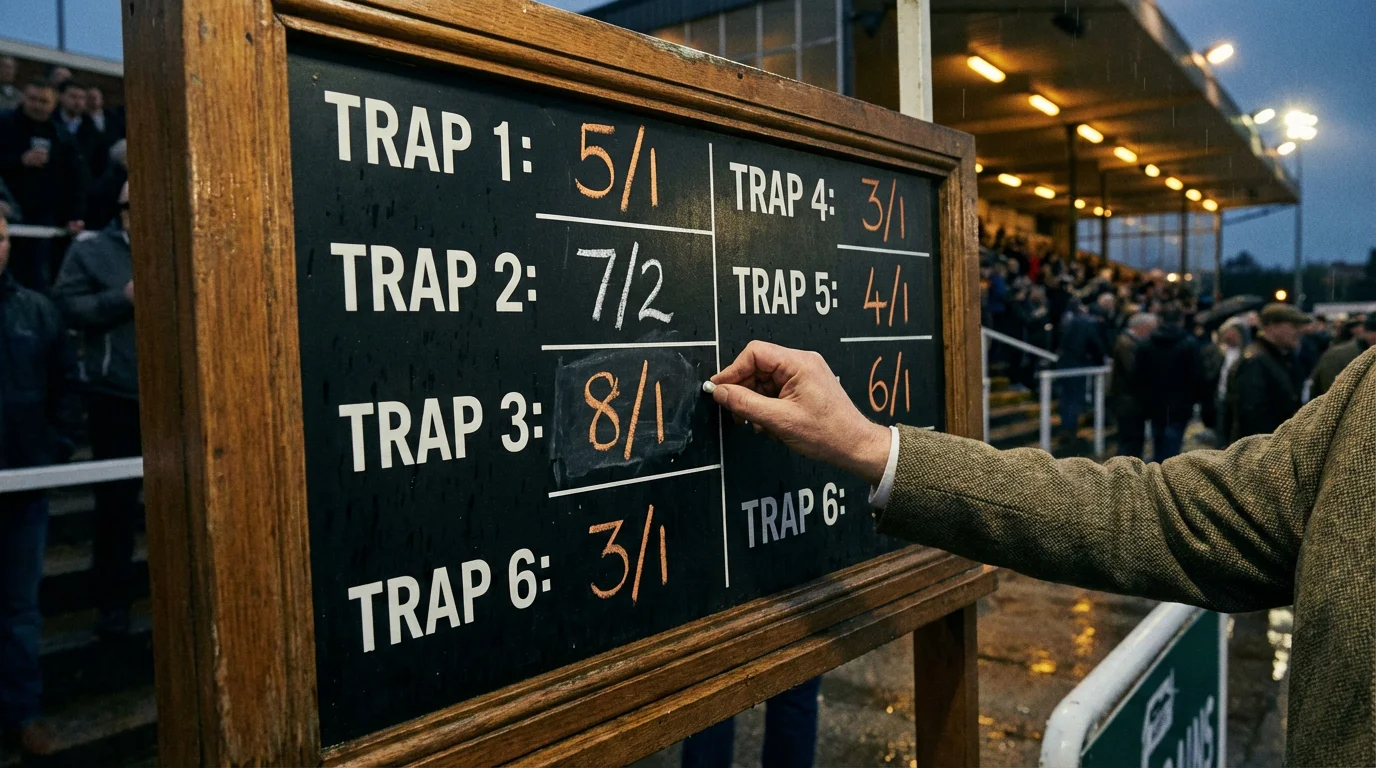
What Value Means in Greyhound Betting
A winning bet at bad odds is still a loss in disguise. Most punters measure success by whether their dog crossed the line first. That feels logical — you backed a winner, you collected. But profitability in greyhound betting has nothing to do with how often you win. It has everything to do with the price you took when you won, and whether that price accurately reflected the dog’s true chance of winning. Find more strategy guides at dogracingoddsuk.
Value is the gap between the probability you assign to an outcome and the probability implied by the bookmaker’s odds. If you believe a dog has a thirty percent chance of winning a race and the bookmaker is offering 5/1 — which implies roughly a seventeen percent chance — you have a value bet. The bookmaker is underestimating the dog’s chance, and the price is better than it should be. If the same dog is offered at 2/1, implying a thirty-three percent chance, there is no value — the price already reflects or overstates the dog’s true probability.
This distinction matters enormously over time. A punter who consistently backs winners at prices below their true probability will lose money in the long run, because the returns do not compensate for the losers. A punter who backs a lower percentage of winners but at prices that exceed their true probability will profit, because the occasional bigger payouts more than offset the more frequent losses. The maths is unambiguous: long-term profitability requires value, not just winners.
In greyhound racing, the concept of implied probability is particularly useful because the field is small. Six dogs, six sets of odds, and those odds sum to more than one hundred percent because of the bookmaker’s overround — the built-in margin. In a typical six-runner greyhound race, the overround sits between fifteen and twenty-five percent. That means the market collectively overestimates the total probability by that margin. Your task as a value bettor is to identify which specific dogs are carrying more of that overestimation than they should, and which are priced more accurately — or, ideally, underpriced.
The starting point is honest self-assessment. Value betting requires you to form your own view of each dog’s probability before looking at the market. If you look at the price first and then rationalise why it might be wrong, you are working backwards and will almost certainly end up confirming the market’s view rather than challenging it. Form your opinion, then compare it to the odds. The disagreement is where value lives.
How to Estimate True Probability in a 6-Dog Race
Six dogs, six chances. Your job is to disagree with the market on at least one. Estimating the true probability of each dog winning a greyhound race is not an exact science — no method will give you a precise percentage that perfectly predicts reality. But you do not need perfection. You need a method that is more accurate than the market’s pricing often enough to generate a positive expected return.
A practical approach starts with rating each dog on the core factors: recent form, class level, trap draw, early speed, and distance suitability. You do not need to assign numerical scores if that feels forced — a simple ranking system works. Go through the field and rank each dog from strongest to weakest on each factor. The dog that ranks highest across the most categories is your top-rated runner. The dog that ranks lowest is the weakest.
From the rankings, you can build a rough probability model. In a six-dog race, the base probability for each runner is approximately seventeen percent — one in six. Your analysis adjusts that base upward for dogs with strong profiles and downward for dogs with weak ones. A dog you rate as clearly the best in the field on form, draw, and class might warrant a thirty to thirty-five percent probability. A dog you rate as the weakest might warrant five to eight percent. The key constraint is that your probabilities should sum to roughly one hundred percent. If they sum to significantly more, you are overrating the field collectively. If they sum to less, you are underrating it.
Once you have your estimated probabilities, convert the bookmaker’s odds into implied probabilities for comparison. The conversion is straightforward: for fractional odds, divide the denominator by the sum of numerator and denominator. So 3/1 implies one divided by four, which equals twenty-five percent. For 5/2, it is two divided by seven, which equals roughly twenty-nine percent. The bookmaker’s implied probability will be inflated by the overround, so you are comparing your raw estimate against a slightly bloated number — which means you need a meaningful gap, not just a marginal one, to be confident in a value assessment.
The threshold matters. A dog you rate at thirty percent whose implied probability from the odds is twenty-eight percent is not a clear value bet — the gap is too narrow to be meaningful given the imprecision of your estimate. A dog you rate at thirty percent whose implied probability is eighteen percent is a strong value candidate. As a rule of thumb, look for a gap of at least five to eight percentage points between your assessment and the market’s before committing to a value play. Smaller gaps are within the margin of error and do not justify a bet.
This process sounds laborious, and the first few times it is. But it becomes faster with practice. Experienced greyhound punters can scan a race card, mentally rank the six dogs on the key factors, and arrive at a rough probability spread within a few minutes. The formal percentage calculation becomes intuitive over time — you stop doing the arithmetic and start recognising patterns that signal when a price is wrong.
Where Greyhound Markets Misprice Most Often
The market is efficient on favourites and sloppy on everything else — that’s where you live. Bookmaker odds on greyhound favourites are generally accurate. The 6/4 shot that the market has identified as the strongest dog in the field is, more often than not, the strongest dog in the field. The public money flows towards the obvious pick, the bookmaker adjusts, and the price settles close to the true probability. Finding value on short-priced favourites is difficult and rarely worthwhile.
The pricing inefficiencies sit further down the market. Mid-priced dogs at 4/1 to 8/1 are where the market’s attention is thinnest and the mispricing is most frequent. These are runners that the casual punter either ignores entirely or backs on a whim, and the bookmaker’s price often reflects a lack of serious money rather than a careful assessment of the dog’s chance. A dog at 6/1 that your analysis rates at four or five to one represents a genuine edge — and these situations arise regularly in graded racing.
Specific situations produce mispricing with reliable frequency. Non-runner adjustments are one: when a dog is withdrawn from a six-runner race and replaced by a reserve or the field is reduced to five, the remaining prices are adjusted mechanically. These adjustments sometimes overcorrect or undercorrect, creating a brief window where one or more dogs are mispriced relative to the new field dynamics.
Class drops are another persistent source. When a dog drops a grade after a run of poor results, the market often prices it based on those recent losses rather than its historical ability at the lower grade. The form figures look bad, so the price drifts, but the dog is returning to a level where it was previously competitive. The gap between its recent form perception and its actual ability at the new grade creates value.
Track switches generate similar opportunities. A dog with poor recent form at an unsuitable track, now returning to a venue where it has a strong record, will often carry prices that reflect the recent bad results rather than the venue-specific form. Punters who track individual dogs across multiple venues — noting which tracks suit which running styles — find these mispriced runners more frequently than those who assess each race card in isolation.
Trainer form runs are the subtlest source. When a kennel is in form — sending out a higher-than-normal percentage of winners across its entire string — individual dogs from that kennel may be underpriced by a market that has not yet noticed the trend. Conversely, a kennel in a slump may produce dogs that are slightly overpriced because the market still prices them on reputation rather than current output. Tracking kennel form is a low-effort, high-reward habit that surprisingly few greyhound punters bother with. Also explore our greyhound racing strategy.
The common thread across all these situations is that the market prices based on the most visible information — recent form figures, obvious class, headline reputation — and underweights context, circumstances, and trends. The value bettor’s edge comes from weighting the things the market underweights. It is not about having secret information. It is about reading publicly available data more carefully than the crowd.