

How Starting Price Is Determined at UK Dog Tracks
SP is the market’s final answer — delivered the moment the traps open. In UK greyhound racing, the Starting Price is the official set of odds returned for every runner at the instant a race begins. It is not a prediction, not a recommendation, and not a number any single bookmaker chooses unilaterally. It is derived from the prices being offered by on-course bookmakers at the track when the hare passes and the traps fly open. Find more odds guides at dogracingoddsuk.
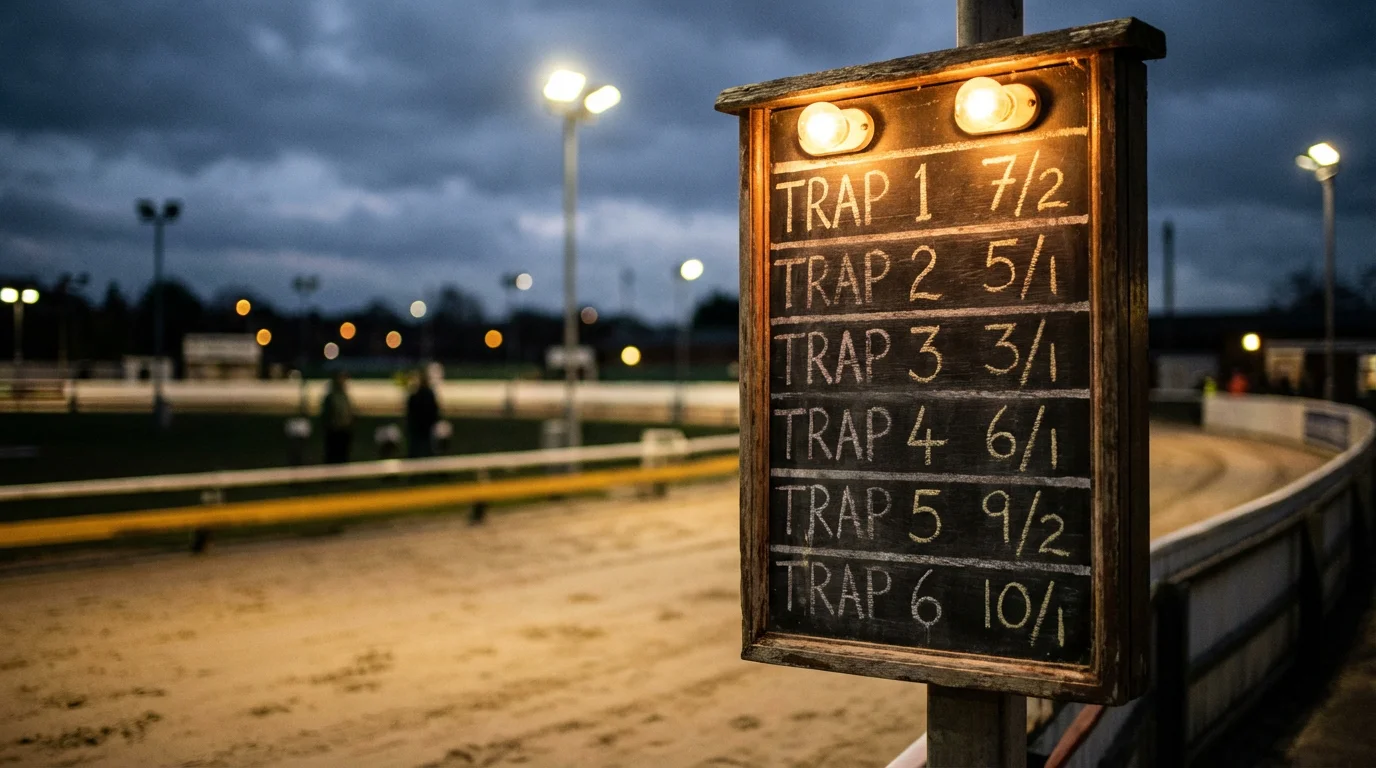
The process runs like this. In the minutes before a race, on-course bookmakers display their odds on boards. Those odds shift as money comes in — a dog attracting support will shorten, while others drift. At the off, an officially appointed SP reporter records the available prices across the on-course ring. The returned SP for each dog is typically based on the most commonly offered price among those bookmakers, not an arithmetic average. If three bookmakers show 5/1 and one shows 9/2, the returned SP is 5/1.
This mechanism works differently in greyhounds than in horse racing, and the difference matters. Dog tracks run thinner on-course markets. A Tuesday afternoon BAGS meeting at Sunderland might have two or three bookmakers standing in the ring. Compare that to a Saturday at Ascot, where a dozen or more layers are competing for business. With fewer bookmakers, a single large bet placed on-course in the final thirty seconds can shift the SP considerably. The price that looked like 4/1 online ten minutes ago might return at 3/1 because one punter dropped £200 in the ring.
There is a downstream consequence here that matters to anyone settling at SP. Because on-course greyhound markets are smaller and more easily influenced, the returned SP can diverge sharply from the price available online shortly before the off. Online odds are shaped by a far larger pool of money. On-course odds are shaped by whoever happens to be at the track. The two markets broadly agree, but in greyhound racing the gap between them is wider and more frequent than most punters realise.
The overround in greyhound SP markets also tends to run higher than its equine equivalent. In a six-dog race, bookmakers have fewer runners across which to spread the margin, so the built-in profit per runner is fatter. For the punter settling at SP, this means the price received is, on average, slightly less generous than the true probability of the outcome. It is not a dramatic penalty on any single bet, but it compounds. Over a hundred bets, that extra margin adds up to real money lost.
When to Take a Price vs When to Bet SP
The decision between early and SP isn’t a guess — it’s a read on where the market is heading. And getting this right consistently is one of the simplest edges available to a greyhound punter who pays attention to market dynamics rather than just form.
The logic is straightforward. If you expect a dog’s price to shorten before the off — because it comes from a well-fancied kennel, because word-of-mouth support tends to arrive late for that trainer’s runners, because the form case is strong and the public hasn’t noticed yet — then you take the early price. You lock in a number that the market will soon regard as too generous. If you expect a dog to drift — attracted some speculative early money that won’t hold, or is in a field where a rival will absorb all the late support — then waiting for SP gives you a bigger number.
In practice, the picture is rarely that tidy. Late money on greyhounds moves fast. A dog showing 5/1 at the early show can be 3/1 when the traps open, or 8/1 if a rival attracts a wave of support that forces the rest of the field outward. The skill lies in reading the probable direction before it resolves.
There are signals worth tracking. Trainer patterns are among the most reliable: certain kennels are known for having their dogs peak on specific race nights or at specific tracks, and the market tends to catch on late. If you have done the homework, you take the early price and let the subsequent money confirm your view. Race composition also matters. A wide-open graded field with no standout favourite tends to produce less dramatic late movement than a race with an obvious class drop that recreational punters are slowly waking up to.
Best Odds Guaranteed changes everything. If your bookmaker offers BOG on greyhounds — and the coverage varies by operator — the early-versus-SP question dissolves almost entirely. You take the early price knowing that if the SP turns out higher, you are paid at the bigger number. If the SP is lower, you keep the early price you locked in. In BOG-eligible races, taking the early price is a free option on a better outcome. There is no rational reason to bet SP when BOG is available and you have a selection in mind.
Without BOG, discipline is the deciding factor. A useful rule: if your analysis gives you genuine confidence in a dog and the current price represents value against your assessment, take it. Do not let the possibility of a better SP at the off talk you out of a price you are happy with. The worst outcome is watching a dog win at a shorter SP than the price you had available — not because SP was wrong, but because indecision was.
SP and Your Bottom Line: Does It Actually Matter?
Over a season, the gap between SP and early price isn’t marginal — it’s your margin. Whether SP helps or hurts your profitability depends on the type of punter you are, the type of dogs you back, and the tracks you frequent.
Take a punter who consistently backs mid-priced dogs in the 3/1 to 6/1 range. Over 200 bets, the average difference between the early price available and the returned SP might be 0.3 to 0.5 points of odds. That sounds negligible. It is not. On a £10 level-stake basis across those 200 bets, a consistent half-point of odds equates to roughly £100 in lost or gained value. At a break-even strike rate, that is the difference between a small profit and a small loss. The margin between a winning and losing season can sit entirely in the pricing gap.
The effect is not uniform across price ranges. On short-priced favourites — odds-on or thereabouts — the gap between early price and SP tends to be narrow. The market has already converged on these dogs early, and the remaining movement before the off is limited. Whether you take the price or bet SP, the impact on your return is minimal.
At longer odds, the picture flips. Dogs at 8/1 or bigger often see the most dramatic movement, and the direction is inconsistent. Some drift further as the market decides they are no-hopers. Others shorten sharply when late money identifies a chance the early market missed. For these runners, the variance between early price and SP is highest, and the punter who defaults to SP is accepting a random adjustment to their returns on every single bet.
Track-by-track variation exists as well. Venues with a stronger on-course betting presence — historically, busier tracks like Romford on feature nights — tend to produce SPs that sit closer to the online market. Quieter daytime meetings at smaller tracks, where two or three on-course bookmakers set the entire SP, can produce returned prices that look disconnected from what was available online moments before the off. At these quieter meetings, the case for taking a fixed early price grows stronger.
The data consistently points one way: punters who take early prices on BOG-eligible races and resort to SP only when they have no pre-race view tend to outperform those who default to SP across the board. The edge is not dramatic. It will not turn a losing punter into a winning one overnight. But it compounds quietly across hundreds of bets, and the discipline of actively choosing your price — rather than passively accepting the market’s final word — produces measurably better returns over the course of a year.
The Price You Don’t See Coming
Every SP tells you what the market believed at the very last second — and whether you agreed in time. That line sounds philosophical, but it is entirely practical. The Starting Price is not merely a settlement mechanism. It is a compressed snapshot of collective intelligence: every pound wagered, every bookmaker adjustment, every late whisper from the kennels, distilled into a single number at the moment the traps open.
For the casual punter, SP is a convenience. It removes the need to monitor markets, weigh prices, or make timing decisions. There is nothing wrong with that approach when betting is primarily entertainment. But for anyone treating greyhound betting as a discipline — tracking results, reviewing performance, hunting edges — SP is information. Treating it passively means leaving that information unused.
The punter who understands SP dynamics does not just know what the Starting Price means. They know what it reveals. A dog that opened at 4/1 and returned 7/2 tells a story: money arrived, confidence built, the market tightened. A dog that opened at 3/1 and drifted to 5/1 tells the opposite story. Neither outcome guarantees a result, but both tell you something about how the market perceived the race — and over time, comparing your own pre-race assessment to the returned SP is one of the simplest methods for calibrating your judgement. Also read our how greyhound betting odds work.
SP is the last piece of evidence the market produces before the race is run. The punter who learns to read it — not just accept it — holds a structural advantage that accumulates quietly, bet after bet, meeting after meeting, across an entire season of racing.