

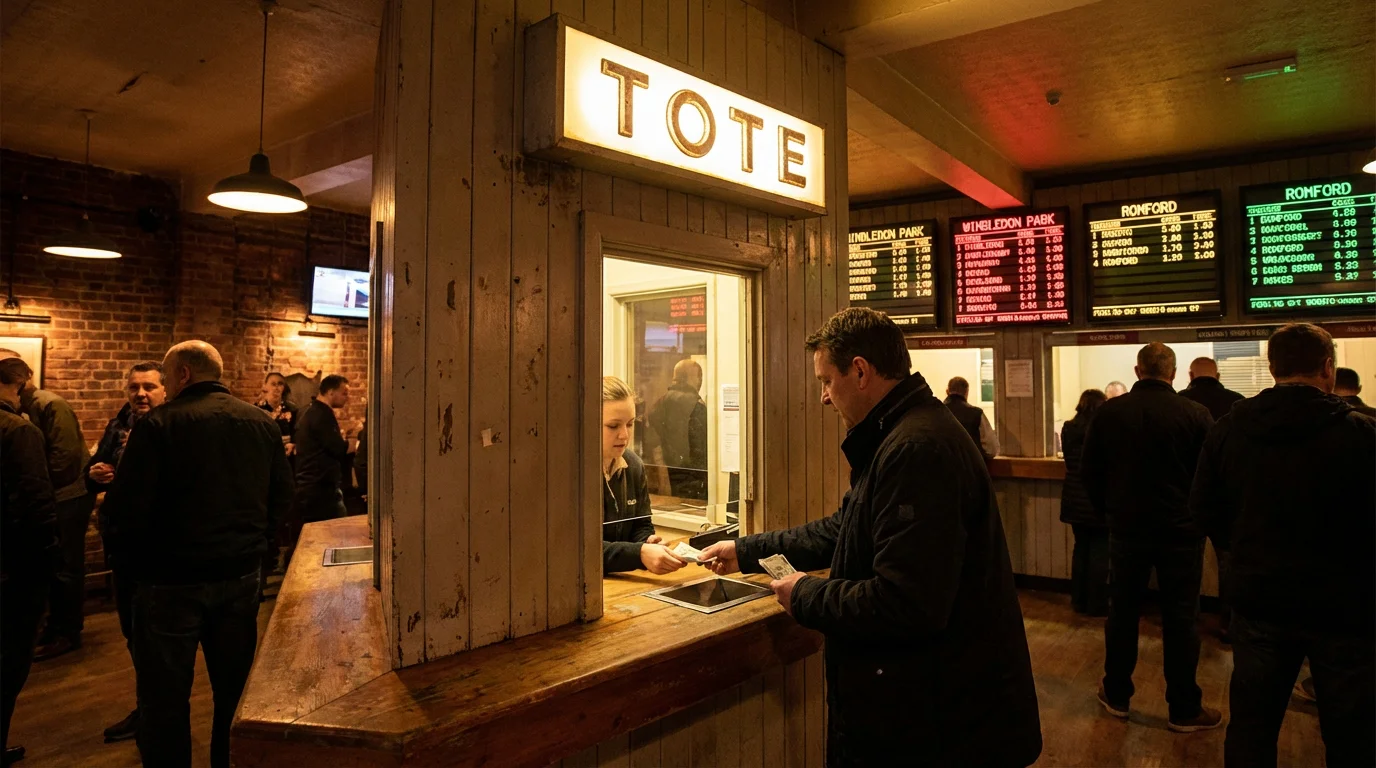
How the Greyhound Tote Works
The tote doesn’t offer odds — it offers a share of the pool. Unlike fixed-odds betting with a bookmaker, where you lock in a price at the moment you place your bet, a tote bet enters a communal pool with every other wager on the same race and bet type. The total pool is then divided among the winning bets after the race, with a deduction taken by the operator before the payout is calculated. You do not know your exact return until after the race has been run and the dividend is declared. Find more bet type guides at dogracingoddsuk.
The mechanics are straightforward. Every bet placed on a particular outcome — say, Dog A to win — goes into the win pool. After the race, the operator deducts a percentage from the total pool. This deduction, typically between fifteen and twenty-five percent depending on the pool type and operator, covers the tote’s operating costs and profit margin. The remaining pool is then divided equally among the winning unit stakes. If the win pool totals ten thousand pounds, the deduction takes two thousand, and eight thousand is shared among all punters who backed the winning dog.
The resulting dividend is expressed as a return per one-pound stake. If the winning dog attracted two thousand pounds in bets and the post-deduction pool is eight thousand, the dividend is four pounds — a return of four to one. That dividend applies to every winning ticket regardless of when the bet was placed. Whether you bet an hour before the race or thirty seconds before the off, you receive the same rate.
Pool types at UK greyhound tracks generally include the win pool, place pool, forecast pool, and tricast pool. Each operates independently: money bet into the forecast pool does not affect the win pool dividend, and vice versa. The deduction percentage varies by pool type — forecast and tricast pools typically carry higher deductions than win pools because the payouts are larger and the operator requires a bigger cushion.
One crucial difference from fixed-odds betting: tote dividends are not affected by bookmaker overround. There is no margin built into the prices in the traditional sense, because there are no prices until the race is over. The deduction is explicit and fixed, and everything else is determined by where the money falls. This creates a transparent payout structure, even if the outcome is less predictable than taking a fixed price.
Tote vs Fixed Odds: When the Pool Pays More
When the crowd bets heavy on the favourite, the tote quietly overpays on everything else. The tote dividend is a direct function of how the betting public distributes its money across the field. When a large proportion of the pool is concentrated on one dog — typically the favourite — the dividend on that dog will be small because the pool is shared among many winning tickets. But the dividends on the other five dogs rise, because fewer people backed them and the pool available per winning ticket is larger.
This creates a systematic pattern: in races with a heavily backed favourite, the tote dividend on outsiders frequently exceeds the fixed-odds SP. A dog that returns 8/1 SP with the bookmakers might pay nine or ten pounds on the tote, because the favourite absorbed so much of the pool that the remaining dogs effectively share an outsized pot. For the punter who specialises in mid-price and longer-priced selections, the tote can provide consistently better returns than the fixed-odds market in races where the favourite dominates the public money.
The opposite is also true. On the favourite itself, the tote dividend is often worse than the bookmaker SP. If seventy percent of the pool is on one dog, the winning dividend for that dog is compressed. The bookmaker, managing their own risk across multiple markets, might offer 6/4 on the same favourite where the tote pays only 1.30 to a one-pound stake. Backing favourites on the tote is almost always a losing proposition compared to fixed odds.
Forecast and tricast tote dividends behave similarly but with even greater variance. Because these pools are smaller in total volume and the money is spread across many more possible outcomes — thirty permutations for forecasts, one hundred and twenty for tricasts — the dividends can swing wildly. An unpopular forecast result in a small pool can produce a dividend ten or twenty times what the computer-generated bookmaker forecast would have paid. These are the tote’s most dramatic value opportunities, though they are unpredictable by nature.
The informational limitation is that you cannot see the tote dividend until after the race. With a bookmaker, you know exactly what you are getting at the moment you place the bet. With the tote, you are committing money to a pool whose final shape depends on every bet placed between now and the off. Late money flooding in on the favourite after you have backed an outsider is good for your tote return — it inflates the outsider dividend. Late money flooding in on your selection is bad — it compresses it. You are essentially betting on the collective behaviour of other punters as much as you are betting on the race itself.
Making the Tote Work at Your Local Track
The tote rewards the contrarian — the punter who bets against the queue. If you attend live greyhound meetings or bet through on-course tote facilities, the pool becomes a tactical environment rather than just a betting mechanism. Understanding the crowd dynamics at your local track — which dogs attract public money, which are overlooked — allows you to position your tote bets where the dividend is most likely to exceed the equivalent fixed-odds return.
The practical approach is selective. Use the tote for mid-price and longer-priced selections in races where a short-priced favourite is dominating the market. In these races, the favourite absorbs the majority of the pool, and the remaining dogs are underbet relative to their chances. A tote bet on a 5/1 or 6/1 shot in this configuration will frequently outpay the bookmaker SP for the same dog.
For favourites and shorter-priced contenders, stick to fixed odds. The bookmaker price on the favourite is almost always more generous than the tote dividend, because the pool arithmetic punishes the popular selection. There is no strategic reason to back a favourite on the tote when a fixed price is available.
Forecast and tricast pools are the tote’s most attractive arena for the punter willing to accept variance. At smaller meetings with thinner pools, forecast dividends can be extraordinary — a result that pays twenty pounds through the bookmaker’s computer calculation might pay sixty or eighty on the tote because so few punters in the pool backed that particular combination. The key is that these outsized dividends are impossible to predict in advance. You commit small stakes and accept that most will lose, but the occasional outsized payout more than compensates across a season. Also see our greyhound bet types explained.
The tote is not a replacement for fixed-odds betting. It is a parallel channel with different pricing mechanics that produce better returns in specific, identifiable situations. The punter who maintains accounts with both bookmakers and tote facilities — and switches between them based on the race profile and their intended selection — captures value from both environments. The queue at the tote window tells you what everyone else is backing. Your job, when using the tote, is to be somewhere else in the field.