

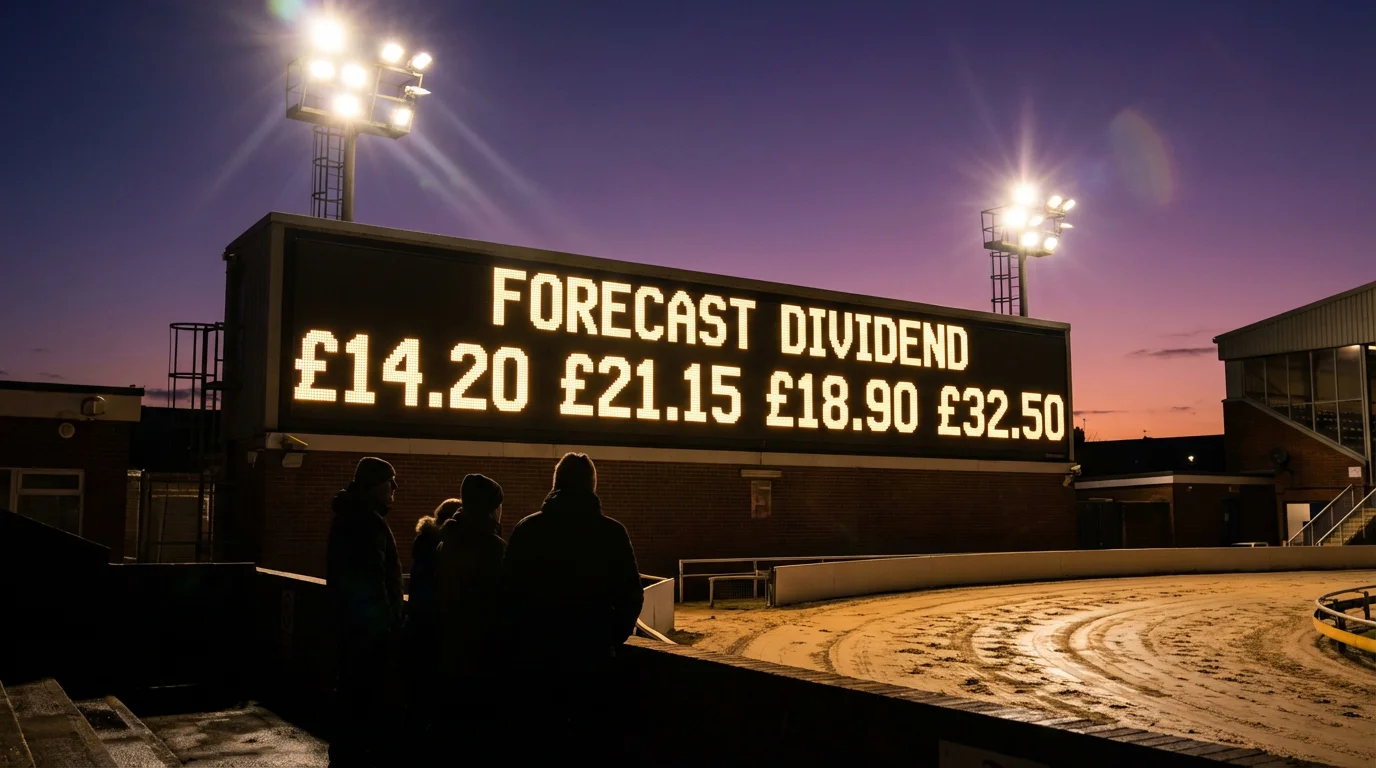
How Forecast Dividends Are Calculated
Forecast dividends aren’t set by anyone — they’re computed, and the formula doesn’t negotiate. Unlike a win bet where you take a fixed price or accept the SP, a forecast bet on greyhounds is settled by a computer-generated dividend calculated after the race. The dividend reflects the starting prices of the first two dogs home, the number of runners, and the specific order in which they finished. No bookmaker decides the payout. No human sets the number. It is algorithmic, and understanding the mechanics explains why two seemingly similar results can produce wildly different returns. Find more bet type guides at dogracingoddsuk.
The calculation uses the SPs of the first and second-place finishers as its primary inputs. In broad terms, the dividend increases when the dogs finishing first and second have longer starting prices. A forecast involving two outsiders — say a 6/1 winner and an 8/1 second — returns substantially more than one involving the 6/4 favourite beating the 3/1 second favourite. The formula also accounts for the field size and adjusts for the number of non-runners, though in a standard six-dog race these adjustments are minor.
What catches many punters off guard is the variability. The same two dogs finishing first and second at two different meetings can produce different dividends because the SPs at each meeting were different. A dog that wins at 4/1 at the afternoon meeting and 7/2 at the evening meeting is effectively a different forecast proposition each time, even though the form is identical. The dividend reflects the market’s pricing at a specific moment, not the dogs’ inherent quality.
There is a structural quirk worth noting that works in the forecast punter’s favour. Because forecast dividends are derived from SPs rather than set by a bookmaker taking a margin directly, the effective overround on a forecast is often lower than on a standard win market. The bookmaker’s edge is embedded in the individual SPs, but the interaction between two SPs in the forecast formula can produce dividends that represent better value than the component parts. This does not happen every time, but it occurs frequently enough that forecast betting holds persistent appeal for sharper greyhound punters.
One practical note: forecast dividends are published after each race and can be checked against tote results for the meeting. Comparing the dividend you received against what was available builds, over time, an intuition for which types of races produce the largest payouts and which produce thin returns that barely cover the outlay.
Straight vs Reverse vs Combination
A reverse forecast doubles your stake but squares your chances. The three forecast variations — straight, reverse, and combination — differ in cost, flexibility, and risk profile. Choosing between them is as important as choosing the dogs.
A straight forecast requires you to name the first and second-place finishers in the correct order. Dog A first, Dog B second — and if the order reverses, you lose. The minimum stake is typically fifty pence with most bookmakers and on-course outlets. The return potential is highest of the three because you accept maximum risk: one correct permutation out of thirty possible first-and-second finishing combinations in a six-dog race.
A reverse forecast covers both orders: A first and B second, or B first and A second. It is two bets, so the stake doubles. A one-pound reverse forecast costs two pounds. The advantage is that you no longer need to determine which of your two fancied dogs beats the other — only that they fill the first two positions. The dividend paid corresponds to whichever order actually occurs. If Dog A wins and Dog B is second, you receive the straight forecast dividend for that specific combination. The other half of the bet is lost.
A combination forecast extends the logic to three or more selections. Three dogs in a combination forecast means you cover all possible first-and-second permutations among those three: six bets. Four dogs: twelve bets. The cost scales quickly, but so does your coverage. The appeal lies in wide-open races where you can narrow the field to three or four contenders but cannot confidently separate them further. The trade-off is direct: broader coverage costs more, and the dividend needs to be large enough to clear the outlay and deliver a profit.
Which variation suits which situation? In races where you have a strong opinion on the likely winner but less certainty about the runner-up, a straight forecast makes sense — you pair your confident selection with the dog you consider the best place candidate. In races where two dogs clearly stand out but you cannot split them, a reverse forecast is the natural fit. In genuinely open races with multiple credible contenders, a three-dog combination offers the best balance of coverage and cost. Four-dog combinations should be reserved for fields where you expect a long-priced outcome, because the twelve-bet cost demands a substantial dividend to turn a profit.
When Forecasts Beat Win Bets
Sometimes you don’t need to know who wins — just who fills the frame. Forecast betting is not a novelty. In certain race types, it is objectively a more efficient bet than a win single, and recognising those situations is a skill worth developing.
The clearest case is the odds-on favourite race. When one dog is a dominant 1/2 or 4/6 shot, the win bet offers minimal return for maximum outlay. But the forecast — naming the favourite first and picking the most likely runner-up — often provides a dividend that represents far better value relative to the probability of the outcome. The favourite wins roughly a third of all greyhound races, and in heavily odds-on races that percentage rises higher. Pairing it with a second dog at 5/1 or 6/1 in a straight forecast converts a low-return win bet into a medium-return forecast at only slightly reduced probability.
The second case is the race with two standout contenders and a weak supporting field. If two dogs are clearly superior — obvious from form, grading, and times — the likelihood of them filling the first two places exceeds either dog’s individual win probability. A reverse forecast on the pair is frequently the sharpest play, offering a return that reflects the combined probability while the market underprices it because most recreational punters are focused on win singles.
The third case is the race where your view on the runner-up is stronger than your view on the winner. This sounds counterintuitive, but it happens regularly. You see a dog in trap 6 with a wide running style that will run on for second but probably cannot overcome the trap 1 railer for the lead. In a win market, that dog’s price reflects its chance of finishing first — maybe 4/1 or 5/1. But its chance of finishing second is considerably higher. A straight forecast with the likely winner first and your strong-second selection in the runner-up position captures that view in a way a win bet cannot.
The Forecast Punter’s Discipline
Forecast betting teaches you a virtue that patience alone cannot: sitting out races that don’t fit your method. The mathematics are direct — across a standard six-dog field, there are thirty possible first-and-second combinations. Even a reverse forecast covering two permutations means you are correct less than seven percent of the time at random. Skill improves that number, but not as dramatically as most punters hope.
Long losing runs are built into the fabric of this approach. A punter with a genuine edge might connect on one forecast in eight or ten attempts. That is a profitable strategy if the dividends are large enough to cover the losing bets and leave a margin, but it demands emotional resilience and, more critically, disciplined race selection.
The forecast punter who bets every race on the card will almost certainly lose. The forecast punter who waits for the right race type — open fields with identifiable contenders, strong-favourite races with a clear second-best, trap draw patterns that suggest a predictable first-two finish — will hit fewer bets in total but at a higher strike rate against better dividends. The discipline is in the selection of races, not just the selection of dogs. Also see our greyhound bet types explained.
Staking matters equally. Because forecasts are inherently lower-strike bets, the staking must be conservative: small, level stakes that your bankroll can sustain through the inevitable dry spells. A one-pound forecast that returns forty-five pounds feels less like genius if you spent eighty getting there. The maths only works when the winning dividends outweigh the cumulative losing stakes over a sustained sample. The patience to wait for that sample — and the discipline to hold the method while the losses stack — is the forecast punter’s defining trait.