
What Makes Greyhound Betting Different
Horse racing punters who move to greyhound betting expecting a smaller version of the same sport get a sharp education quickly. The two share a common vocabulary — odds, form, going, each-way — but the underlying dynamics are different enough that strategies built for one do not transfer cleanly to the other. Understanding where the sports diverge, and why, is the first step to betting on greyhounds effectively rather than treating them as miniature horse races. Find more betting guides at dogracingoddsuk.
Field size is the most obvious difference and the most consequential. A standard UK greyhound race has six runners. A typical handicap on the Flat has twelve to sixteen. This reduction in field size changes the probability landscape fundamentally. In a six-dog race, the favourite wins approximately thirty percent of the time — nearly double the rate for favourites in large-field horse races. The smaller field means fewer variables, fewer potential disruptors, and a tighter distribution of probabilities across the runners.
Race duration amplifies this. A greyhound race lasts under thirty seconds. A horse race over a mile and a half lasts two and a half minutes or more. The compressed timeframe of a greyhound race means that the first few seconds — the trap break and the run to the first bend — carry disproportionate weight. In horse racing, a bad start can be overcome over the remaining distance. In greyhound racing, a bad start is often terminal. The first bend determines the race more often than any other single factor, and there is not enough track remaining for the field to sort itself out naturally.
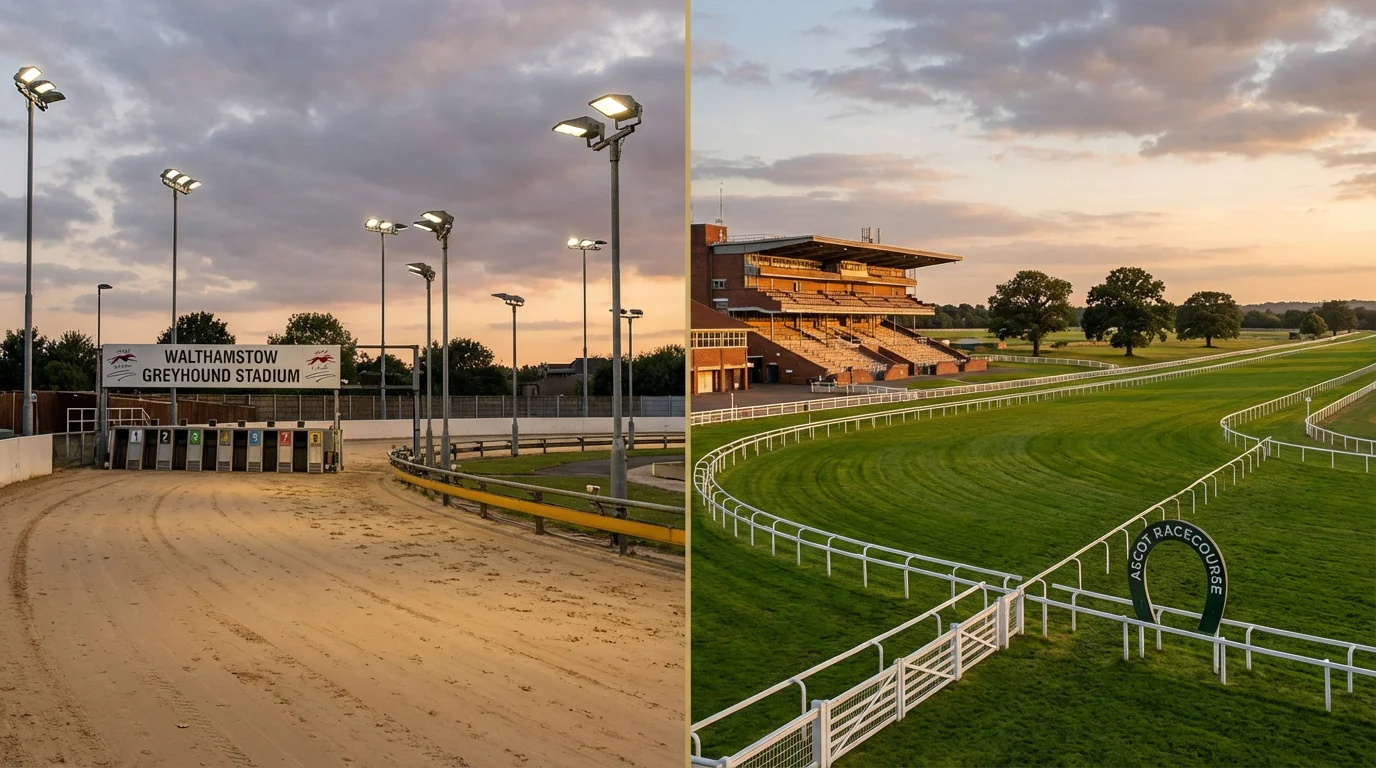
Market liquidity is substantially lower in greyhound racing. The volume of money wagered on a midweek greyhound meeting is a fraction of what flows through a Saturday afternoon of racing at Ascot or York. This lower liquidity has practical consequences: odds can move sharply on relatively small bets, the overround tends to be higher, and exchange markets are thin enough to be impractical for many races. The tighter market also means that information edges — knowing something the rest of the market has not yet priced — are potentially more exploitable, because fewer punters are competing to identify and act on them.
The absence of a jockey removes an entire analytical dimension. In horse racing, the jockey’s ability, tactical decisions, and riding style are significant factors. In greyhound racing, the dog runs its own race. There is no human decision-maker on board adjusting the pace, choosing when to challenge, or deciding whether to go wide or hold the rail. The dog runs according to its instincts, its fitness, and the trap draw. This simplifies the analysis in one sense — fewer variables — but it also means that the remaining variables (form, draw, class, early speed) carry more weight individually.
The going — track surface condition — affects greyhound racing differently from horse racing. In horse racing, going ranges from firm to heavy and fundamentally alters which horses are competitive. In greyhound racing, the going affects times more than it affects the competitive order. A fast track produces faster times across the entire field; a slow track produces slower times. Individual dogs are less dramatically affected by going changes than horses, though some dogs do have a surface preference that shows up over a large sample.
Strategy Adjustments: From the Flat to the Track
The horse racing punter arriving at greyhound betting needs to recalibrate three core habits: how they assess form, how they evaluate the draw, and how they approach staking.
Form analysis in horse racing involves weighing a wide range of factors — distance, going, class, weight, jockey booking, course form, track configuration, pace scenario. In greyhound racing, the list is shorter but the individual factors are more decisive. The trap draw and early speed are the two most important analytical inputs. A horse racing punter accustomed to building complex multi-factor models needs to resist the temptation to over-complicate greyhound analysis and instead focus on the three or four factors that genuinely drive results: draw suitability, early pace, recent form trajectory, and class level.
Draw assessment requires a fundamental shift in thinking. In horse racing, the draw matters on certain courses and at certain distances, but it is one factor among many and is often overridden by class and ability. In greyhound racing, the draw can be the single most important factor in the race. A good dog in a bad draw is a worse bet than a moderate dog in a good draw in many situations. Horse racing punters tend to underweight the draw when they first move to greyhound betting, and this is one of the most common sources of early losses.
Staking needs adjustment for the higher overround and lower market efficiency of greyhound betting. In horse racing, the bookmaker’s margin on a competitive handicap might be eight to twelve percent. In a six-dog greyhound race, it is commonly fifteen to twenty-five percent. This higher margin means that the bar for a profitable selection is higher — you need a bigger edge per bet to overcome the larger built-in disadvantage. For the horse racing punter who was marginally profitable at level stakes, the same approach applied to greyhound racing without adjustment will produce a loss.
The frequency of betting also requires recalibration. Horse racing punters might bet on three or four races per day during the Flat season. Greyhound racing offers twelve or more races per evening meeting, six days a week. The temptation to bet more frequently is strong, and the discipline to be selective is harder to maintain when opportunities arrive every fifteen minutes. The most successful greyhound punters bet on fewer races per meeting than the number available — typically three to five selections from a twelve-race card — and pass on the rest. Horse racing punters accustomed to a more moderate pace of opportunity need to develop this filter quickly.
Two Sports, One Punter
The skills are more transferable than the strategies. The core analytical habit of horse racing — reading form, assessing conditions, identifying value, managing a bankroll — applies directly to greyhound betting. What changes is the weighting of the inputs and the tempo of the decision-making. The punter who recognises this makes the transition productively. The punter who assumes identical dynamics in both sports pays for the assumption.
The most transferable skill is value assessment. If you can identify when a horse’s odds are longer than its true chance warrants, you can do the same with a greyhound — the maths is identical, even if the factors that inform the probability estimate are different. The discipline of only betting when value is present, rather than betting because a race is about to start, transfers directly and is arguably more important in greyhound racing, where the volume of available races can erode discipline faster.
Bankroll management translates without modification. The staking principles that protect a horse racing bankroll — level stakes, session limits, loss limits, honest record-keeping — work identically for greyhound betting. If anything, the higher frequency of greyhound racing makes disciplined bankroll management more critical, because the potential to accumulate losses quickly is greater. Also read our greyhound betting glossary.
The unique demand of greyhound betting is specialisation. In horse racing, a punter can profitably follow multiple courses, distances, and race types. In greyhound racing, the punter who specialises in two or three tracks — learning their specific draw biases, trap statistics, regular runners, and kennel tendencies — consistently outperforms the generalist who dips into whichever meeting is streaming. The sport rewards depth over breadth, and the punter who commits to knowing a small number of tracks intimately will find edges that the broader market, spread thinly across the entire UK schedule, consistently overlooks.