

How Greyhound Accumulators Compound Odds
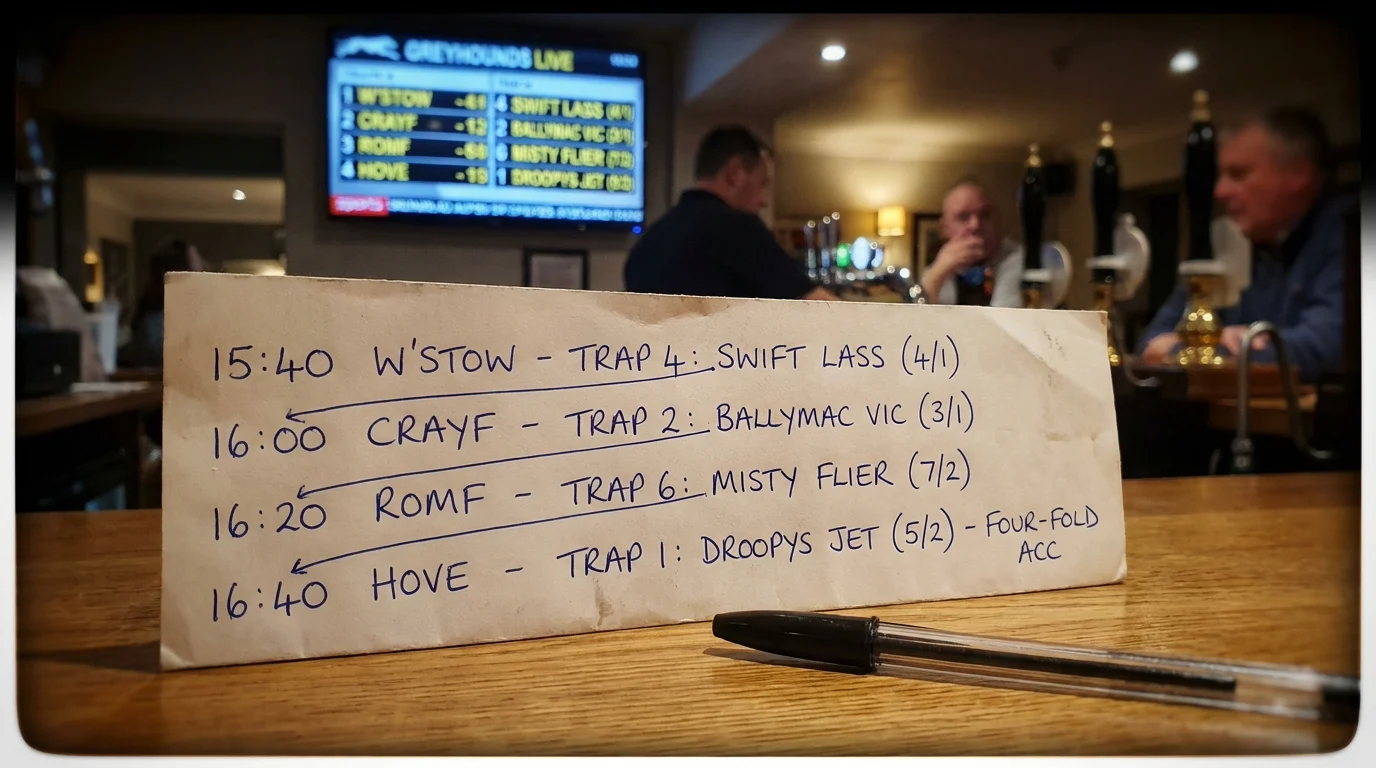
An accumulator takes the simplest idea in betting — combining selections — and turns it into something that is simultaneously thrilling and mathematically treacherous. The principle is straightforward. Instead of placing separate win bets on dogs in different races, you link them into a single bet where the return from the first selection rolls over as the stake on the second, and so on through the chain. Every dog must win for the bet to pay. One loser and the entire accumulator is gone. Find more bet type guides at dogracingoddsuk.
The attraction is the compounding effect on the odds. A double on two dogs at 3/1 each does not return 6/1 — it returns 15/1. Your one-pound stake produces four pounds from the first winner, and that four pounds goes onto the second dog at 3/1, returning sixteen. The odds multiply rather than add, and the potential returns escalate rapidly as you add legs. A treble on three dogs at 3/1 produces 63/1. A four-fold at the same prices: 255/1. A five-fold: 1,023/1 from a one-pound stake.
The numbers look spectacular on paper. They are supposed to. The compounding works identically on the probability side, and that is where the reality check lives. Each dog at 3/1 has an implied win probability of roughly twenty-five percent. Two consecutive wins at that probability: six and a quarter percent. Three: one and a half percent. Four: under half a percent. By the time you are looking at a five-fold, the probability of all five legs winning is around one in a thousand. The odds accurately reflect the difficulty, and the bookmaker’s margin compounds along with them.
In greyhound racing specifically, the compounding problem is amplified by the nature of the sport. Six-dog fields are inherently unpredictable — the favourite wins only about thirty percent of the time, and interference at the first bend can upend any race regardless of form. Linking multiple greyhound results together multiplies this uncertainty exponentially. A single upset anywhere in the chain collapses the entire bet.
The bookmaker benefits disproportionately from accumulators because the overround — the margin built into each individual price — also compounds. If the overround on a single race is twenty percent, the effective overround on a four-fold accumulator from four separate races is not eighty percent — it is roughly one hundred and seven percent, because the margins multiply. The punter is fighting a steeper hill with every leg added.
Named Multiples: Yankees, Lucky 15, Patents
Beyond the simple accumulator, there are structured multi-bet formats that cover combinations of selections in a more systematic way. These named multiples — Yankees, Lucky 15s, Patents, and others — are popular with greyhound punters because they do not require every selection to win for a return. They cost more but offer partial payouts when some legs win and others lose.
A Patent is the entry point. It covers three selections across seven bets: three singles, three doubles, and one treble. If only one of your three dogs wins, you collect on the single. If two win, you collect on two singles and a double. If all three win, you collect on everything. The cost is seven times your unit stake, so a one-pound Patent costs seven pounds. The trade-off is clear: you are paying seven units for the insurance of getting a return even when two of your three selections lose.
A Yankee covers four selections across eleven bets: six doubles, four trebles, and one four-fold. No singles are included, so you need at least two of your four dogs to win for any return. At eleven units, the cost is higher than a Patent, but the coverage of doubles and trebles means that two winners from four selections will usually produce a small return, and three winners can produce a significant one. A Lucky 15 adds the four singles to the Yankee format, creating fifteen bets total — and some bookmakers offer bonuses on Lucky 15s, such as enhanced returns if only one selection wins or a bonus if all four land.
These structured multiples are more resilient than straight accumulators because they do not require a clean sweep. But they are also more expensive per selection, and the maths is not always kind. A Yankee where two of your four dogs win at average prices of 3/1 returns roughly twenty-four pounds from an eleven-pound outlay — a profit, but a modest one that required two winners to achieve. The dramatic payouts that make accumulators exciting require three or four winners, which brings you back to the same probability problem as the straight accumulator.
For greyhound punters, the most practical named multiple is the Patent on three strong selections at mid-range odds. The seven-unit cost is manageable, the singles provide a floor that limits downside, and the doubles and treble provide upside if two or three of your views are correct. Anything beyond a Patent — Yankees, Lucky 15s, Heinz bets — increases the cost rapidly and requires a higher proportion of winners to show a profit.
Why Most Dog Accas Lose — and When They’re Still Worth It
The mathematical case against greyhound accumulators is strong, and there is no way to soften it. The compounding of margins, the multiplication of uncertainty, and the inherent unpredictability of six-dog racing mean that the vast majority of accumulators lose. Over a large sample, the bookmaker’s edge on accumulators exceeds their edge on singles by a significant margin. This is not opinion — it is arithmetic.
So why do punters keep placing them? Because the potential reward, however improbable, is genuine, and because the emotional experience of a running accumulator — watching the first leg win, then the second, then sweating on the third — is uniquely exciting in a way that a series of independent singles is not. Accumulators sell a story, and stories are worth something even when they end badly.
The honest framework for greyhound accumulators is to treat them as entertainment with a clear budget, not as a serious path to profit. Allocate a small, fixed amount of your weekly betting budget to accumulators — five or ten percent at most — and accept that this money will, in the long run, produce a negative return. The entertainment value is the return. Any actual payout is a bonus.
Within that framework, there are marginal ways to improve your chances. Limit accumulators to two or three legs — doubles and trebles — where the compounding of margins is still manageable. Restrict your selections to races where you have a genuine analytical edge rather than filling legs with selections from races you have barely glanced at. Avoid the temptation to add a fourth or fifth leg because it makes the potential payout look more impressive. Each additional leg degrades your expected return even if it improves the headline number. Also see our greyhound bet types explained.
Use named multiples like Patents rather than straight accumulators when you have three strong views. The additional cost buys insurance that a straight treble does not offer, and the return from two winners out of three often covers the outlay and leaves a small profit. This is the realistic ceiling for accumulator betting in greyhound racing: modest, occasional profits from well-chosen small multiples, funded by a limited entertainment budget. The punter who expects more is buying a lottery ticket. The punter who accepts this is buying a structured experience — and there is nothing wrong with that, as long as the budget is respected.