
How GBGB Regulations Shape the Betting Market
The Greyhound Board of Great Britain is the regulatory body that governs licensed greyhound racing in the UK. Its rules determine how races are structured, how dogs are graded, how trap draws are allocated, and how results are validated. For the punter, these regulations are not bureaucratic background — they are the architecture within which every race and every bet operates. Understanding the key rules gives you a framework for interpreting the race card, assessing the draw, and identifying situations where the regulations themselves create betting opportunities. Stay informed at dogracingoddsuk.
The draw allocation rules are among the most directly relevant to betting. As covered in the trap draw guide, the GBGB mandates that dogs in graded races are seeded by running style — railers inside, middles in the centre, wides outside — and the draw within each pair is conducted by the racing manager. This is not a random process for graded racing. The seeding system means that a trap 1 runner is almost always a natural railer, and a trap 6 runner is almost always a wide runner. Knowing this tells you immediately whether a dog is drawn in its preferred position, which is the first question in any draw analysis.
Open race draws operate differently. In OR events, the draw is randomised, meaning railers can end up in outside traps and vice versa. This randomisation is mandated by the GBGB to ensure fairness at the highest level of competition, but it creates a fundamentally different analytical challenge for the punter. In open races, the draw is a genuine variable rather than a structured allocation, and draw mismatches are more frequent and more impactful.
Grading rules govern promotion and relegation. The GBGB sets the broad framework — winners are promoted, dogs finishing unplaced in consecutive races are relegated — but allows individual tracks discretion in the details. This discretion means that grading practices vary between venues: some tracks promote aggressively after a single win, while others require consistent performance before moving a dog up. Understanding your regular track’s specific grading tendencies helps you anticipate when a dog is likely to be promoted or relegated, and therefore when class-drop or class-rise opportunities are about to appear.
Anti-doping regulations affect the market indirectly. The GBGB conducts routine and random drug testing on competing greyhounds, and a positive test results in disqualification of the result, suspension of the trainer, and potential retroactive void of bets. While doping is rare in modern UK greyhound racing, the regulations provide a baseline of competitive integrity that punters can rely on when assessing form.
Kennelling rules require that dogs arrive at the track a specified time before their race and are held in secure kennel facilities under veterinary supervision until they are brought to the traps. This prevents any last-minute interference with the dogs and ensures that the animal presented at the traps is in the same condition as the one declared to run. For punters, the kennelling requirement means that the race card information — weight, condition, fitness — is as current as it can reasonably be.
Rules That Directly Affect Your Bets
Several GBGB rules and associated racing regulations have a direct impact on how bets are settled, what happens when things go wrong during a race, and when results can be overturned. Knowing these rules before they affect you is significantly more useful than learning them afterwards.
Non-runner procedures are governed by GBGB regulations. When a dog is withdrawn, the racing manager determines whether a reserve runner replaces it. If a reserve is inserted and the market has not yet opened, the race proceeds as a normal six-dog field. If the market has already opened and the withdrawal occurs close to the off, the race may run with five dogs and Rule 4 deductions apply to winning bets. The specific timing thresholds vary by track and by the circumstances of the withdrawal.
Void race conditions are defined by the rules of racing. A race may be declared void if the hare malfunctions, if interference prevents a fair result, or if other technical failures occur. When a race is voided, all bets on that race are void and stakes are returned. This is rare but not unheard of — hare failures, while uncommon with modern equipment, do occasionally occur and result in an abandoned race. If you are building accumulators that include greyhound selections, a voided race collapses that leg of the accumulator, and the remaining legs are settled as a shorter accumulator.
Disqualification and amended results can affect settled bets in limited circumstances. If a dog tests positive for a banned substance after the race, the result may be amended by the GBGB stewards. Whether this affects your bet depends on the bookmaker’s rules: most UK bookmakers settle bets on the official result at the time of the weigh-in, not on subsequent amendments. A retrospective disqualification typically does not change the settlement of bets already paid out. However, the rules vary between operators, and checking your bookmaker’s terms on amended results is worthwhile.
Trial results and unofficial form should be distinguished from official GBGB-sanctioned races. Some tracks hold trial meetings where dogs run in timed runs without an official race result. Times recorded at trials can appear in some data services and may inform your assessment of a dog’s fitness, but they are not part of the official form record and should be weighted accordingly. A fast trial time tells you the dog is in physical condition to run quickly. It does not tell you how it will perform under race conditions with five other dogs competing for position.
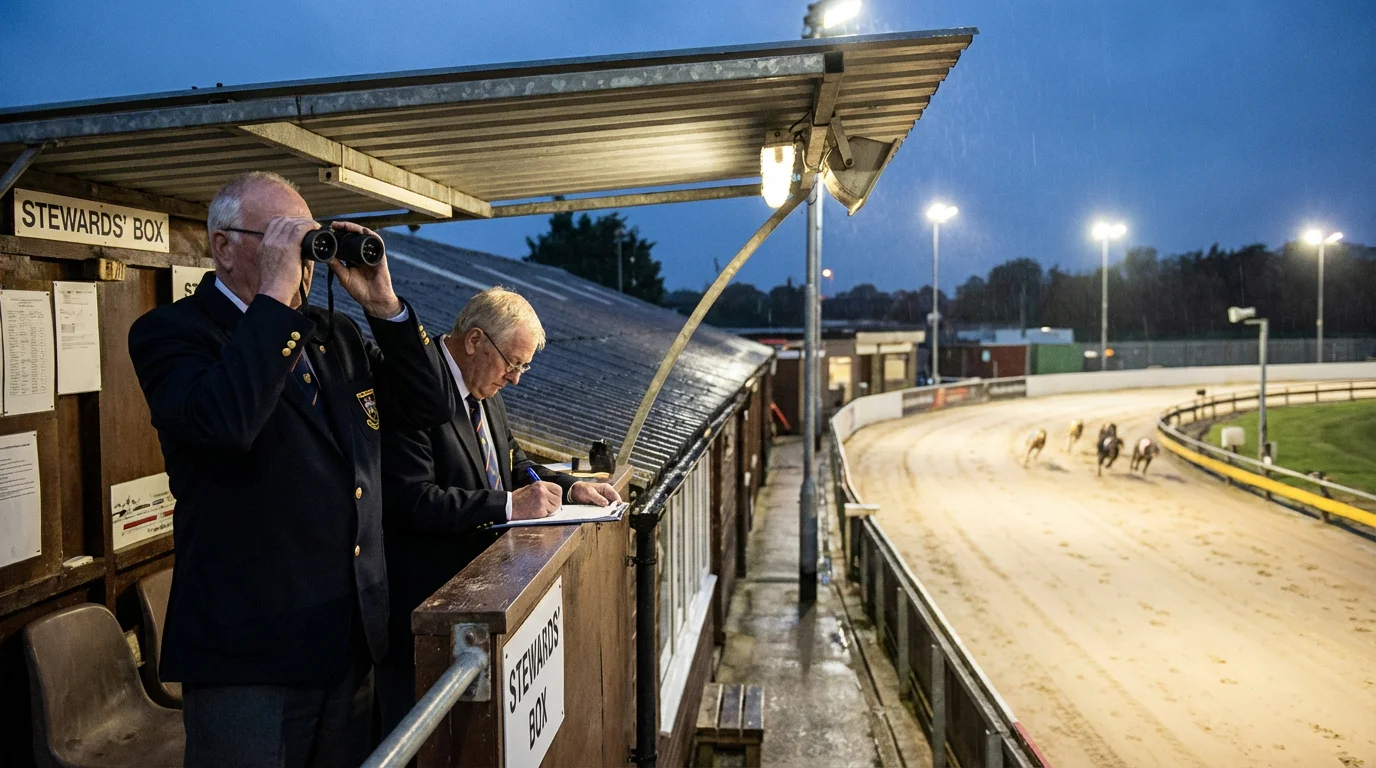
Interference and stewarding decisions during a race are adjudicated by the GBGB-appointed stewards at the meeting. If a dog causes interference that materially affects the result, the stewards may issue a warning, fine the trainer, or — in extreme cases — disqualify the offending dog. Again, the betting settlement question hinges on whether the disqualification occurs before or after the official result is declared. Most post-race stewarding inquiries that lead to changes occur quickly, and bookmakers typically wait for the all-clear before settling.
Regulation as Information
Rules are not just constraints — they are structure you can exploit. This is not about finding loopholes or bending regulations. It is about recognising that the rules of greyhound racing create predictable patterns in how races are constructed, how fields are assembled, and how results unfold. The punter who understands these patterns has a systematic advantage over one who treats each race as an isolated event.
The seeding rules tell you, before you look at a single form figure, whether each dog is drawn in its preferred position. The grading rules tell you whether a dog has been promoted, relegated, or is sitting at its natural level. The non-runner rules tell you how the market will adjust if a dog is withdrawn and where the repricing might create value. The void race rules tell you how to structure accumulators to manage the risk of a collapsed leg.
Collectively, these rules create the playing field on which every greyhound race is staged. The dogs, the form, the times — these are the variables that change from race to race. The rules are the constants. And in any analytical discipline, understanding the constants is the foundation for interpreting the variables correctly. Also read our legal information.
The GBGB publishes its rules of racing and updates them periodically. For the punter who wants to operate with a complete understanding of the framework, reading the relevant sections — particularly those covering grading, draw allocation, and race-day procedures — is a worthwhile investment of time. The rules are not light reading, but they are the instruction manual for the sport you are betting on. The punter who reads the manual has an advantage over the one who does not, and that advantage is available to everyone willing to make the effort.